As a medical student, do you ever wonder what it's like to specialize in pulmonary disease and critical care medicine? Meet AMA member Syed Nazeer Mahmood, MD, a pulmonary disease and critical care medicine physician and a featured doctor in the AMA's “Shadow Me” Specialty Series, which offers advice directly from doctors about life in their specialties. Check out his insights to help determine whether a career in pulmonary disease and critical care medicine might be a good fit for you.
The AMA's Specialty Guide simplifies medical students' specialty selection process by highlighting major specialties, detailing training information and providing access to related association information. It is produced by FREIDA™, the AMA Residency & Fellowship Database®.
Learn more with the AMA about the broader medical specialty of pulmonary disease and critical care medicine.
“Shadowing” Dr. Syed Nazeer Mahmood
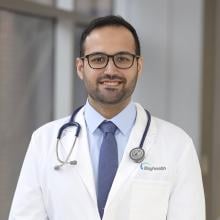
Specialty: Pulmonary disease and critical care medicine.
Practice setting: Hospital.
Employment type: Employed by Bayhealth, in Dover, Delaware. Bayhealth is part of the AMA Health System Member Program, which provides enterprise solutions to equip leadership, physicians and care teams with resources to help drive the future of medicine.
Years in practice: Three.
What the specialty of pulmonary disease and critical care medicine is: Pulmonary disease and critical care medicine is a subspecialty of internal medicine. This specialty focuses on the diagnosis and treatment of acute and chronic respiratory diseases as well as the management of critically ill patients in intensive care units. Physicians who specialize in pulmonary disease and critical care medicine often manage conditions such as asthma, COPD, pneumonia, lung cancer and respiratory failure.
A typical day and week in my practice: It depends on which service I am covering that day. When I am covering the ICU, I work from 7 a.m. to 7 p.m. I am responsible for overseeing the work of medical residents and nonphysician providers in the intensive care unit (ICU). We manage critically ill patients who often require mechanical ventilation and procedures like central and arterial lines. ICU coverage is typically one week per month.
Additionally, I work in the pulmonary clinic and see patients with pulmonary issues in the hospital. While in clinic, the day starts at 8 a.m. and ends at 4:30 p.m. During the day, I see patients with a wide variety of conditions, including chronic obstructive pulmonary disease, asthma, lung fibrosis, pulmonary hypertension, lung nodules and lung cancer. While in the hospital, I help manage patients admitted with respiratory complaints. I also perform procedures such as endobronchial ultrasound and bronchoscopy for patients requiring more invasive testing.
The most challenging and rewarding aspects of pulmonary disease and critical care medicine: There is a significant need for pulmonary providers in our area. It is a challenge at times to figure out a way to see all the patients who need urgent evaluation. As a critical care physician, I deal with a lot of patients at the end of life, and helping patients and their families during this time can be a very challenging but also rewarding experience as I get to help vulnerable people in a difficult time.
The most rewarding aspect is when a patient in clinic says that they can finally breathe better after years of trouble breathing.
The impact burnout has on pulmonary disease and critical care medicine: There is a lot of burnout in my specialty. It does affect your personal life and family especially on those hard days when there is a lot of mental and emotional tolls. I am fortunate to have a good support system at home that helps me mitigate burnout symptoms.
How Bayhealth is reducing physician burnout: We have resources like VITAL WorkLife—which provides app-based access to free peer coaching and counseling services—that we can access if needed. This helps with figuring out child care and appointments easier than if I had to do it all myself.
How my lifestyle matches, or differs from, what I had envisioned: I do think that pulmonary disease and critical care medicine allows for more flexibility than some of the other specialties. This is because we have three different roles we fulfill. When I was in medical school, I envisioned working 8 a.m. to 5 p.m. on weekdays, along with one weekend coverage per month. Although my hours are different based on my rotation, I am able to get three weekends off per month and I am able to schedule work well in advance, allowing me to be there for the important events with my family. It also helps to have a supportive group of colleagues who are willing to cover if you need to take time off, which I luckily have.
Skills every physician in training should have for pulmonary disease and critical care medicine but won’t be tested for on the board exam: First, efficiency. Days can get busy, especially in the ICU, so being efficient is key to having a good day.
Second, good bedside manner. We see patients in their most vulnerable state, and it is essential that we are able to create good connections with them as we help them deal with their conditions.
Third, compassion.
One question physicians in training should ask themselves before pursuing pulmonary disease and critical care medicine: Why should I not do pulmonary disease and critical care medicine? I think this is an amazing specialty that allows you to practice the breadth of medicine while also giving you flexibility in what you want to do at various stages in your career.
Also, trainees should ask themselves: How they would respond under pressure, because this specialty can be stressful.
Books, podcasts or other resources every medical student interested in pulmonary disease and critical care medicine should be reading or listening to:
- The PulmPEEPs podcast. This is a good podcast on pulmonary and critical care topics.
- West’s Pulmonary Pathophysiology: The Essentials, by John B. West, MD, PhD, and Andrew M. Luks, MD. This is a good book for understanding pulmonary physiology.
- The ATS BreatheEasy podcast, from the American Thoracic Society.
Additional advice I would give students who are considering pulmonary disease and critical care medicine: Doing well in pulmonary disease and critical care medicine is all about understanding physiology and applying it appropriately. Be curious and be a sponge. People are being taught things all around you, so absorb that.
ICU management is a multidisciplinary effort, so build connections and relationships with nurses, respiratory therapists, dietitians and everyone else who works in the ICU. Every person there plays a huge role in the management of the patient.