At every home game played by the Hawkeyes, University of Iowa’s football team, in the short time between the end of the first quarter and the beginning of the second, something remarkable happens.
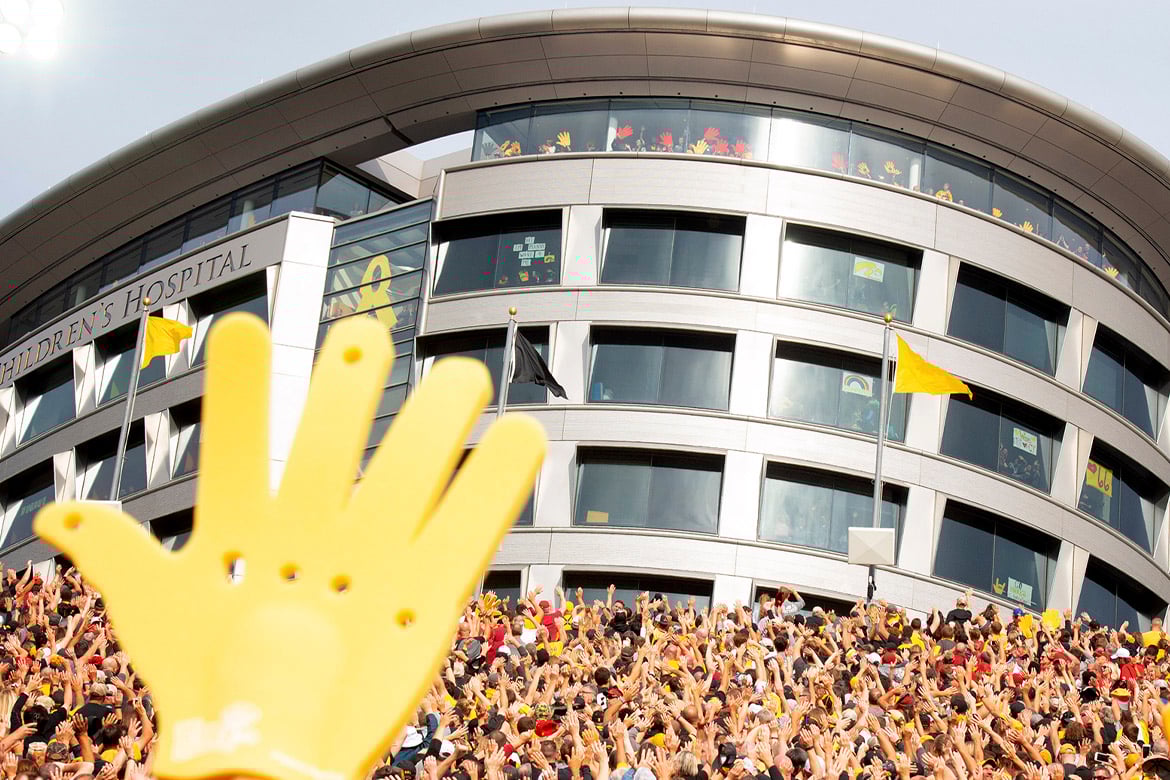
Every player, coach, official and up to 70,000 fans in the university’s Kinnick Stadium, led by a pediatric patient named as the “Kid Captain” for that day, stand up. They turn and face the University of Iowa (UI) Health Care Stead Family Children’s Hospital. Then, while a song selected by the Kid Captain plays, they wave to the pediatric patients and their families watching the game from the hospital windows.
It’s the Hawkeye Wave, and six times a year more than 70,000 people participate together in a gesture of love and support for all pediatric patients.
David Dickens, MD, a pediatric oncologist and director of pediatric cancer services at the UI Health Care Stead Family Children’s Hospital, watches from his clinic one floor down.
University of Iowa Health Care is part of the AMA Health System Member Program, which provides enterprise solutions to equip leadership, physicians and care teams with resources to help drive the future of medicine.
“It’s difficult to find the words to describe such an emotional experience. It’s like trying to explain what love means,” Dr. Dickens said. “You fumble around because it’s difficult to translate emotion into language.”
“People are rooting for the patients. They’re there to support everything involved with caring for those patients,” he said.
In 2017, Iowa fan Krista Young saw a photo of a child watching a game from a hospital window. She had an idea and in May posted on Hawkeye Heaven, a Facebook page for Iowa supporters.
“With the new U of I hospital addition open, Kinnick should hold a ‘wave to the kids’ minute during the game,” she wrote. “Can you imagine how neat it would be to have all those fans, players and coaching staff looking up at you sending a little extra inspiration?”
The post went viral and just four months later, on September 2, 2017, the first Hawkeye Wave took place.
Kid Captains take charge
Starting in 2009, the hospital began its Kid Captain program to honor its current and former pediatric patients. Each cohort of Kid Captains is selected annually from nominees named by families, friends and hospital staff. The child must be a current or former patient at Stead Family Children’s Hospital, exhibit extraordinary strength and courage and, most importantly, inspire others in the face of their own grave medical challenges.
Each Kid Captain receives a personalized Hawkeye jersey and tours the stadium with their families just before the football season begins. Each Kid Captain’s story is featured on the hospital’s website along with their scheduled game day. At each home game that day’s Captain joins the Hawkeyes and waves along with the crowd to their fellow patients above.
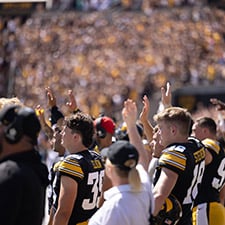
“The team treats these kids like VIPs,” Dr. Dickens said. “They’re the most important person at the game. It’s a day away from their troubles and a completely different mindset and experience from what they face in the hospital.”
For the first few years Pat Green’s Top 10 country hit “Wave on Wave” was played over the stadium’s sound system during the Hawkeye Wave, but since 2022 each Kid Captain has selected the song to be played that day, but “screened of course to make sure it’s appropriate,” Dr. Dickens wryly noted.
Recognition off the field
Only the home-game Kid Captains get to be physically on the field and experience the Hawkeye Wave in person. The away-game Kid Captains are still publicly celebrated by the team and hospital, featured online, in media and through other forms of acknowledgment.
For instance, 12-year-old Lily Sebastian of Cedar Rapids, Iowa was the Kid Captain for the Iowa v. Wisconsin game.
Lily and her twin sister were born prematurely, Lily with a rare abdominal condition known as a giant omphalocele. Some of her organs were outside her body and she had her first surgery at just one day old. Her sister went home after five weeks, but Lily spent her first 10 months in the NICU. Despite living with kidney disease and a heart condition, she is otherwise thriving.
When Lily was named an away-game Kid Captain in October 2025, students and staff at her middle school held a parade through the halls in her honor, accompanied by their football team and drumline.
Meanwhile, 10-year-old Harper Atkinson, the ninth Kid Captain of the 2025 Iowa Hawkeyes football season, has dealt with spontaneous fractures since she was 2 years old. While her twin brother was diagnosed with cerebral palsy, Harper seemed healthy. While there were similarities to other conditions, none of the known diseases fit with Harper’s symptoms.
Since her first break at 2 years old, Harper has had more than 35 bone fractures, resulting in 11 surgeries for broken bones, multiple admissions and other procedures over the past eight years.
Her family has long cheered on the Hawkeyes from the stands and even from the 12th floor of the children’s hospital. But on Nov. 8 she was on the other side, waving up to the kids in the hospital from the football field. And, prior to that, Harper and her whole family got to tour Kinnick Stadium, meet the players and collect autographs during Kids Day in August.

Patients, families and care teams affected
The Hawkeye Wave is more than just a spectacle for patients and families watching from inside the hospital.
“Imagine having a really tough day and 70,000 people stop what they are doing to acknowledge that they see you, that they understand and that they support you,” Dr. Dickens said. “Receiving that kind of collective kindness is profoundly uplifting and it fills them with a sense of caring and connection.”
“It’s a very positive emotion. It’s a feeling that their situation matters to their community, and by community, I mean 70,000 people,” he said. “For a brief moment they can step away from the fear, anxiety and uncertainty of their situation and simply feel surrounded by compassion and hope.”
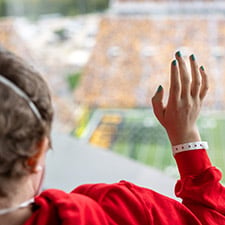
The Hawkeye Wave’s impact is felt by their caregivers too.
“I’ve asked my colleagues and other health care providers what the Wave means to them, and their response reflects a very similar, very positive emotion,” Dr. Dickens said. “It sometimes feels like that collective gesture is directed not just at the patients but at those caring for them as well.”
It also gives hospital staff a moment to see their patients simply being kids again.
“Everyone I work with is human. They have their own challenges, emotions and hardships,” he said. “And when the Wave happens the people who work here feel a real sense of elevation. It’s actually kind of amazing.”
Part of the community
While Dr. Dickens is on the 11th floor, “you’re watching this all go down from a sky box with a very clear view of the people and the players and the emotion,” he said. “When you do this work every day, it’s nice to feel supported by your community.”
“The Hawkeye Wave is this expression of humanity, which is really empowering to see and experience from this side of the glass, but that’s just one visible activity that happens,” Dr. Dickens said. “Outside of the Wave we have community supporters who help supplement funds for families of emergent crisis and needs that arise during their cancer journey, gifts and backpacks for kids going to school.
“All these things that you do on a daily basis that is hard to think about when you’re trying to navigate a pediatric cancer diagnosis,” he added. “So, what you see in the Wave is just the tip of the iceberg for the actual support that the community has.”
“When you’re a physician, it’s helpful to recognize that those things make a difference. I come in with a job to cure kids with cancer and things get very complex in areas that I have no expertise in such as helping families navigate through that process psychologically, emotionally and financially,” Dr. Dickens said. “This relationship that a community has with this hospital is absolutely critical to being at the highest level of health care.”
A favorite in sports
From the very beginning, the Hawkeye Wave has drawn national attention and praise. In its very first year it earned the Disney Sports Spirit Award, given annually to the most inspirational figure, team or individual in college football. In 2018 it was recognized with the Musial Award from the St. Louis Sports Commission. Meanwhile, USA Today readers voted it the Best College Sports Tradition in 2024 and 2025, and ESPN has consistently rated it among the most meaningful moments in college football.
Over the course of eight years and a total of 54 home games, almost 3,400,000 people have waved to the children watching from 12 floors up.
In physician specialties as emotionally charged as pediatric oncology, such highly visible moments of public support sustain the spirits of everyone involved.
“Health care providers in pediatric oncology are true heroes,” Dr. Dickens said. “The Wave reminds us that pain and joy, loss and life, exist side by side every week. It’s more than a football tradition. It’s a gesture of shared humanity that turns competition into connection.”
The Hawkeye Wave demonstrates—in real time and with real emotion—that a stadium full of strangers will happily prioritize empathy over rivalry. In doing so they connect as one with young patients and their families, who are reminded that they are not alone when they need to be reminded the most.