Everyone relies on their thumb more than they realize. When it stops working, joint pain can limit mobility for millions of people in the U.S. who rely on their hands for daily tasks.
Jonathan Tueting, MD, an orthopaedic surgeon, sees many patients with thumb arthritis. These patients develop pain and dysfunction as a result of the altered biomechanics and position of their thumb that occurs during the arthritic process. Commonly, they have trouble with pinching, opening jars, turning doorknobs, or turning keys.
“Many times, they’ve already had a steroid injection, and sometimes they’ve tried splints or therapy. They’re usually coming in to talk with me about the next stage of treatment,” said Dr. Tueting who is a shoulder, elbow and hand surgery specialist with Rush Copley Medical Center in Aurora, Illinois, and part of Rush University System for Health.
Rush University System for Health is part of the AMA Health System Member Program, which provides enterprise solutions to equip leadership, physicians and care teams with resources to help drive the future of medicine.
Across the world, but mainly in the U.S., previous methods for treating thumb carpometacarpal (CMC) arthritis usually involved trapeziectomy with suspensionplasty, a procedure removes the arthritic bone that stabilizes the thumb metacarpal to an adjacent bone. While it improves pain for many patients, the method often fails to restore an anatomic, functional position for the thumb metacarpal that allows for the restoration of pinch and grip strength.
Patients often didn’t regain the same level of strength and function, even if they had pain relief. Sometimes they developed recurrent deformity.
“Over time, almost any method used to suspend the thumb, the metacarpal would gradually shift, subside or even collapse. It would slowly move occupy the space once occupied by the arthritic trapezial bone that was removed,” he explained.
Dr. Tueting was chosen amongst a small group of surgeons to train in Switzerland, France, and Belgium to learn and adopt a procedure already used in Europe for quite some time. Dr. Tueting was the very first surgeon in the U.S. to successfully implant a tiny ball and socket thumb joint, otherwise known as the “tiny hip replacement for the thumb.” He’s now passing his knowledge and skill along to future doctors in the U.S.
An established practice in Europe
For many decades, surgeons worldwide had been exploring different joint replacements for the carpal-metacarpal joint in the thumb. None of them really worked consistently until the mid-1990s, when the earliest generation of cementless total joint arthroplasty for the thumb became available. It’s relatively new in the U.S., but it’s been around in Europe for a long time.
“That’s what really changed the game in Europe. There were still some issues with durability and instability,” but outcomes improved significantly, he said.
Instead of using bone cement to glue the implant into place, this design relies on the interface between the bone and the small metal prosthesis to achieve stability through a special coating that facilitates bone ingrowth. Furthermore, it has a “dual mobility” ball and socket design that dramatically improves joint stability. Since that time, the design has been implanted more than 125,000 times, supported by dozens of peer-reviewed published studies.
“We’re now on the fourth generation” of that technology, Dr. Tueting explained.
About 10 years ago, a French orthopaedic solutions company, KeriMedical, began development of its own dual-mobility cementless design.
Their concept is interesting because it creates an inherently more stable joint, said Dr. Tueting. The metals and plastics used in this procedure have been used in hip replacements for many decades.
The dual mobility aspect “is actually something that's been available for the treatment of patients who have hip fractures,” otherwise known as bipolar hip hemiarthroplasty, he explained. Not only that, but the procedure itself also functions very much in the same manner as a total hip replacement.
Essentially, you have a small ball rotating within another durable plastic ball, which then rotates within a metal socket or cup.
“You have a trapezial cup, or socket, that sits in the trapezium, which is one side of the biconcave saddle joint. And then you have a metacarpal stem that goes into the thumb metacarpal on the other side,” Dr. Tueting said. There’s also a third component called the metacarpal neck that includes the dual-mobility ball itself.
That dual-mobility ball combines metal and polyethylene and has a slightly larger diameter than a traditional single-mobility ball, which makes it more stable and less subject to subluxation or dislocation.

Delivering on quality-of-life expectations
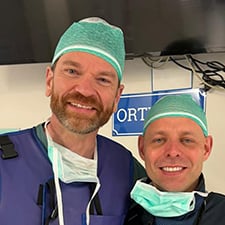
Dr. Tueting had the opportunity to observe how different European surgeons taught the procedure and was invited to do it himself on a cadaver. He eventually trained with Joris Duerinckx, MD, a well-known Belgian surgeon, to learn how to do the tiny hip replacement for the thumb. As of July 1, 2026, Dr. Tueting has implanted more than 125 prostheses in his own patients and the results so far have been phenomenal.
“Even after seeing these patients come back with no pain, I was still thinking, ‘I can’t believe they’re doing this well,’” he said.
With the first 10 or 15 patients, he had all of them come back on postoperative day two. Without question, “they were telling me their pain was dramatically better than it had been” before surgery, Dr. Tueting said, adding that people were moving their thumbs and already able to use them.
“I could tell right away that at two weeks, six weeks, and six months, they were going to be super-duper happy,” he added.
Trapeziectomy with suspensionplasty usually calls for immobilization in splints or casts for six weeks and therapy for another three months.
“I used to tell patients that they would continue seeing improvements in symptoms, strength and function for six months to a year after surgery,” said Dr. Tueting.
With the new procedure, the conversation is very different. At six weeks, he’s telling patients to slow down, not because they still have pain or limited function, but because they’re feeling so good.
He explains to patients that “we need to allow the bone to heal into the prosthesis so that it remains well fixed and stable.”
It’s important to choose the right patients
The new procedure offers a meaningful opportunity for people dealing with something that can be very debilitating and can significantly affect quality of life. But patient selection is essential.
You have to choose the right patients who are compliant, who have the right anatomy, and whose work, vocational or hobby demands are compatible with this type of joint replacement. When those factors align, “this procedure can really help people,” said Dr. Tueting.
That’s not to say the indications for this procedure can’t expand—they already have expanded somewhat in Europe. Over time, this may happen in the U.S. as well. But right now, “we have to be pretty specific about who meets the criteria,” he emphasized.
Ideal candidates are patients with Eaton Stage III thumb CMC arthritis. That means the arthritis is primarily confined to the CMC joint and not significantly affecting the scaphotrapeziotrapezoidal (STT) joint, which is the other side of the trapezium.
That distinction is important because if patients have severe pain on both sides of the joint complex and you only replace one side, they can still potentially have persistent pain coming from the untreated area, said Dr. Tueting.
The procedure requires specific training
Obtaining patient access to carpometacarpal total joint arthroplasty in the U.S. will be a challenge because it’s still new. Right now, it only has a temporary CPT code, which means insurance companies, Medicare and others are understandably a little more reluctant to fully buy into it.
Based on Europe’s experience, “What I’m telling surgeons—and more importantly, patients—is that while this procedure is new to the U.S., it is FDA approved and it’s not experimental or investigational,” said Dr. Tueting.
Adopting a new procedure responsibly is about continuing to build evidence, expanding expertise across more surgeons, and advancing the technology safely within the U.S. system.
On the surgeon side, it’s all about training, education and humility. Dr. Tueting noted that “if you approach this procedure thinking, ‘Oh, I’ve got this,’—like some of us surgeons tend to do—you can definitely be humbled.”
It’s a technically demanding procedure, and proper training matters, he emphasized.
To perform this procedure, KeriMedical requires that surgeons attend a dedicated training lab. The company has invested in an entire training force—not sales reps, but clinical trainers—who work directly with surgeons and their teams at their own practice sites. “They teach, mentor, guide and assist surgeons through as many cases as it takes for them to become comfortable performing the procedure safely and effectively,” said Dr. Tueting.
That’s critical, because the company is operating under Food and Drug Administration (FDA) premarket approval.
“We’re under FDA scrutiny and have to make sure we’re having [the same] good outcomes in the U.S. that have already been demonstrated overseas,” he said.
This means carefully tracking patient outcomes. Dr. Tueting is following his own patients to demonstrate that the European experience can be successfully replicated in the United States, working with KeriMedical and Rush University System for Health to disseminate both early experience and longer-term outcomes data.
Organizations like the AMA, the American Academy of Orthopaedic Surgeons, and the American Society for Surgery of the Hand can play an important role in helping spread awareness. This can ultimately help patients by reducing barriers such as prior authorization and insurance reluctance.
There needs to be responsible stewardship of healthcare costs. That’s critical, Dr. Tueting acknowledged. But as patient outcomes become clearer and more widely recognized, he’s confident that adoption will continue to grow.