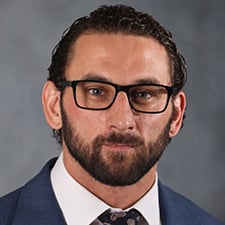
As a five-time winner of the California’s Strongest Man competition, AMA member Andrew J. Mock, MD, is arguably the picture of health, at least to judge from his Instagram account. Combine that with his interest in heading off the root causes of chronic disease and he is an apt representative of the fast-growing physician specialty of lifestyle medicine.
But for a time, Dr. Mock wasn’t even a likely candidate to become a physician.
“I'm actually a high-school dropout,” Dr. Mock said in an interview with the AMA. “I had a lot of abdominal issues and had to have four stomach surgeries early in life. For years, I didn’t know what was going on.”
Then one day a friend of his mother’s, a personal trainer, offered to take him to the gym. And that’s where, he remembers, medicine found him.
“I was learning about anatomy, physiology, how nutrition was helping my performance,” he said. “I’d always had an interest in science and I knew that ... was where I was going, but at that point I thought: Man, this is cool! Then I realized I liked teaching what I was learning, and I came across the root word for doctor, docere, which literally means ‘to teach.’ That's what got me into medicine.”
8 billion patients need lifestyle medicine
Going into his fourth year of medical school, Dr. Mock wasn’t sure which specialty he wanted to pursue, but he was excited by the potential of applying lifestyle medicine—the evidence-based practice of applying therapeutic lifestyle interventions to treat, reverse and prevent chronic conditions—to any practice.
“I could have been a surgeon, and I had a thought: What would the gym clinic version of, say, cardiothoracic surgery or ob-gyn look like?” he said. “I wanted to know: How can we help people adopt the behavior changes that will add not just more years but more function to their lives? How can we help them retain or even regain the ability to do all the things they want to do?”
He ended up doing a combined family medicine and preventive medicine residency at Loma Linda University Health Education Consortium, in Southern California, because he wanted to work in lifestyle medicine full time.
“This is an 8-billion-person problem,” he said. “Everyone will benefit from lifestyle interventions.”
He is now the medical director of Hoag Compass, the preventive wellness arm of the Hoag health system, in Orange County, California.
“We have integrated health coaches, dietitians and exercise physiologists all working together to empower patients to make impactful lifestyle changes, and we're within the digital health department, so we’re integrating all kinds of data into our work,” he said.
But one of his missions remains to spread the message of lifestyle medicine way beyond primary care—to literally every specialty.
“Why? Because there isn’t a single health condition that can’t be improved with lifestyle changes,” he said.
Consider the possibilities
Surgery, again, is a great example. One of the lectures Dr. Mock used to give after residency had the title, “Fit for Surgery: Lifestyle Medicine Interventions for the Surgical Team and the Surgical Patient.”
“The big thought-provoking question was: What if surgical outcomes start long before you even pick up the scalpel?” he said. “What can we do to make patients better able to deal with the stress of surgery?”
The answer was a “prehab” program. Surgeons sent patients to physical therapy in advance of their procedures to focus on general strength and compound movements.
“In many cases, we made immense progress in just a few weeks,” he said. “We just had to learn how to get the dose right.”
Use a system you already know
Getting the dose right isn’t as hard as it might sound, Dr. Mock noted. In fact, the process should already be familiar to most physicians.
“The very simple framework of assess-prescribe-refer fits very well into lifestyle medicine,” he said, adding that most practices are already set up to assess patients’ current activity levels through online questionnaires sent to patients through the EHR ahead of their visits.
Dr. Mock and his colleagues use one called Physical Activity Vital Sign, which is already a part of the most popular EHRs and, he expects, will be a required metric in all EHRs within a few years.
It consists of three simple questions:
- How many days per week are you doing moderate to vigorous physical activity?
- On average, how long is a typical session in minutes?
- How many days per week are you doing muscle strengthening activities?
“If you see the answers to those questions are ‘zero, zero, zero,’ you immediately know what your intervention is: You need to find a way to get that patient to do something more than zero. Which is anything—doing one squat, walking 10 steps. Those are infinitely better than doing nothing,” he said.
Pro tip: Start with yourself
Dr. Mock is also a delegate from the American College of Lifestyle Medicine to the AMA House of Delegates. The college was inducted into the House of Delegates in 2024.
And besides working to get every practicing physician to adopt some level of lifestyle medicine in their practices, Dr. Mock is working to help physicians embrace the pillars of lifestyle medicine in their own lives.
The American College of Lifestyle Medicine defines those pillars as:
- Optimal nutrition.
- Physical activity.
- Restorative sleep.
- Stress management.
- Connectedness.
- Risky substance avoidance.
“This is a tough job. We know that the stress of the job has health impacts, but there are physical risks in every specialty too,” he said.
Here again, think of surgery. About 40% of surgeons will experience some sort of musculoskeletal issue as a result of the job’s demands, Dr. Mock said. Or consider the effects suffered by diagnostic radiologists from sitting for long spells. Or the challenges posed by varying shift work on emergency medicine physicians.
And there’s an added benefit to physicians’ being on board with lifestyle medicine in their personal lives, Dr. Mock noted.
“They report better outcomes in clinic. Their patients are more engaged and report higher satisfaction,” he said. “It’s a tool to improve your practice.”
Look here for expert help
Learn more from the American College of Lifestyle Medicine about earning board certification as a lifestyle medicine physician. In the meantime, an AMA Ed Hub™ bundle features more than 30 evidence-based lifestyle medicine training toolkits from ACLM to help parents and care teams partner to prevent, treat and even reverse chronic disease. Most are designated by the AMA or another institution for AMA PRA Category 1 Credit™. Examples include:
- “Introduction to Lifestyle Medicine” (1.5 credits).
- “Lifestyle Interventions for Treatment and Remission of Type 2 Diabetes and Prediabetes in Adults: A Clinical Practice Guideline From the American College of Lifestyle Medicine” (3.75 credits).
- “Food as Medicine for Cancer Risk Reduction” (2 credits).
The AMA Ed Hub is an online platform that consolidates all the high-quality CME, maintenance of certification, and educational content you need—in one place—with activities relevant to you, automated credit tracking and reporting for some states and specialty boards.
Explore further and earn CME with the “Healthy Diet and Dietary Patterns” webinars. They all were hosted by AMA Immediate Past President Bobby Mukkamala, MD, an otolaryngologist who also is board-certified in lifestyle medicine.