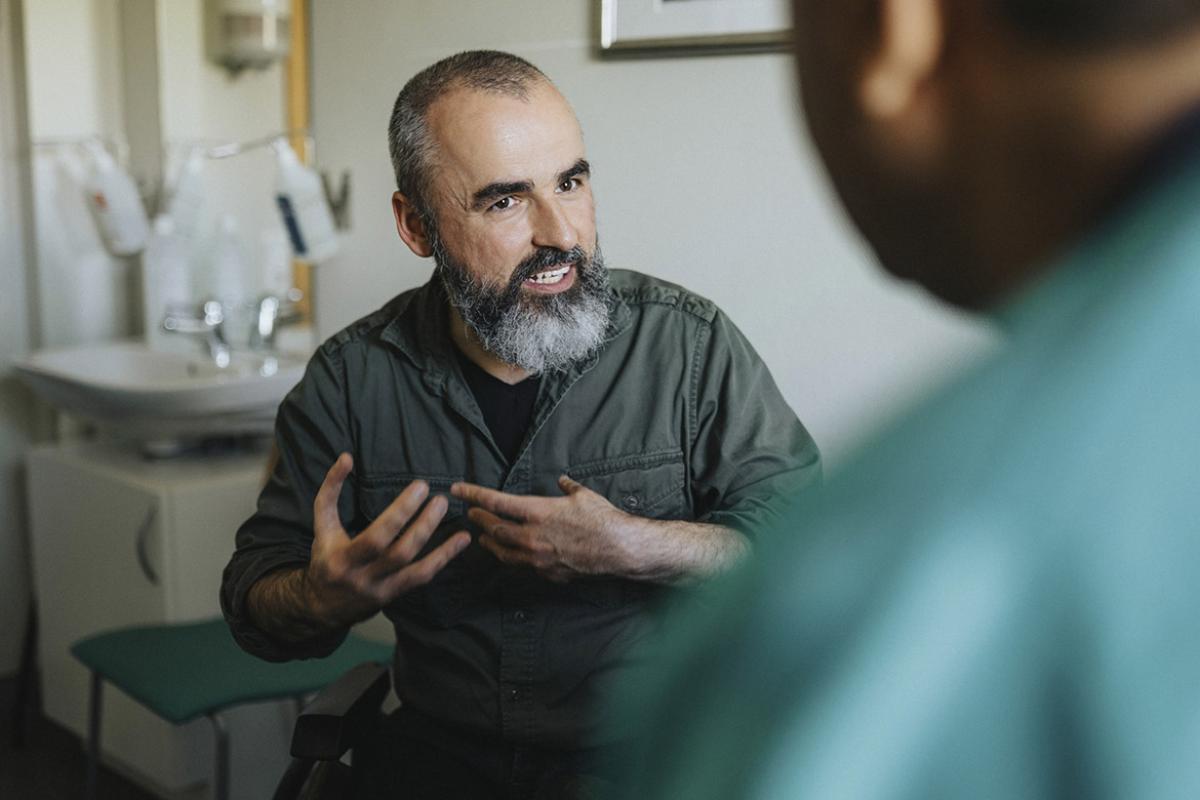
It’s an inconvenient truth of the U.S. medical profession: Burnout begins in medical school. The overwhelm from the heavy workload and hectic pace is compounded by constant change and a feeling of outsider status. An academic coach can provide a vital counterpoint to worry and self-doubt, supplying insight, support and stability.
Following are highlights from “How can I use coaching throughout my training?” Chapter 7 of It Takes Two: A Guide to Being a Good Coachee, a learner handbook focusing on what learners need to know to get the most out of a coaching relationship, produced by the AMA Accelerating Change in Medical Education Consortium.
“It is not surprising that medical trainee well-being is often at its lowest during education transition periods where emotions are most turbulent and there is a perceived lack of structured support. However, adequate socialization and support, such as from a coach, can smooth these transitions,” says the chapter. It was co-written by Helen K. Morgan, MD, associate professor of obstetrics and gynecology, William Peterson, MD, clinical lecturer in emergency medicine, and medical student Salomeh M. Salar, all at University of Michigan Medical School.
Transitioning to clerkship
With the national trend of shifting to the “1+3” curricular model, the first major change often comes after just the first year of medical school, upon entering the wards. With a relationship established in advance of this transition, a coach can help you with these three key challenges.
Managing change
Knowing your strengths and weaknesses, your coach can help you quickly adapt to this new environment, such as by developing SMART goals (specific, measurable, achievable, relevant, timely).
Prioritizing self-care
Given the demands of preparing for both clerkship exams and patient care, you might lose sight of your personal well-being. A coach can help you set a realistic study schedule to make sure you are working at a healthy and effective pace.
Combating insecurities
“Whether answering questions on rounds or discussing study habits, it can be difficult to resist comparing yourself to classmates, especially if you have competitive peers,” the authors wrote. “Your coach can support you to both proactively set specific goals for improvement … and maintain confidence and perspective.”
Read more at the AMA about what you should know before you start clinical rotations.
Specialty choice and the Match
Soon after your transition to life as a clinical student, you face the daunting question of which medical specialty to choose and where to interview for your residency. An academic coach can provide the insight you need to:
Stay true to yourself. He or she can remain objective and remind you of the clinical environments you most enjoyed.
Make sense of your applications. While guidance from an adviser within your specialty is essential, a coach can also guide you through asking for letters of recommendation, review your personal statement and CV and help you prepare for interviews.
Create a Match rank-order list. Your coach can help you sort out which qualities you are seeking in a residency program.
Keep your head up. “During a time when your future is unknown, there are long waiting periods,” the authors wrote. “The fear of rejection is at its peak, and a coach can help ensure you are organized and emotionally supported.”
The AMA Specialty Guide simplifies medical students’ specialty selection process, highlight major specialties, detail training information, and provide access to related association information. It is produced by FREIDA™️, the AMA Residency & Fellowship Database®️.
Beginning residency
Just as when you first entered the clinical world, residency involves a new environment, a new role and a steep learning curve. A coach can help you:
Recognize your strengths and needs. This could be by reviewing your clinical evaluations and guiding you through a cumulative self-assessment.
Prepare for personal changes. The added responsibility that comes with moving to a new city and becoming financial independent can be daunting. A coach can provide stability.
Maintain professional continuity. “We encourage you to maintain your coaching relationship even if you change institutions, as your coach can provide lifelong support,” the authors wrote.
A corresponding text, Coaching in Medical Education: A Faculty Handbook, provides an academic coaching framework for educators, as well as tools to provide professional development and assistance to learners in medical education.