In botany and zoology, they call it being a keystone species. It’s when a plant or an animal has a disproportionately large influence on its ecosystem. Think oak trees which, according to the National Park Service, “support more lifeforms than any other North American tree genus.”
Regardless of whether health system leaders want to deal with this responsibility, each of their organizations is a keystone species—another term for it is an anchor institution—in the U.S. health care ecosystem.
“Being an anchor institution isn't a choice. It’s a fact,” said David Ansell, MD, MPH, senior vice president for community health equity at Rush University Medical Center, in Chicago. “Health care in every state is usually the No. 1 employer. We’re big purchasers of goods. We contribute in many ways to the benefit to the community.”
This reality is particularly evident for physicians working at Rush because their hospital straddles the largely affluent downtown of Chicago and the relatively low-income West Side. Rush’s 2016 community health needs assessment found that this staggering 14-year difference in life expectancy between the two communities can be changed. The key contributors to premature death are vital conditions for health and well-being—which bring together determinants and drivers of health—and include everything from reliable transportation to meaningful work opportunities to safe housing.
Therefore, the question each health system faces, Dr. Ansell said in an interview with the AMA, is: Can we mindfully and intentionally leverage our assets to influence vital conditions?
“We have a sign on the side of our building that asks, ‘Who gets the chance to be healthy?’ Because we want to really stimulate thoughts and ideas about it,” he said. “It's going to take all of us to build these vital conditions that really can make a difference in the well-being of a community.”
Rush University System for Health is part of the AMA Health System Member Program, which provides enterprise solutions to equip leadership, physicians and care teams with resources to help drive the future of medicine.

Building stronger communities
Rush has been pursuing solutions to these questions for more than a decade. In fact, Dr. Ansell helped develop the Healthcare Anchor Network, a national collaboration that now includes more than 85 health systems nationwide with the stated goal of “building more inclusive and sustainable local economies.”
The health system is also a founding member of West Side United, a collaborative working to ensure that communities on Chicago’s West Side can overcome social, economic and environmental barriers to staying healthy. The AMA also is a West Side United anchor mission partner, having invested $5 million in the effort since 2020.
Rush, along with several community-based organizations—including West Side United and the Garfield Park Rite to Wellness Collaborative—broke ground last year on construction of a flagship wellness center that will integrate accessible, integrated health and social services that address vital conditions in West Garfield Park, a neighborhood profoundly affected by decades of disinvestment. Rush will offer behavioral health services on the site, called the Sankofa Wellness Village, which is set to open in the spring of 2026 as the new headquarters of West Side United.
Ayesha Jaco, executive director of West Side United, took part in an expert panel discussion, held at the Rush MD Anderson Cancer Center in October, that focused on how health systems can invest in their communities to address vital conditions and make lasting gains in local financial and population health. (Watch the event and claim CME.)
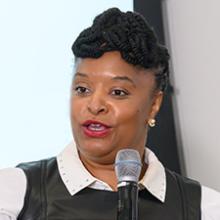
Jaco said that health systems like Rush must seek community input from the outset for their investments and philanthropic efforts to succeed.
“It's not enough to put a seat at the table for the people that you're looking to serve,” Jaco said. “They have to help build the table ... the people that you want to be impacted by your work, they're also architects.”
Focus on these 3 areas
A colleague of Dr. Ansell’s, John A. Rich, MD, MPH, is the inaugural director of the RUSH BMO Institute for Health Equity. He also took part in the panel discussion at Rush and in interview with the AMA afterward, Dr. Rich highlighted three areas where health systems can have immediate and lasting impacts on their communities: hiring, investment and procurement.
“Hiring is the first place because it is part of the day-to-day activity of organizations,” he said. “So ask yourself: How are we enhancing wealth in the community? What proportion of our employees are taking advantage of their retirement dollars? And for those who aren’t, how can we make sure that they have a living wage?”
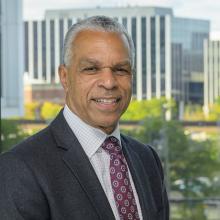
For the second investment, Dr. Rich advised continuously asking: Where are we putting our money? Is it benefiting the local economy?
The third area, procurement, is in fact, a form of investing. For example, Rush recently contracted with a local laundry vendor, Fillmore Linen Service. The company is a 45,000-square-foot operation and anchor tenant for a previously vacant 111-year-old building purchased by the Steans Family Foundation for $3.3 million in 2022. The company employs nearly 100 people and the partnership now saves Rush nearly $1 million a year.
“Every institution is buying goods and services,” he said. “Is there capacity here in the community to provide those same supplies?”
Creativity is key
Pulling all this off requires support and expertise, Dr. Rich noted.
“These kinds of opportunities may require some thought leadership within the organization,” he said, noting where to start. “Assign this to the procurement folks and empower them to look for opportunities.”
The point is that vital conditions will never be a set-it-and-forget-it function.
“Anyone who works at an organization—or works in a community, whether they live there or not—may notice that there are local businesses that are doing great work and could be partners,” Dr. Rich said. “So any person in an organization might say: I found this great place …”
Those businesses might do job development or stress reduction or even food preparation, he said.
“It's about asking questions,” he said. “Think about other organizations in your space and ask: How can we do this together?”
Physicians can lead in building these linkages, understanding the needs of their patients and connecting the dots to their communities.
Along related lines, the AMA Community Health Impact Lab micro grants will offer up to 20, one-year grants of $50,000 each to support physician-led initiatives aimed at improving health outcomes at the community level. The grants will fund innovative, community-centered projects that address a broad range of health-related challenges faced by that populations that are most affected by systemic drivers of health outcomes. The grants will incubate and test new or expanded solutions implemented in partnerships between health systems and community-based organizations. Learn more now.