If you are preparing for the United States Medical Licensing Examination® (USMLE®) Step 2 exam, you might want to know which questions are most often missed by test-prep takers. Check out this example from Kaplan Medical, and read an expert explanation of the answer. Also check out all posts in this series.
This month’s stumper
A 78-year-old woman comes to the physician because of pain and stiffness in her hands for six months. She has had stiffness in the morning that improved after 20 minutes. She occasionally takes ibuprofen when the pain is unbearable, but is generally reluctant to take medication. She has a history of psoriasis and hypertension. Current medications include a topical steroid and hydrochlorothiazide. Her blood pressure is 123/74 mm Hg. Examination is shown.
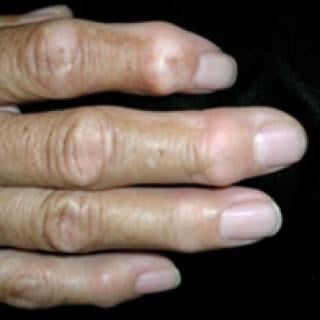
No swelling or redness is noted. She has scattered scaly patches on her arms and back.
Which of the following is the most likely diagnosis?
A. Gout.
B. Osteoarthritis.
C. Psoriatic arthritis.
D. Reactive arthritis.
E. Rheumatoid arthritis.
The correct answer is B.
Kaplan Medical explains why
The patient described has typical symptoms of osteoarthritis, including morning stiffness that resolves, worsening pain with activity and no evidence of swelling or inflammation.
Subscribe and succeed in medical school
Get tips and insider advice from the AMA on succeeding in medical school—delivered to your inbox.

Why the other answers are wrong
Choice A: Gout is a peripheral arthritis that results from the deposition of sodium urate crystals in one or more joints. There is usually a spontaneous onset of pain, edema, and inflammation (swelling and redness) with gout. The most common joint involved is the metatarsal-phalangeal joint of the great toe (podagra). Other than the great toe, other common sites of gouty arthritis are the ankle, wrist, and knee.
Choice C: Psoriatic arthritis is not the correct answer. The patient's past medical history for psoriasis does not mean she suffers from psoriatic arthritis. Only 5 percent of patients who have psoriasis develop psoriatic arthritis, which presents with swelling, redness, and more than 30 minutes of morning stiffness. Distal interphalangeal (DIP) joint involvement and nail pitting is classic.
Choice D: Reactive arthritis, formerly known as Reiter syndrome, usually presents with a history of GI or genitourinary infection, most commonly after Campylobacter jejuni or Chlamydia trachomatis. The classic triad is urethritis, conjunctivitis and arthritis.
Choice E: Rheumatoid arthritis is also an inflammatory arthritis associated with swelling and redness, morning stiffness lasting longer than 30 minutes, and joint pain that gets better with activity. It usually involves the proximal interphalangeal (PIP), metacarpophalangeal (MCP) and wrist joints. There may also be constitutional symptoms. An x-ray film may show bony erosions, cysts, osteopenia, joint space swelling, calcifications and narrowed joint space.
Tips to remember
- Osteoarthritis: Pain that worsens with activity, no inflammatory changes.
- Rheumatoid arthritis: Pain that improves with activity, inflammatory changes.
- Heberden nodes at the DIPs and Bouchard nodes at the PIPs equals osteoarthritis.
The AMA and Kaplan have teamed up to support you in reaching your goal of passing the USMLE® or COMLEX-USA®. If you're looking for additional resources, Kaplan provides free access to tools for pre-clinical studies, including Kaplan’s Lecture Notes series, Integrated Vignettes, Shelf Prep and more.
For more prep questions on USMLE Steps 1, 2 and 3, view other posts in this series..