If you’re preparing for the United States Medical Licensing Examination® (USMLE®) Step 1 exam, you might want to know which questions are most often missed by test-prep takers. Check out this example from Kaplan Medical, and read an expert explanation of the answer. Also check out all posts in this series.
The AMA and Kaplan have teamed up to support you in reaching your goal of passing the USMLE® or COMLEX-USA®. If you're looking for additional resources, Kaplan provides free access to tools for pre-clinical studies, including Kaplan’s Lecture Notes series, Integrated Vignettes, Shelf Prep and more.
This month’s stumper
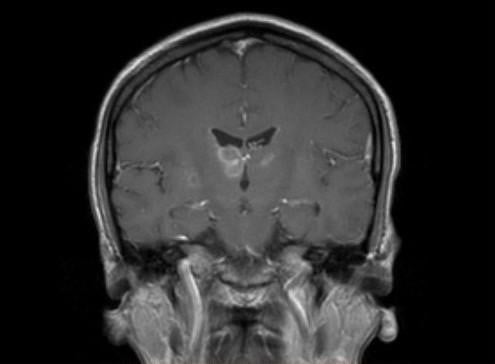
A 45-year-old man comes to the physician because of a one-week history of headaches, nausea and vomiting. He has a history of dilated cardiomyopathy and underwent a heart transplant one year ago. His temperature is 37.9° C (100.2° F), pulse is 110 beats per minute, respirations are 14 breaths a minute, and blood pressure is 160/112 mm Hg. He is alert, awake, and oriented and has no signs of meningeal irritation. Examination of the fundus shows bilateral papilledema. An MRI scan of the head is shown.
Which of the following is most likely deficient in this patient?
A. Complement.
B. Immunoglobulin A.
C. Immunoglobulin E.
D. Immunoglobulin G.
E. T-helper 1 cells.
F. T-helper 2 cells.
The correct answer is E.
Kaplan Medical explains why
This man, immunosuppressed to prevent rejection of his transplanted heart, has developed cerebral toxoplasmosis as evidenced by the multiple ring-enhancing lesions seen on MRI.
- Toxoplasma is an intracellular protozoan parasite in humans.
- Approximately 70% of the population of the United States is seropositive, so reactivation of cysts held in latency by a normal immune response becomes commonplace as the immune response declines.
- Cats act as the definitive host of the parasite and shed infectious forms in their feces.
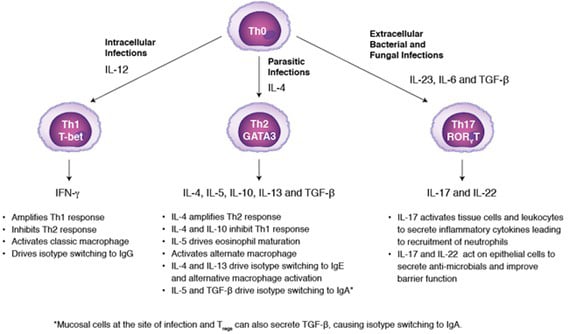
- Intracellular pathogens are best controlled by cell-mediated immune responses, which are orchestrated by T helper-1 (TH1) cells.
- Effectors of cell-mediated responses include cytotoxic T lymphocytes, natural killer cells, macrophages and cells capable of mounting antibody-dependent cell-mediated cytotoxicity (ADCC).
Why the other answers are wrong
Choice A: Complement is a set of serum proteins that act on each other in a cascading fashion to culminate in the production of a membrane attack complex that will lyse whatever particle has started the cascade. Complement is useful only against extracellular agents, as it is not carried into cells.
Choice B: Immunoglobulin A (IgA) is the major immunoglobulin of the mucosal surfaces. Although Toxoplasma are typically introduced across a mucosal surface, within the human, they exist as intracellular cysts. Intracellular organisms are not affected by the presence of IgA.
Choice C: IgE is an immunoglobulin that can mediate ADCC against parasites, but it is elicited against helminth parasites and not intracellular protozoa such as Toxoplasma.
Choice D: IgG is the most abundant antibody in the serum. Intracellular organisms require cell-mediated responses, but IgG is likely also produced as B cells are activated from Th1 cells. The IgG would also activate ADCC, neutralize the pathogen when outside the cell, and activate complement.
Choice F: TH2 cells are important in humoral immunity, but antibodies isotypes stimulated by Th2 do not usually play important roles against intracellular pathogens.
Tips to remember
- Immunosuppressed patient with ring-enhancing brain lesions: Toxoplasma gondii.
- Intracellular organisms require TH1 responses.
- Effector cells are macrophages, cytotoxic T lymphocytes, natural killer cells, and cells capable of mounting ADCC.
For more prep questions on USMLE Steps 1, 2 and 3, view other posts in this series.