If you’re preparing for the United States Medical Licensing Examination® (USMLE®) Step 1 exam, you might want to know which questions are most often missed by test-prep takers.
Check out this example from Kaplan Medical, and read an expert explanation of the answer. Also check out all posts in this series.
This month’s stumper
A 68-year-old man comes to the physician because of fatigue and night sweats. His temperature is 37.6 °C (99.6 °F), pulse is 76 beats per minute, respirations are 14 per minute, and blood pressure is 138/88 mm Hg. Physical examination shows generalized lymphadenopathy and hepatosplenomegaly. Laboratory studies show:
- Leukocyte count: 18,800/mm3.
- Hemoglobin: 12.5 g/dL.
- Hematocrit: 38%.
- Platelet count: 120,000/mm3.
A peripheral blood smear shows numerous small mature lymphocytes; some cells are fragile and ruptured.
Which of the following markers is/are most likely present on the abnormal cells?
A. CD3.
B. CD8.
C. CD14.
D. CD16 and CD56.
E. CD19 and CD20
The correct answer is E.
Kaplan Medical explains why
This patient most likely has B-cell chronic lymphocytic leukemia (CLL), which usually occurs in people over 50 years of age. The symptoms—which may or may not be present—and the physical findings are classic for this disorder. The peripheral smear usually shows an increased number of small, round lymphocytes, with occasional "smudge cells," which are fragile cells that have been disrupted in the process of making a smear.
The neoplastic cells have an immunophenotype somewhat like B cells, with IgM, or IgM and IgD, on their surfaces. In addition, both the tumor cells and normal B cells have CD19 and CD20 markers that aid in their identification on flow cytometry. In CLL, the tumor cells may additionally have CD5 positivity, a T-cell marker present on a small minority of normal B cells.
Why the other answers are wrong?
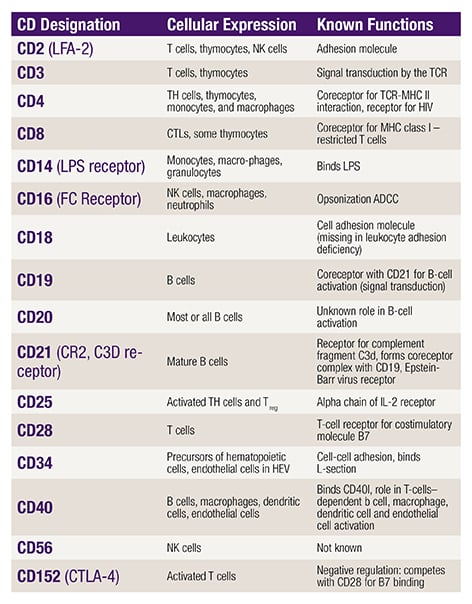
Choice A: The CD3 marker is present on all T cells. The majority of CLL is of B cell type. A small percent can be CLL, T cell type.
Choice B: The CD8 marker is present on cytotoxic T lymphocytes.
Choice C: The CD14 marker is used to identify macrophages.
Choice D: The CD16 and CD56 markers are present on natural killer cells.
A summary of CD markers is provided to the right.
Tips to remember
- Chronic lymphocytic leukemia: small, round lymphocytes and smudge cells.
- The majority of CLL is comprised of neoplastic B cells.
- Neoplastic cells have CD19, CD20, and sometimes CD5 positive markers.
For more prep questions on USMLE Steps 1, 2 and 3, view other posts in this series.
The AMA and Kaplan have teamed up to support you in reaching your goal of passing the USMLE® or COMLEX-USA®. If you're looking for additional resources, Kaplan provides free access to tools for pre-clinical studies, including Kaplan’s Lecture Notes series, Integrated Vignettes, Shelf Prep and more.