As a medical student, do you ever wonder what it's like to specialize in medical hematology and oncology? Meet AMA member John "Bo" Hrom, MD, a medical hematologist-oncologist and a featured physician in the AMA's “Shadow Me” Specialty Series, which offers advice directly from doctors about life in their specialties. Check out his insights to help determine whether a career in medical hematology/oncology might be a good fit for you.
The AMA's Specialty Guide simplifies medical students' specialty selection process by highlighting major specialties, detailing training information and providing access to related association information. It is produced by FREIDA™, the AMA Residency & Fellowship Database®.
Learn more with the AMA about the medical specialty of medical hematology/oncology.
“Shadowing” Dr. Bo Hrom
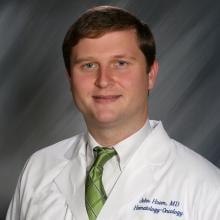
Specialty: Medical hematology/oncology.
Practice setting: Group.
Employment type: In private practice at Hattiesburg Clinic, in Hattiesburg, Mississippi. Hattiesburg Clinic is part of the AMA Health System Member Program, which provides enterprise solutions to equip leadership, physicians and care teams with resources to help drive the future of medicine.
Years in practice: 15.
A typical day and week in my practice: I begin my day by arriving at my office around 7 a.m. I will typically review my patient charts for the day, which is usually around 25 patients. I will start seeing patients in the clinic at 8 a.m., with most of them needing follow-up on cancer treatments. I will see patients until noon, when I will typically have a lunch meeting, as I am the clinical trial director for oncology clinical trials, or I will participate in committees and the tumor board once a week. I normally resume clinic at 1 p.m. and will often be in the clinic until 4 p.m. In the afternoon, I will see three to five new patients.
Following the clinic, I go to one of the two hospitals where I am on staff and perform inpatient consultations. I am usually home by 5:30 or 6 p.m. and spend the evening with my wife and four children.
I work Monday through Thursday, seeing patients in clinic and performing hospital consultations. I am off Friday through Sunday, unless I am on call. I am on call typically every fifth weekend.
The most challenging and rewarding aspects of medical hematology/oncology: I find the most challenging aspect of patient care is discussing end-of-life issues and complex treatment decisions with patients and their families when the patients have advanced malignancies. It is important that I, as an oncologist, give truthful information regarding life expectancy and expectations of the side effects of treatments. It is challenging to dispel many false beliefs that patients may harbor regarding cancer and its treatment.
The most rewarding part of my job is being able to improve the lives of patients who have advanced malignancies. Providing state-of-the-art treatment that can improve patients’ quality of life, as well as their life expectancy, is extremely rewarding. Also, as an oncology clinical trial director, I truly enjoy being able to offer patients in a rural setting the newest therapies in oncology clinical trials. It is intellectually stimulating to learn about and help develop the latest treatments and to be able to implement those treatments in patients who otherwise would not have access to them.
The impact burnout has on medical hematology/oncology: Burnout is a real problem in the subspecialty of medical hematology/oncology. Frequently, we deal with patients who are very ill, and being able to deliver high-quality care is of utmost importance. Despite our best efforts and newest medical advancements, many of our patients succumb to advanced cancers, and this can be emotionally draining.
In addition, patients and their family members frequently have unrealistic expectations regarding prognoses. I have found over the years that it is important to maintain close personal relationships with both patients and their families, as this can help with communication at the end of patients' lives.
As an oncologist, I frequently deal with issues related to insurance providers regarding patient care. I can spend several hours a week dealing with denials and peer-to-peer discussions that, in my opinion, are rarely necessary and waste my time as well as our patients’ time. Many of these peer-to-peer discussions are not with medical oncologists but are with physicians outside of the specialty who have little to no understanding of the disease states. This can be frustrating and cause severe burnout. I frequently hear this from my colleagues as well.
How Hattiesburg Clinic is reducing physician burnout: My health system has programs that enable physicians to meet with colleagues and discuss burnout. This is typically done after hours, and I have found these sessions to be a safe space where we can discuss our issues as a group. These sessions are very helpful and can help physicians realize that they are not alone in dealing with burnout.
How my lifestyle matches, or differs from, what I had envisioned: Being a hematologist/oncologist is much like what I expected when I was in medical school. I thoroughly enjoy the science of medical oncology and learning about complex treatments. That is the main reason I wanted to go into medical hematology/oncology when I was a medical student. I also wanted to go into a specialty where you are closely following patients and maintaining close relationships with those patients.
After medical school, I was surprised to learn how satisfying it is to be a clinical trial investigator. I had very little exposure to clinical medical research in medical school, and I was a bit surprised when I finished training that I could participate in clinical research in private practice. I quickly learned that this would be a great option for my career. I have enjoyed my 15 years as a principal investigator in oncology clinical trials, bringing high-quality clinical trials with the newest oncologic innovations to patients.
It is very important, however, to have work-life balance. I love coaching my children’s sports teams and being very present in their lives. It is vital to leave work at work. My wife and I have a weekly date night when we go out for the evening and only discuss things that are nonmedical.
Skills every physician in training should have for medical hematology/oncology but won’t be tested for on the board exam: I would have to say the key skills are empathy and understanding what patients who have cancer and their caregivers are going through. It is very important in my specialty that the physician truly listens to the concerns of patients and their families.
Treating cancer goes beyond simply prescribing the correct chemotherapy. It is essential that you treat the entire patient and their family, and that goes way beyond simply caring for patients’ physical ailments. You must care for the psychosocial needs of patients and families as well. This involves giving truthful information to patients in a manner that they will understand.
One question physicians in training should ask themselves before pursuing medical hematology/oncology: Am I willing to care for patients with terminal illnesses? It is important when choosing this specialty to understand that there will be hard treatment decisions, and you will frequently have to deal with patients succumbing to cancer. I have found that caring for patients and their families can be extremely rewarding, even when patients succumb to their malignancies.
Books, podcasts or other resources every medical student interested in medical hematology/oncology should be reading or listening to:
- The "ASCO Daily News" podcast: This provides the latest treatments and innovations in oncology. I have found it very informative over the years.
- The Emperor of All Maladies: A Biography of Cancer, by Siddhartha Mukherjee, MD. This book is a fascinating look into the history of cancer and the treatment of cancer. I highly recommend reading this when considering the field of oncology.
- The “Oncology Today with Dr. Neil Love” podcast. This has been one of my favorites since fellowship. Dr. Love is a brilliant oncologist who brings guests on to discuss the latest clinical trials and data regarding trials. It is a true treasure trove of information for the budding oncologist.
Additional advice I would give to students who are considering medical hematology/oncology: I recommend that anyone going into this specialty be aware that treating patients with advanced malignancies can take an emotional toll on your psyche. On the other hand, I have found it to be one of the most gratifying and rewarding things in my life. Being able to improve cancer patients’ lives is an extremely rewarding endeavor. Choosing medical hematology/oncology was the best decision I could have made, and I would not go back and change it under any circumstances.