
What are PBMs and what do they do?
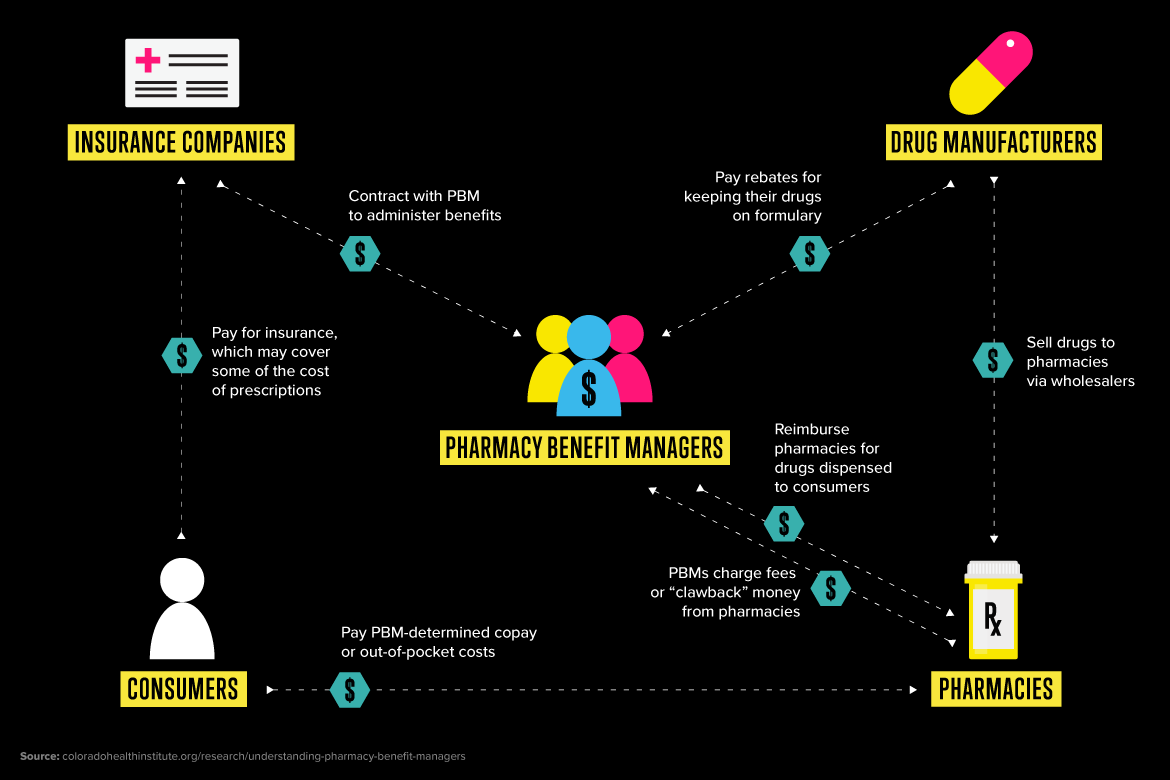
Pharmacy benefit managers (PBMs) manage prescription drug plan (PDP) benefits for insurers and/or employers. PBMs are “middlemen” in the prescription drug supply chain. PBMs were established in the 1960s to help insurers control prescription drug spending and manage benefits. Consolidation and vertical integration in the PBM market have raised concerns about the potential for reduced competition and higher prescription drug prices.
Their primary functions include:
- Negotiating rebates and discounts with drug manufacturers
- Managing drug formularies
- Assembling retail pharmacy networks
- Processing and adjudicating pharmacy claims
- Designing drug benefits
- Conducting utilization management (e.g., prior authorization, step therapy)
Learn more about PBMs and their role in drug pricing at TruthinRX.
Why can PBMs be controversial?
While PBMs can help control drug spending, they can also lessen competition. Low competition can lead to:
- High prices paid by insurers for PBM services.
- Incomplete rebate pass-through: Negotiated rebates may not be fully passed through to consumers.
- Higher insurance premiums.
- Lower reimbursement to pharmacies.
In addition, vertical integration of insurers and PBMs can lead to unintegrated insurers losing access to PBMs or obtaining smaller rebates than integrated insurers, which can put upward pressure on premiums.
What is the AMA doing about PBMs?
Conducting research
Using 2022 and 2024 data on prescription drug plan (PDP) lives and the pharmacy benefit managers (PBM) used by insurers to perform five PBM functions, an AMA study titled Competition in Pharmacy Benefit Manager Markets and Vertical Integration with Insurers: 2026 Update (PDF) assesses competition in PBM markets and the extent of vertical integration between insurers and PBMs. It also assesses competition in PDP insurance markets.
Key findings include:
- The four largest PBMs collectively had a 75% share of the national PBM market in 2024—up significantly from 70% in 2022.
- The vast majority (94%) of PBM markets across PDP regions were highly concentrated (HHI>1800) in 2024—up from 82% of markets in 2022.
- Across PDP regions, PDP insurance markets are highly concentrated on average, with HHIs of 2578 in commercial markets, 2406 in Medicare Advantage PDP markets, and 2214 in standalone PDP markets.
- In 2024, 69% of PDP lives at the national level were covered by an insurer that is vertically integrated with a PBM—down from 72% in 2022.
Advocacy
- 8 wins for doctors, patients in latest federal budget deal: Targeted pharmacy benefit manager (PBM) reforms introduced to enhance transparency, curb abusive Medicare drug rebate practices, and strengthen enforcement against anticompetitive behavior. These provisions represent tangible progress toward lowering prescription-drug costs and improving fairness in the drug supply chain for patients and physicians. Learn more with this Leadership Viewpoints column, “Unchecked power in PBM industry puts patients at risk of harm,” by AMA President Bobby Mukkamala, MD.
- Stay current with PBM reform by visiting TruthinRX, an AMA grassroots advocacy campaign. This campaign explores common PBM practices, current events, and patient stories related to drug price transparency.
Supporting PBM reform
The AMA wrote letters to Congressional sponsors in support of the Pharmacy Benefit Manager Reform Act of 2025 (HR 4317) (PDF) and to the administrator of the Center for Medicare & Medicaid Services—Dr. Oz—in response to a request for information (PDF) on Pharmacy Benefit Manager Compensation and Data Collection (CMS-4218-NC).
Council on Medical Service reports
- CMS Report 5-A-19: The Impact of Pharmacy Benefit Managers on Patients and Physicians (PDF)
- CMS Report 05-A-23: Prescription Drug Dispensing Policies (PDF)
- Report 6-A-24: Economics of Prescription Medication Prior Authorization (PDF)
- CMS Report 6-A-25: Prescription Medication Price Negotiation (PDF)
- CMS Report 3-A-26: Improving Patient Access to Pharmacies and Medications in Pharmacy Deserts (PDF)
- CMS Report 5-A-26: Inclusion of Discounted Prescription Medication in Patient Cost-Sharing (PDF)
Policy briefs
- Prescription Drug Pricing & Cost Transparency (PDF)
- Mandatory White Bagging and Brown Bagging Policies Threaten Patient Access to Care (PDF)
As PBMs increasingly act in their own self-interest without transparency or accountability, drug prices rise and patients face health risks from cost-prohibitive drug treatments. The AMA’s analysis is intended to provide insight to help policymakers understand the anticompetitive conditions in the PBM market that can result in harm to patients. The AMA fully supports greater transparency and accountability that is needed to prohibit PBMs from engaging in opaque and harmful business practices.
—AMA Immediate Past President Bobby Mukkamala, MD, on the harm of PBM markets for patients.
Explore other AMA resources on PBM markets and reform
- Competition in health care research
- JAMA Health Forum™: Pharmacy Benefit Managers: History, Business Practices, Economics, and Policy
- AMA Ed Hub™: The History, Economics, and Policy Context of Pharmacy Benefit Managers
- JAMA Health Forum™: Use of and Steering to Pharmacies Owned by Insurers and Pharmacy Benefit Managers in Medicare



