As a medical student, do you ever wonder what it’s like to specialize in obstetrics and gynecology? Meet Nariman Heshmati, MD, an obstetrician-gynecologist and a featured physician in the AMA’s “Shadow Me” Specialty Series, which offers advice directly from physicians about life in their specialties. Check out his insights to help determine whether a career in obstetrics and gynecology might be a good fit for you.
The AMA’s Specialty Guide simplifies medical students’ specialty selection process, highlight major specialties, detail training information, and provide access to related association information. It is produced by FREIDA™, the AMA Residency & Fellowship Database®.
Learn more with the AMA about the medical specialty of obstetrics and gynecology.
“Shadowing” Dr. Heshmati
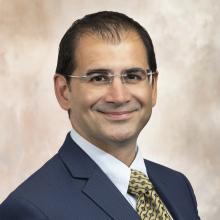
Specialty: Obstetrics and gynecology.
Practice setting: Multispecialty group practice.
Employment type: Employed at Lee Health in Fort Myers, Florida. Lee Health is part of the AMA Health System Member Program, which provides enterprise solutions to equip leadership, physicians and care teams with resources to help drive the future of medicine.
Years in practice: 16.
What the specialty of obstetrics and gynecology is: I think of ob-gyn as one of the most unique but also comprehensive specialties in medicine. Ob-gyns are surgeons, specialists and primary care physicians wrapped in one and provide care throughout a very large continuum of a woman’s life. That care may start with contraceptive counseling in adolescence, evolve to pregnancy care later in life, perhaps include surgical management of conditions such as fibroids, and end with management of menopause. It’s one of the few fields that allow you the privilege of providing care for someone through multiple transitions of life—or to subspecialize and focus on one.
A typical day and week in my practice: My schedule is a bit different than many ob-gyns because I’ve moved into a leadership role as chief physician executive of my group, Lee Physician Group, where I help support our 1,400 clinicians providing care at over 100 outpatient sites throughout Southwest Florida.
Prior to this, each week was very different. Some days I was in clinic seeing patients—and the variety of patients is immense since it could be a pregnancy, a surgical consult or a procedure. Other days I would operate and do hysterectomies, tubal ligations, or endometrial ablations.
There were also days when I took obstetrics call. For me, that was 24 hours in the hospital managing the laboring patients. It sounds like a long time to be in the hospital—and it is—but it’s also very rewarding. You start to know the nurses really well and they become close friends. Day shift and night shift have distinct cultures that you get to witness. You also get to eat lots of food from the different potlucks.
The most challenging and rewarding aspects of obstetrics and gynecology: The most challenging aspect is when there is an adverse event like a miscarriage. In obstetrics and gynecology, you really get to know your patients well. You care for them through multiple pregnancies and see children who you have delivered grow up. When a difficult event like a miscarriage occurs, you share in that pain with your patient.
The most rewarding aspect is helping a woman through a successful pregnancy. I’ve had patients who have struggled with infertility because of endometriosis or polycystic ovary syndrome, and we work together to develop a plan to help them achieve a pregnancy. The look on a woman’s face when she holds her newborn for the first time is something impossible to describe and immensely rewarding to witness.
The impact burnout has on obstetrics and gynecology: The topic of burnout has been something we have all been concerned about and discussing for many years. I was really concerned at the peak of the COVID-19 public health emergency when the AMA survey noted that 62.8% of physicians were experiencing at least one symptom of burnout, the highest ever noted.
That number has, fortunately, come down, but burnout remains a real issue among ob-gyns. In 2021, a study of ob-gyns found that burnout among us was in the middle to upper one-third of all medical specialties.
While being an ob-gyn is extremely rewarding, if the practice isn’t designed to provide the level of support needed, then the long hours, challenging clinical scenarios and lack of work-life balance can take a toll. This is especially an issue when you realize that the average age of an ob-gyn in the U.S. is 51 and we have a significant shortage with many counties around the nation lacking access to ob-gyns.
How Lee Health is reducing physician burnout: Something I am really proud about is how Lee Health has tackled the issue of burnout head on and made physician well-being a priority. Last year, we created a leadership role of clinician wellness and dove right into developing mentoring and support programs.
We also recently signed on to do the AMA’s Organizational Biopsy® to identify any places we should further focus our efforts. We also made a commitment to our clinicians that we would look at all aspects of their practice—compensation, administrative burden, support staff, work-life balance—and design a system where they want to stay and be able to focus on providing the highest level of care.
We rolled out augmented intelligence (AI) scribes to reduce charting times, are trialing over 40 different technology and AI solutions to support clinical practice, and have started virtual drop-in office hours for our leadership to hear directly from our front-line physicians. To highlight our level of commitment, every single physician at Lee Physician Group has my personal cell phone number and is encouraged to reach out with concerns. We all entered medicine to take care of patients, but we also know we need to take care of each other.
How my lifestyle matches, or differs from, what I had envisioned: I always knew that obstetrics and gynecology was a hardworking specialty. I saw this as a medical student and later in my residency, so I was prepared to not have much of a work-life balance. However, the specialty has changed to be much more family-friendly—as has much of medicine.
We now have laborists who reduce our call burden and there is a strong push to improve work-life balance and reduce burnout. Today, two different ob-gyns may work completely different schedules based on their wishes and priorities and alter that as life circumstances change. For example, I have several colleagues who work part-time in order to have more time with their children and the system accommodates those needs well.
Skills every physician in training should have for obstetrics and gynecology but won’t be tested for on the board exam: You’ll be tested on your medical fund of knowledge, and, in residency, they will test your surgical skill. Both of these are important. However, there are other skills that are critically important for succeeding as an ob-gyn. You have to have empathy and truly listen to your patients. You need to work well in teams—you can’t do this alone. You have to know when to ask for help—whether that’s managing a labor or in a complex surgery. Sometimes you need to phone a friend.
One question physicians in training should ask themselves before pursuing obstetrics and gynecology: Do you want to truly bond with your patients? Some aspects of medicine are problem-oriented where someone comes in for an acute issue that needs to be addressed. Much of ob-gyn is about developing bonds with your patients and caring for them through different phases of life. You may provide contraception and STD counseling early in life and then help manage a pregnancy later and then operate on that same patient or discuss menopause.
I’ve cared for patients who then brought their daughters or mothers to me for care later. It’s really one of the amazing parts of ob-gyn—the connections with your patients. I see patients around town or their children at school functions. If you enjoy knowing your patients, this is the perfect specialty for you.
Books, podcasts or other resources every medical student interested in obstetrics and gynecology should be reading:
- Blueprints Obstetrics & Gynecology by Tamara L. Callahan, MD, PhD, and Aaron B. Caughey, MD. Dr. Callahan was one of my professors and this is an excellent concise source of information about obstetrics and gynecology.
- Te Linde’s Operative Gynecology by Victoria L. Handa, MD, and Linda Van Le, MD, is our go to source for gynecologic surgery.
- Obstetrics: Normal and Problem Pregnancies by Steven G. Gabbe, MD, et al. This is our go-to source for obstetrics.
I have autographed copies of all three on my shelf to this day.
Additional insights I would give to students considering obstetrics and gynecology: It’s a great specialty, and I would recommend it to anyone. If you are considering it, shadow an ob-gyn for a day. For most, after they are immersed in the specialty, they know that’s what they want to do. It’s a long road, so you really want to make sure it’s a good fit for you.
Obstetrics and gynecology also has many possible subspecialties. You can focus on obstetrics, high-risk obstetrics, urogynecology, minimally invasive gynecologic surgery, primary care, or infertility. There are almost endless possibilities. Make sure you explore all the options as you decide whether this is the specialty for you.