At a bustling Chicago Park District facility in the South Side neighborhood of Englewood last month, physicians, health system representatives, community organizational leaders and dedicated volunteers gathered at a Live Healthy Chicago event to share resources provide free BP checks and go into the community to build trust and awareness of the risks of high BP.
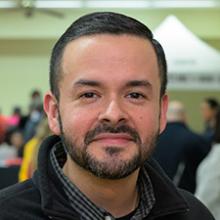
“In the busy day-to-day practice of clinic or hospital-based work, it’s easy to lose sight of some of the issues that affect patients outside of the hospital room and outside of the exam room,” said Octavio Vega, MD, an internist with Rush University Medical Center in Chicago. The South Side event and another similar one on Chicago’s West Side help physicians establish connections in the communities they treat, he noted. “Events like this bring us back to thinking about those [social determinants of health] factors that aren't necessarily right in front of us in the exam room, to really take those into consideration when we're treating folks who have hypertension or other cardiovascular diseases so that we can treat the patient holistically.”
Live Healthy Chicago represents “a multi-institutional effort to improve health outcomes, specifically cardiovascular health outcomes, on the South and West sides,” Dr. Vega explained, noting that heart disease is the No. 1 cause of death in those communities.
The project builds on existing infrastructure from dozens of organizations, with a list of collaborators including the AMA and a dual partnership helmed by the University of Chicago Medicine and the South Side Healthy Community Organization on the South Side, and Rush University Medical Center and Wellness West on the West Side.
Rush University Medical Center is part of the Rush University System for Health, which is a member of the AMA Health System Program that provides enterprise solutions to equip leadership, physicians and care teams with resources to help drive the future of medicine.
According to a 2023 Chicago Department of Public Health report, Black residents live 71.8 years on average. That compares with an average life expectancy of 81.3 years for white Chicagoans and 82.7 years for Latino Chicagoans. Live Healthy Chicago events get the message about the risks of high BP into the community, connecting people with existing resources and giving them an opportunity to get a free, quick BP check.
Patients need these low barrier to entry options in checking and monitoring their blood pressure, said David Ansell, MD, MPH, senior vice president for community health equity at Rush University System for Health and associate provost for community affairs at Rush University. Many patients have trouble getting to the doctor, whether they work a job that affords them paid time off or not. Dr. Ansell offered his own case as an example, saying that he recently discovered it had been some time since he had scheduled one of his own regular screenings.
“I don’t even have time to go to my own doctor—and I’m a doctor. I’m in the office,” noted Dr. Ansell, a primary care physician and author of County: Life, Death, and Politics at Chicago’s Public Hospital and The Death Gap: How Inequality Kills and co-editor of Community Health Equity: A Chicago Reader.
“Imagine you’re a working person. You have parents who are elderly, kids. You’re back and forth commuting. Your blood pressure’s up. You don’t have that much money. You have to pay $30 for parking. You go in, of course your blood pressure’s up in the office, and then they say: ‘Come back in a month.’ That’s no way to treat something like this.”
Hypertension: Deadly if untreated
Hypertension increases the risk of both stroke and heart disease, which are the country’s leading causes of death. The Centers for Disease Control and Prevention estimates that hypertension was a primary or contributing cause of more than 664,000 deaths in the U.S. in 2023.
Guidelines from the AMA and the American Heart Association, issued in 2025, reinforce the use of automated BP cuffs, the incorporation of team-based care and home monitoring, the early initiation of combination pills and acting rapidly when hypertension is discovered.
As part of the Live Healthy Chicago efforts to combat high BP in the community, its leaders have adopted the AMA MAP™ clinical framework to drive the clinical interventions.
MAP stands for the program’s three key components:
- Measure accurately.
- Act rapidly.
- Partner with patients.

Finding a way into the community
Dr. Ansell noted that in 27 of Chicago’s 77 neighborhoods, mortality from heart attacks and stroke can be as high as four times that of the other neighborhoods. Englewood, which has a predominantly Black population, is one of those 27 neighborhoods and has a 37.1% rate of hypertension, which is 5.2 percentage points higher than the city average, according to Live Healthy Chicago. In some community screenings, Dr. Ansell said, they have found that half of those willing to have their blood pressure measured wind up having high BP.
“It’s not enough just to be top in quality if we’re not really addressing the conditions under which people live, work, play and pray—but more broadly, the conditions that lead to better health versus poor health, which are oftentimes outside of the medical center,” Dr. Ansell said. “So, we set our sights on improving things broadly, across the ecosystem.”
Rush is also a founding member of West Side United, a collaborative working to ensure that communities on Chicago’s West Side can overcome social, economic and environmental barriers to staying healthy. The AMA also is a West Side United anchor mission partner, having invested $5 million in the effort since 2020.
There are three strategies to the Live Healthy Chicago effort, which include a campaign to increase public awareness of hypertension, mobile health efforts to get BP screening into the community using existing infrastructure, and clinical transformation to increase the use of best practices in diagnosing and treating hypertension.
As part of Live Healthy Chicago, community health workers are trained on accurate blood pressure measuring, as well as how to discuss the results with patients and train them to perform their own blood-pressure measurements.
The way forward on hypertension
Those kinds of efforts can help turn the tide on hypertension. To improve BP control in a population, “you need to have team-based care. It can’t just be the doctor anymore,” Dr. Ansell said. You also “need to have remote monitoring where people check their blood pressures at home and send them into clinic.”
He noted the benefit of lower BP, adding that even a small reduction of 5 mm Hg of systolic blood pressure is associated with a significant reduction of 10% in cardiovascular risk. For his part, Dr. Vega noted that events that come into communities with a history of being disinvested or underserved by limited access to health care can make the medical system feel more caring and approachable.
Given the injustices within the U.S. health system and outside of it “that some of our patients have experienced,” he said, it is understandable “that some patients may not be as forthcoming. There are certainly aspects of mistrust within folks in the community.”
He added that it is incumbent upon physicians “to take that into account as we’re counseling patients and as we're making recommendations, to make patients feel heard, to make patients feel like they have a true say in what their treatment plan is. That’s how patients feel heard, and that's how patients can feel like the physician's truly partnering with them.”
To help, the AMA offers a series of short, interactive CME modules and resources designed to help physicians and other health professionals quickly refresh and enhance their knowledge and skills on measuring blood pressure properly. The CME series, “AMA Measure BP Accurately,” is enduring material and designated by the AMA for a total of 1.50 PRA Category 1 Credit™.
The series is part of the AMA Ed Hub™, an online learning platform that brings together high-quality CME, maintenance of certification and educational content from trusted sources, all in one place—with activities relevant to you, automated credit tracking and reporting for some states and specialty boards. Learn more about AMA CME accreditation.