Hypertension and overall poor cardiovascular health are leading contributors to health problems among Black women in the U.S. But focused, coordinated programs—along with community outreach to connect individuals to these resources—can make a meaningful difference and advance progress toward health equity.
Release the Pressure is an innovative national campaign designed to amplify heart health messaging, centering Black women not only in its mission but also in its visual storytelling. The campaign is guided by the RTP Coalition, which includes the AMA, the AMA Foundation, American Heart Association, Association of Black Cardiologists, Minority Health Institute and the National Medical Association, all committed to advancing heart health equity.
More than 74,000 people have taken the Release the Pressure pledge to prioritize heart health. A panel discussion on the campaign and how it helps to target interventions where they are needed most was the focus of an education session at the 2025 AMA Annual Meeting in Chicago.
“One in three pregnancy-related deaths is due to cardiovascular conditions, and the burden falls disproportionately on communities of color—and particularly Black women,” said panel moderator Yolanda Lawson, MD, a Dallas-based ob-gyn, AMA member and the immediate past president of the National Medical Association.
“Black women are nearly 60% more likely to have high blood pressure than non-Hispanic white women and are more likely to develop it at younger ages,” Dr. Lawson added. “Approximately one in two Black women age 20 and older has some form of cardiovascular disease. And yet—despite this high burden—they're less likely to have their blood pressure under control, and more likely to experience complications from unmanaged hypertension, including maternal morbidity and mortality.”
She noted that these inequities “are not rooted in biological differences, but stem from some of the systemic factors,” including uneven access to quality care, the physiologic toll of chronic stress, structural racism and implicit bias within the health care system.
Learn how maternal access to care varies by where moms live and explore the AMA's advocacy to improve maternal health.
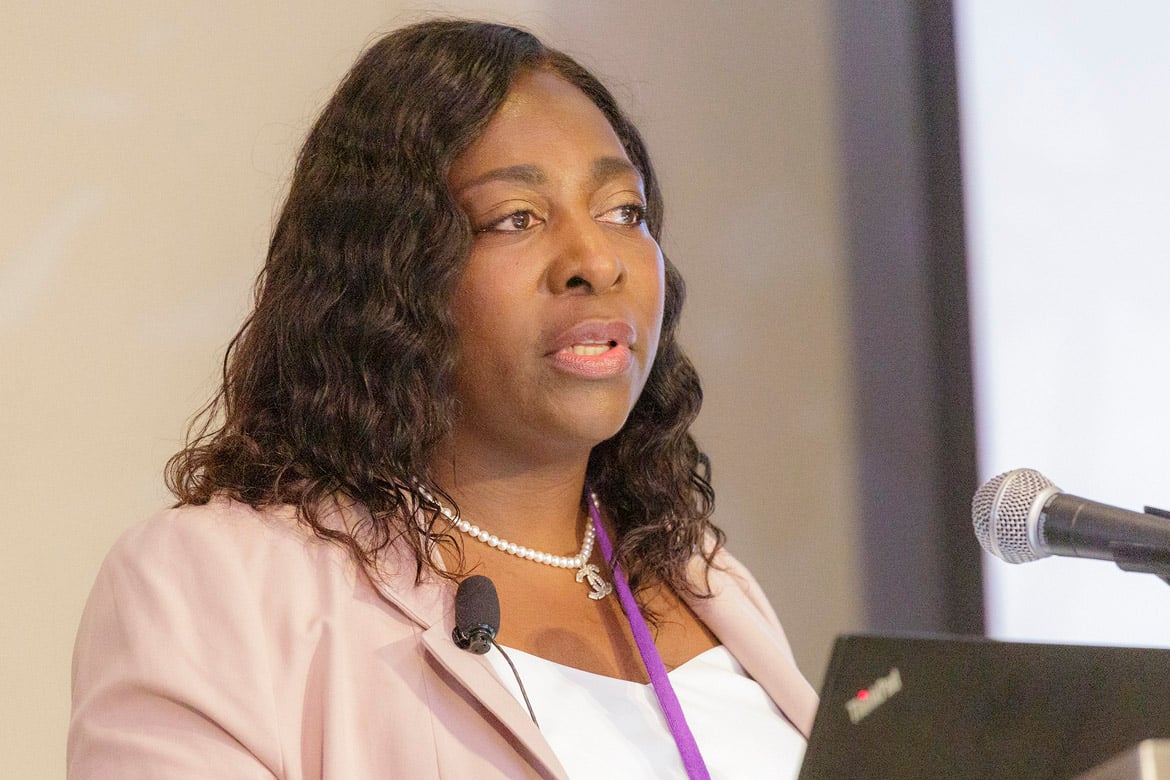
Untreated conditions raise concerns
An ongoing issue is that chronic conditions such as hypertension are going undiagnosed until pregnancy, said panelist and AMA member Diana Ramos, MD, MPH, an ob-gyn and California’s surgeon general.
“When we're talking about pregnancy and cardiovascular disease, oftentimes that's when the conversation starts, because many times—especially people of color—are not getting the well-visit exams that we should all be getting,” Dr. Ramos said.

Having an untreated chronic condition raises the risk of having complications during pregnancy, she explained.
“We are looking for different ways of providing the information to increase awareness and educate, because once you are aware, then you can take action,” Dr. Ramos said.
Building trust is vital
Another problem cited by Dr. Ramos was access to care, which can be exacerbated by the lack of access to a physician whom a patient trusts, or one who looks like them.
She noted how only 6% of U.S. physicians are Hispanic and less than 8% are Black.
But being of the same race or ethnicity does not automatically gain a patient’s trust, said panelist and AMA member Willie E. Lawrence Jr., MD, who recently moved to Dallas from Michigan.
“When I got to Benton Harbor, I thought that folks would love me because I'm a Black cardiologist and the city would embrace me—I was completely wrong,” Dr. Lawrence said. “They didn't trust the hospital system I was at because it hadn't provided quality care for decades, and they didn't trust me because I chose to be a part of that health care system.”

Dr. Lawrence added that working to develop trust in a community allows physicians and health systems to provide better and more inclusive care.
Trust was also brought up by another cardiologist on the panel, Richard Allen Williams, MD, a founder of both the Minority Health Institute and the Association of Black Cardiologists. An AMA member, Dr. Williams is also a former president of the National Medical Association.
Dr. Williams, who noted that he was “approaching 90 years of age,” said he had a long-term perspective on the issues being discussed. He noted that the AMA “was not always the best supporter of civil rights.”
“Suffice it to say that there's this big elephant in the room right now in regard to whether the AMA is the trustworthy body to be taking a stand in regard to health equity?” Dr. Williams said. “And these days, my answer is: Absolutely, yes.”
He added that “we are proud to have the AMA not only to initiate, but to be behind, Release the Pressure.”
The campaign stresses community outreach—an activity that will help develop trust in the AMA and physicians in general, he said.
“In doing that, we will engender more trust in what we do as members of the medical profession in carrying out our duties to bring the best possible health care to all people, and especially those most in need,” Dr. Williams said.
AMA MAP™ Hypertension is an evidence-based quality improvement program that provides a clear path to significant, sustained improvements in BP control. With the AMA MAP program, health care organizations can increase BP-control rates quickly. The program has demonstrated a 10% increase in BP control in six months with sustained results at one year.
Ongoing commitment
The forum opened and closed with AMA leaders declaring that the nation’s oldest and largest physician organization remains committed to achieving health equity, which AMA policy defines as “optimal health for all.”
“As an organization, we reaffirmed our commitment to this work last year as part of the 2024–2025 AMA Organizational Strategic Plan to Advance Health Equity,” said AMA President Bobby Mukkamala, MD. “And we do this for one simple reason: We need to work to close the gaps in the health of our country.”
Dr. Mukkamala noted that the AMA strategy includes developing a more diverse physician workforce, influencing social drivers of health, and voicing and modeling a commitment to health equity.
“Approaching our work based on this policy is particularly important when it comes to chronic diseases such as hypertension and maternal health,” he said. “Maternal mortality rates, particularly for Black women, continue to rise at alarming levels.”
This work includes detecting the early warning signs for lifelong health complications and premature death from heart disease, diabetes and obesity.
“This focus and this approach are critical at this pivotal moment in health care,” Dr. Mukkamala said. “Not only are we seeing widening health inequities, but we continue to see attacks meant to stall and dismantle our efforts to create a culture of equity and inclusion within medicine.”
That’s why collective efforts such as Release the Pressure are essential to moving towards more equitable solutions, Dr. Mukkamala said, adding that “our collective advocacy is necessary to maintain these commitments.”
Learn more about the AMA Center for Health Equity and catch up with the other highlights from the 2025 AMA Annual Meeting.
Editor's note: A previous version of this article included incorrect caption information for the photo of Dr. Lawrence. The AMA regrets the error.
Stay updated on the fight for optimal health for all.