Sanford Health has built a physician well-being program focused on relationships and collective responsibility that has produced positive results culturally, emotionally and financially. Robust and genuine connections have been carefully nurtured to help keep their more than 4,000 physicians and other health professionals throughout the Midwest healthy and happy, on and off the job, for five years now.
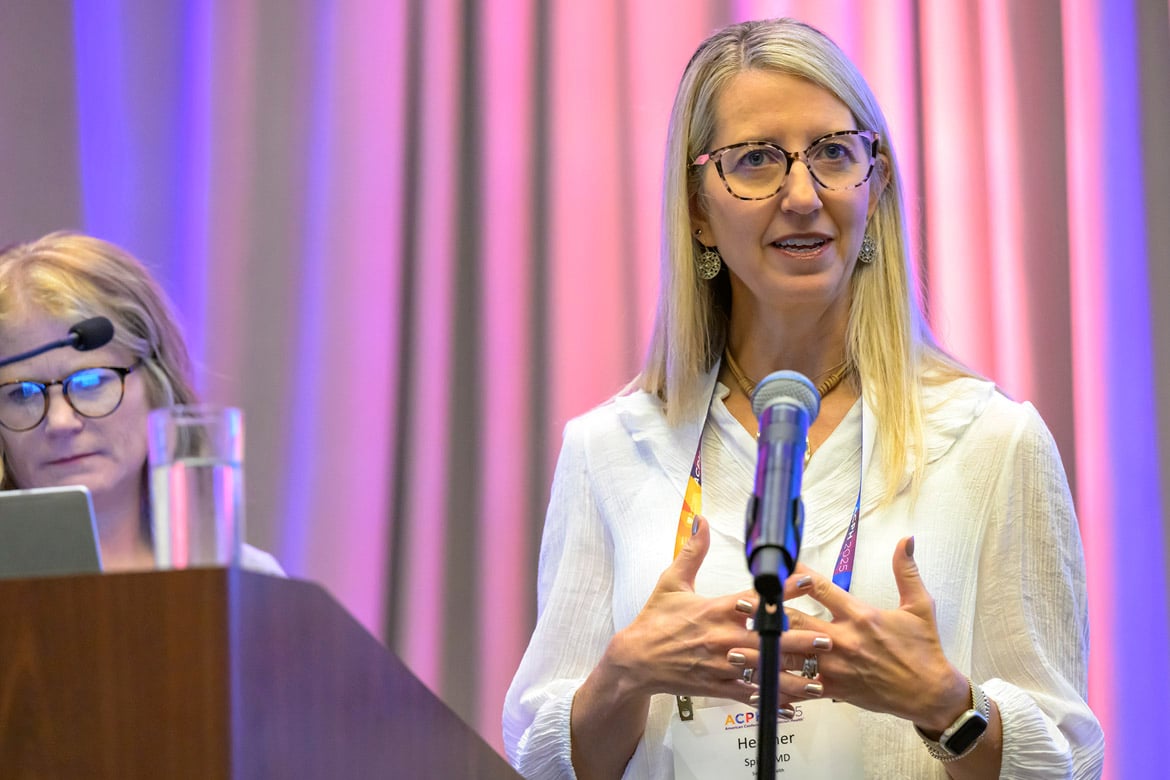
“We built our Clinician Experience and Well-Being program with great intention and firmly grounded in relationships,” Heather Spies, MD, an ob-gyn and physician director of clinician experience and well-being at Sanford Health, said during a presentation at the 2025 American Conference on Physician Health™ in Boston.
“That has been critical in our ability to truly support well-being throughout our organization,” said Dr. Spies, who is also member-at-large for the AMA Integrated Physician Practice Section.
Dr. Spies and Aaste Campbell, enterprise director of clinician experience at Sanford Health, discussed the development, evolution and success of the Sioux Falls, South Dakota-based organization’s approach to improving well-being through a leadership program.
Sanford Health is part of the AMA Health System Member Program, which provides enterprise solutions to equip leadership, physicians and care teams with resources to help drive the future of medicine.
Structured growth
Core components of the well-being program at Sanford Health is the Clinician Well-Being Council—made up of volunteers from across the system—and their Reaching others, Innovating and making an impact, Strategizing to support and sustain the organization, Elevating and empowering others, Serving our colleagues and communities (RISES) leadership development program, which identifies and develops potential leaders.
Through the Clinician Experience & Well-Being program, Sanford Health has created a feedback loop that motivates physicians and their care teams to stay engaged, knowing that their work is acknowledged, respected and appreciated.
The program’s beginnings were modest. A physician leader established an Office of Physician Practice in Fargo, and the appointment of Sanford’s first clinic president in 2019 drove the momentum to replicate it systemwide. Campbell set about obtaining buy-in to support expansion of the model in two of Sanford Health’s four markets.
“We began strategizing around building our program, always keeping in mind that the clinician is at the center of everything we do, and that one size does not fit all,” Campbell said. “We set about investing with intention to building relationships across the markets and break down silos.”
That focus reorganized isolated efforts into a single, coordinated, relationship-centered effort, and that strategic framework has been central to the program’s success.
As the leader in physician well-being, the AMA is reducing physician burnout by removing administrative burdens and providing real-world solutions to help doctors rediscover the Joy in Medicine®.
Checking in
A key part of the Clinician Experience and Well-Being program is annual 30- to 60-minute check-ins with physicians and other health professionals.
“These are scheduled, protected times for each physician and their direct leader, who is usually the department chair,” Campbell explained. “We know that physician engagement and satisfaction is directly correlated to that relationship.”
But there was some uncertainty early on.
“Some wondered at first if this was going to be just one more thing on their plate,” Dr. Spies said. “But leaders kept showing up, listening and responding. Just sitting down, asking thoughtful questions and really listening made people feel seen and heard.”
What began as informal, personal conversations have evolved into a more intentional practice. Certain questions became standardized over time, and leaders received training to listen without judgment or rushing to solutions.
“It’s time that is set aside to specially recognize the clinician’s role, their victories and contributions, and address any concerns they have,” Campbell said. “Finding the pebble in their shoe, so to speak.”
Once it was understood that the check-ins were not evaluations but time for honest and constructive dialogue, trust was established in the knowledge that the purpose is not scrutiny but support.
The standard of care in physician well-being recognition
Institutions in this article have been honored by the Joy in Medicine® Health System Recognition Program.
Developing potential
“To truly support clinicians, we have to mobilize our collective strengths,” Dr. Spies said. “We believe we have done this through our RISES Leadership Program.”
Every year RISES selects 30 physicians and other health professionals who demonstrate their potential to become effective leaders. The program addresses all aspects of leadership and medicine with a consistent emphasis on well-being. In fact, every session begins with a well-being check-in for each member of the cohort.
The curriculum combines classroom learning with mentoring, coaching and relationship-building exercises. Now in its third cohort, the groups from the first two cohorts have implemented impact projects across Sanford Health’s regions designed to elevate workplace culture and overall well-being, as well as to create opportunities for physicians to network, establish, build and strengthen relationships.
By helping participants translate classroom lessons into systemwide initiatives, RISES ensures that leadership growth is not just a lofty goal, but a realistic outcome directly derived from improvements in consistent practices.
Dr. Spies recounted a recent conversation with a Sanford Health physician about the impact the program had on her, noting that “throughout her time in RISES she strengthened her leadership skills, developed new personal and professional relationships, and built a network of deep and meaningful relationships with fellow clinicians.
“She has leaned into those relationships and came out leading, thriving, and doing amazing work, both locally and nationally,” she added.
Real ROI
Thoughtful investment in relationships that support well-being has driven positive metrics, and Sanford Health’s Clinician Experience and Well-Being program has produced real and measurable results. An engagement survey conducted every May, pulse surveys in December, and a biannual AMA Organizational Biopsy® show steady progress.
Physician engagement is trending upward, job satisfaction has increased, stress has declined, intent to leave is down, burnout has dropped from 50.3% to 36.5% since 2022, and Sanford Health’s physician turnover rate has decreased significantly.
The financial metrics are also impressive.
“The estimated financial impact of physician turnover has dropped dramatically,” Dr. Spies explained. “In 2022, the potential cost was $59 million a year. Today it’s closer to $32 million, a savings of about $27 million annually that translates to roughly 34 fewer physicians leaving.”
Use the AMA STEPS Forward® “Organizational Cost of Physician Burnout” calculator to uncover the cost at your organization.
The rising tide
“A rising tide only lifts boats that are seaworthy,” Campbell said. “Every boat has a different size, shape, and purpose. What’s under the waterline, where the boat meets the water, is unseen. If it’s cracked, neglected, or weighed down, it won’t float, not even in high tide. It may even sink.”
For Sanford, the work of well-being means addressing hidden burdens, or what Campbell called the “quiet struggles we all carry,” and providing the support that keeps every provider at Sanford Health afloat in job satisfaction through well-being. That support has been built through a culture of relationships throughout all departments, roles and markets.
“Continuing to invest in relationships and well-being is a collective responsibility,” Dr. Spies said. “When we work to promote relationships and build a foundation for sustainable support, we’re advocating for systems that prioritize well-being, and we hold ourselves and our organization accountable.”
Mark your calendars—the next American Conference on Physician Health takes place October 14–16, 2027 in National Harbor, Maryland.