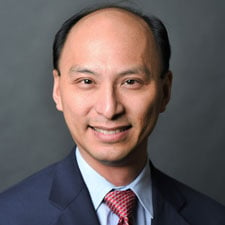
Even longer than he’s been practicing allergy and immunology, Tao Le, MD, has been founding and growing medical education businesses. His most recent venture, ScholarRx, a digital authoring and learning platform, has been a going concern since 2004. It now includes nearly one-third of U.S. medical schools as customers.
From that, you might think he’s a natural-born entrepreneur. But in some ways, he doesn't even consider himself one.
“I never actually intended to be an entrepreneur,” Dr. Le said. “I wanted to be a doctor, of course. That’s what led me to medical school. But along the way, I became an accidental educator.”
A native of Vietnam who fled the fall of Saigon with his family when he was just 4 years old, he had no entrepreneurial lineage—his father and mother were a physician and a pharmacist, respectively—but he had a broad education from Centre College, a national liberal arts college, and developed a strong sense of curiosity.
So when he was a medical student in the early 1990s and was asked to write a series of articles about Asian Pacific cultural issues for the university’s newspaper, he thought: Why not? I'll try my hand at journalism.
“I discovered that I really enjoyed writing, and then they asked me to be the editor of the paper. Eventually, I had 35 beat writers, two full-time employees and a quarter-of-a-million-dollar budget. We were pumping out eight- to 12-page tabloids on a weekly basis,” he said.
Then some fellow students came to him with an idea: They were trying to put together a board book for the United States Medical Licensing Exam (USMLE) Step 1. Would he be willing to help by being the lead student editor?
“I said sure, I can help out,” he remembers. “And that book just blew up.”
First Aid for the USMLE Step 1, now published by McGraw Hill, became a global bestseller in just a few years. It’s now in its 36th edition, and it is one of the gift options for medical students who become AMA members.
Physicians, residents and medical students interested in healthcare entrepreneurship and business leadership should consider attending the AMA Physician Entrepreneur Forum Aug. 7–8 at the AMA headquarters in Chicago. The event will feature healthcare leaders who have built successful businesses, practices and ventures. Learn more and register now.
Going big time
Pretty soon, Dr. Le and his colleagues had founded their own book company and published a successful series of medical education texts. They then took their ideas online and raised $12 million in venture capital funding during the dot-com boom, as well as about twice that number after the dot-com bubble burst by pivoting to pharmaceutical and medical device training and communications.
Fast forward to 2004, and, having left his startup to do his allergy/immunology fellowship and a master’s in health sciences, he returned to Kentucky to join his father's allergy practice and take a part-time medical school faculty position at the University of Louisville. But he was restless.
“I enjoy the scientific rigor of the academic world, but it can move slowly,” he said. “I really wanted another shot at doing something revolutionary in digital medical education. That's where my passion was.”
So while working those two jobs, he founded ScholarRx, an innovative curriculum and medical education platform. Years later, ScholarRx would be backed by Health2047, a Silicon Valley venture studio the AMA created in 2016 that builds and backs early-stage healthcare companies. The goal of Health2047 is to make a meaningful and measurable impact on healthcare by 2047—the AMA’s 200th anniversary. It invests in three strategic pillars: data, chronic disease and productivity.
Building on the success of his earlier work, the company focused at first on test preparation, creating question banks, videos and digital flashcards. Today, it also has a library with hundreds of customizable “bricks”—high-yield, interactive modules that explore topics with simple explanations, clinical correlations and real-world stories, most of which take less than 20 minutes to complete.
ScholarRx has helped train more than 1 million medical students worldwide, Dr. Le estimated. Over 100,000 learners on six continents do some 70 million activities on the platform annually.
In addition, the company has a strong social mission, reflected in the open-access side of its business in collaboration with the World Health Organization and the U.N. Educational, Scientific and Cultural Organization (UNESCO). Outside educators have built more than 3,000 open-access modules on ScholarRx, and those are usable by everyone, everywhere.

Challenges to anticipate
Dr. Le doesn’t just want to see his business succeed; he wants to share some of the secrets of his success with other physicians to support their ambitions to find and fund new ways to push the art and practice of medicine forward. After all, entrepreneurship is simply an extension of medicine’s broader mission of service.
At the top of the list are the many ways physician entrepreneurs can run into trouble getting their ideas off the ground.
“One of the biggest challenges is that people may not believe your idea, or they don't believe in you,” Dr. Le said. “That could be from colleagues, who may wonder: Why are you leaving a perfectly good job? Or it could come from family or spouse. I'm fortunate because by the time I started ScholarRx, I already had a successful book business.”
Another, which is unique to businesses like his that have a social mission, is creating something that can compete with all the other commercial products and services out there.
“Double-impact companies have a higher bar to clear because you're trying to do well by doing good,” he said.
Where to look for help
Fortunately, there are lots of resources available to aspiring physician entrepreneurs, Dr. Le noted, starting with people who disagree with you about what to do.
“I've always been a big fan of Abraham Lincoln’s ‘team of rivals’ model. I love getting opinionated, smart people who've really done things to advise me. Sometimes we almost get into shouting matches with each other, but having strong opinions allows you to compare and contrast ideas,” he said.
He has a handful of other favorite resources—ones that align closely with scientific and evidence-based thinking.
One is the Business Model Canvas, which helps entrepreneurs think through how a business creates value, serves its customers and sustains itself financially.
Another is a book called The Lean Startup: How Today's Entrepreneurs Use Continuous Innovation to Create Radically Successful Businesses, by Eric Ries.
“It's all about the scientific method. You have a business hypothesis about how the world works and how you can make positive change in the world profitably,” he said. “Then you are essentially running experiments, and with every experiment you run, you collect data, you analyze the data and then you decide whether you need to refine or pivot the model.”
A third is the Lean Launchpad, an entrepreneurship methodology created to test and develop business models based on querying and learning from customers.
“The basic idea is: It doesn’t matter how good your tech is or how good your product is,” he said. “If you don't truly understand the needs of the customer, you’ll ultimately fail. You have to get out of the building and do intensive customer discovery.”
Lastly, he recommends taking a formal course in entrepreneurship. He took one when he was with his first startup.
“It was a six-month course. It taught me a lot of the basics—the language, the vocabulary, the methodology,” he said.
Three core pieces of advice
Dr. Le knows physicians with business ideas may wonder what they most need to know. He advises keeping these three things in mind:
Start with a problem you have experienced. “You become your own focus group,” he said.
Protect your vision, but remain flexible. “Be willing to be proven wrong, and admit if you're wrong,” he said. “Then pivot as necessary.”
Think first about mission, not money. “Keep your eye on continuously adapting the value proposition until you reach a tipping point where things then take off,” he said.