If you’re preparing for the United States Medical Licensing Examination® (USMLE®) Step 1 exam, you might want to know which questions are most often missed by test-prep takers. Check out this example from Kaplan Medical, and view an expert video explanation of the answer. Also check out all posts in this series.
This month’s stumper
An investigator is evaluating the effects of new synthetic drugs on arteriolar resistance. Drug X maximally increases vascular resistance by 50 percent at a dose of 20 mg per mL. Drug Y maximally increases vascular resistance by 75 percent at a dose of 40 mg per mL. Which of the following conclusions can be drawn from this study?
A. Drug X has a smaller volume of distribution than drug Y.
B. Drug X has a shorter half-life than drug Y.
C. Drug X is less efficacious than drug Y.
D. Drug X is less potent than drug Y.
E. Drug X has a lower LD50 than drug Y.
The correct answer is C.
Kaplan Medical explains why
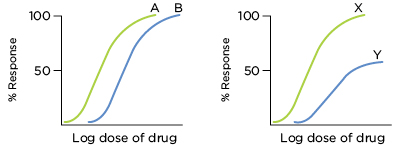
The only conclusion that can be drawn from these data is that Drug X is less efficacious than Drug Y. Efficacy is defined as the maximum effect that can be produced by a drug, regardless of dose. Drug X can produce only a 50 percent change in resistance, whereas Drug Y can produce a 75 percent change in resistance. Therefore, Drug X is less efficacious than Drug Y.
In the figure below, Drug X has a greater efficacy than Drug Y because it produces a larger effect. Drug A is more potent than Drug B because less drug is required to produce a given response.
Why the other answers are wrong
Choice A: A volume of distribution is a hypothetical volume of body fluid that would be required to dissolve the total amount of drug at the same concentration that is found in the blood.
Choice B: The half-life is the time it takes for the concentration of a drug to decrease 50 percent from its previous measurement. There is no information given to determine half-life.
Choice D: The potency is the dose or concentration required to produce 50 percent of the drug's maximal effect. We cannot determine the potency of Drug Y from this question.
Choice E: The LD50 is the dose that causes death in 50 percent of a population of subjects. The experiment described does not involve a population study, and it does not give any indication about the toxicity of the drug.
Tips to remember
- The efficacy of a therapeutic agent is related to its ability to produce a desired effect.
- Efficacy is not related to the agent's affinity for its target.
For more prep questions on USMLE Steps 1 and 2, view other posts in this series.