If you’re preparing for the United States Medical Licensing Examination® (USMLE®) Step 2 exam, you might want to know which questions are most often missed by test-prep takers. Check out this example from Kaplan Medical, and read an expert explanation of the answer. Also check out all posts in this series.
A 41-year-old man with a long history of schizophrenia has been in the inpatient unit for almost two weeks. This is his third admission in the past six months, and each time he seems to be less responsive to treatment. In the past, he has been on first generation antipsychotics. Recently he has been taking a second-generation antipsychotic agent, risperidone, with limited success. His family is supportive and makes sure he takes his medication.
Given his most recent poor response, which of the following is the most appropriate next step in treatment?
A. Clozapine.
B. Droperidol.
C. Electroconvulsive treatment (ECT).
D. Lamotrigine.
E. Paliperidone.
The correct answer is A.
Kaplan Medical explains why
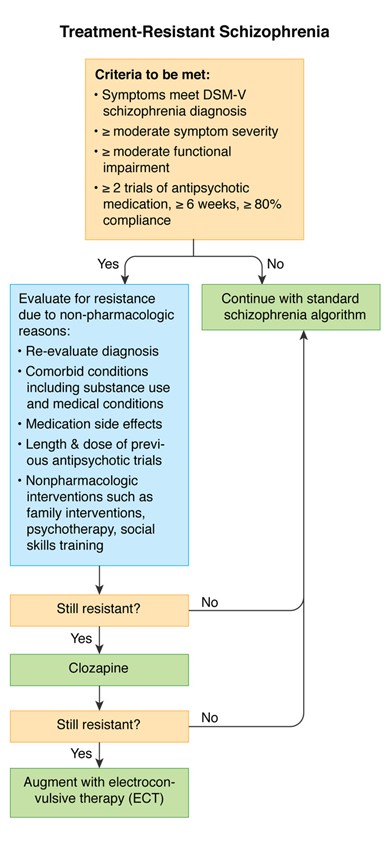
Clozapine is a second-generation antipsychotic agent. It is indicated for patients with treatment-resistant schizophrenia and is effective in 30% of these patients within the first six weeks. Clozapine exerts an antagonistic effect on D1 and D4 receptors, as well as on the alpha-adrenergic, histaminergic, serotonergic and cholinergic systems. It can produce troublesome side effects, the most significant of which is agranulocytosis.
Clozapine requires regular complete blood count (CBC) monitoring because of this serious but rare side effect. This patient’s family is supportive and thus is likely to bring him in for regular CBCs.
What is the question asking?
The question is asking for the most appropriate next step in the treatment of this patient.
Evaluate the clinical vignette
- 41-year-old male patient with treatment resistant schizophrenia necessitating three admissions over the past six months