As a medical student, do you ever wonder what it's like to specialize in family medicine? Meet AMA member Ammar Husan, MD, a family medicine physician and a featured doctor in the AMA's “Shadow Me” Specialty Series, which offers advice directly from doctors about life in their specialties. Check out his insights to help determine whether a career in family medicine might be a good fit for you.
The AMA's Specialty Guide simplifies medical students' specialty selection process by highlighting major specialties, detailing training information and providing access to related association information. It is produced by FREIDA™, the AMA Residency & Fellowship Database®.
Learn more with the AMA about the medical specialty of family medicine.
“Shadowing” Dr. Ammar Husan
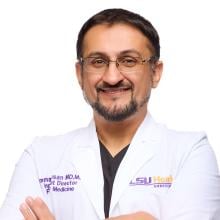
Specialty: Family medicine.
Practice setting: Academic medical center.
Employment type: Practices at Ochsner LSU Health in Shreveport, Louisiana, and is an assistant professor of family medicine at LSU Health Shreveport. Ochsner Health is part of the AMA Health System Member Program, which provides enterprise solutions to equip leadership, physicians and care teams with resources to help drive the future of medicine.
Years in practice: Five.
A typical day and week in my practice: No two days are the same. That’s the beauty of family medicine. Some mornings, I'm rounding on inpatients in the hospital, teaching residents how to manage complex cases. Other mornings, I'm in clinic, seeing everyone from newborns to seniors, switching from managing chronic conditions to delivering acute care. It's like a box of chocolates, you never know what you're going to get—that's what I tell my students when they start out.
With all that, there's teaching going on in the hallways and during precepting sessions. My day is full, but variety is what keeps me energized. Everybody's workweek hours are different. My typical week blends clinical care, teaching and administrative leadership. So about two and a half to three days a week, I'm in outpatient clinic, and I have medical students and residents who rotate with me, and I also have inpatient service blocks. These are where I'm helping or teaching the hospital team. We're managing admissions, and we're coordinating complex care for these patients.
Then I have administrative time. This is where I'm developing or improving on curriculum development, doing faculty development and having mentoring sessions between my medical students or my residents.
And then I have my leadership duties, because I'm the program director of the rural medicine tract, as well as the clerkship director, so I'm overseeing the operations in the background of both of these different programs. So, on average, I'm working 50–55 hours a week. Because it's academic medicine, you have your peaks and valleys.
The most challenging and rewarding aspects of family medicine: With the broadness of family medicine, you're typically the first contact for nearly any health issue that your patients might have. Sometimes you're the safety net that the patient needs. So, you have to balance their big picture with the realities of the resources you have, as well as with the expectations that patients have. All this can be challenging, because of different issues the patient might present with, such as social determinants of health—maybe transportation, financial aspects, a lot of different things. Insurance gaps make things more challenging, too.
In the rural setting, we often face limited access to specialty care. So, we have to be creative about how we use resources. Being creative is really essential when it comes to rural medicine.
I'll give you one word that sums up the whole reward: relationships. You're not just treating conditions. You care for people across their lifespans. I've delivered babies, cared for parents, seen grandparents, all in the same family. That longitudinal connection is deeply fulfilling to me. That's one thing that I really admired about the family doctors who I worked with. Lifespan care develops trust, and that trust, that rapport, that connection I have with my patients—I wouldn't trade that for anything.
The impact burnout has on family medicine: Burnout is a real thing. You’re pushed and pulled in so many different ways. You have to be able to balance high patient loads and electronic medical records. There's also emotional turmoil that is part of healing patients and getting everything you need for them. Doctors are people, too. It doesn't matter if you're a surgeon or if you're in family medicine or internal medicine or pediatrics. You have to be able to balance things out and deal with both the medical and social aspects.
How Ochsner Health is reducing physician burnout: Ochsner LSU Health is really good at dealing with different aspects of burnout. We have a lot of well-being initiatives. We have peer support networks, mindfulness workshops and counseling. For our residents and for our clerkship teams at LSU Health Shreveport, we emphasize building a culture where they're encouraged to ask for help.
We also try to be very thoughtful about how we're designing their schedules. And we try to be flexible for physicians with families. We try to help out as much as we can, because medicine is a career, but you have family dynamics too. You would be surprised where people have stress, so we try to first identify that stress and then see how we can help deal with that stress.
How my lifestyle matches, or differs from, what I had envisioned: Back in medical school, I was picturing a predictable 8 a.m. to 5 p.m. workweek, with plenty of time for hobbies. But you have to be flexible. There are going to be long hours. Some professions are more rigid than others, but family medicine is relatively flexible.
For example, I’m a husband and a father to three kids. Family medicine allows me to attend my kids' school events. I coach my daughter's softball team. I'm also an assistant coach to my son's baseball team. I try to go to their soccer games. Outside life is just as fulfilling as academic life, so you just have to find a balance. If you don't find that balance, then you're heading toward frustrations for yourself and your family.
At the end of the day, it's all about sustainability: What is it that you can sustain? Too much of a good thing or too much of a bad thing is not good. You have to have a balance. And sometimes, it's our family members who remind us about that balance. “Hey, Dad, you’re not doing this” or “Dad, you're not doing that.” My kids come from a two-physician household. My wife is also a family medicine doctor. So, we always try to give them everything that they require so they don't look back and think, “You guys didn't do this or that for us.” I just want them to have a well-rounded childhood.
Skills every physician in training should have for family medicine but won’t be tested for on the board exam: It doesn't matter if it's family medicine, surgery, pediatrics, internal medicine … I tell my residents and students this all the time: Your bedside manner is what's most important. You can always learn theory. You can always learn different things. But you have to know that the patient comes first, you have to know that this is a human being. So, practice empathy with boundaries.
What do I mean by that? You must connect with the patient, without carrying everything home with you. Empathy is about adaptability. You may go from managing diabetic ketoacidosis one minute to removing a splinter or a toenail in the next minute. That's the diversity that family medicine has.
Another necessary skill is systems thinking—knowing how to navigate insurances, community resources and referral networks can be make-or-break to patient outcomes. So, you have to look at each patient in a holistic way. You can prescribe them million-dollar medications, but if they can't afford them, then there's no point to it.
Books, podcasts or other resources every medical student interested in family medicine should be reading or listening to:
- The Human Side of Medicine: Learning What It's Like to Be a Patient and What It's Like to Be a Physician, by Laurence A. Savett, MD. It's a reminder that listening is still our most powerful tool. Sometimes we don't listen to our patients—we just go in and rattle off what they are supposed to do. But you have to listen to your patient. Everything you need to know is in front of you.
- The American Family Physician podcast. It's very practical, it's evidence-based, and it's time-efficient.
- “The Curbsiders” podcast. It has really good, engaging discussions with experts from multiple specialties, so it gives you a lot of clinical pearls. They make things very interesting, and they're not dry.
Additional advice I would to give students who are considering family medicine: In any specialty, you want to remember that your main goal is to give patients the best quality of life. It doesn't matter if you're in surgery, family medicine, internal medicine, pediatrics—how can we give them the best quality of life? Remember, family medicine is not less specialized, it's more inclusive. You're wearing many hats. At one point, you're a dietician. At another one, you're a counselor. At another, you're an advocate. And sometimes you're even a detective. So, if you love relationships—if you love variety, if you love lifelong learning—you'll really thrive here.
And remember, the work you do in family medicine often changes not just one life but entire family trees. You might educate somebody about something, and they'll go home and say, “I learned this from my doctor, so let me go ahead and do this.” And then those people go ahead and tell somebody else about it. You just created a ripple effect, and you affected the whole community.
You're so powerful when it comes to prevention: Hey, let's stop smoking. Hey, let's decrease our weight. Hey, let's eat better. Hey, let’s watch TV less. Hey, let’s spend more time with our family. It's about getting back to our roots, and it's about achieving the best quality of life.
So, in family medicine, you can go into emergency medicine; you can do hospice; you can do sports medicine; you can do sleep medicine. There are so many different specialties that you can do through family medicine. One minute you could be doing surgery. Another minute, you can be talking to somebody about their congestive heart failure, or about their kidneys not working, or them having some kind of endocrine problem, or their acne. There are so many different things you can do.
Again, it’s like a box of chocolates—you never know what you're going to get.