Medical schools across the country are developing new tools and technology to improve the way they educate tomorrow’s physicians. At Vanderbilt University School of Medicine, a new program is tracking where and how students learn, gathering data on a variety of metrics to provide students with a real-time snapshot of their progress through medical school.
Collecting this data will help Vanderbilt chart students’ personalized learning routes and help students figure out where they’d like to head in their future careers.
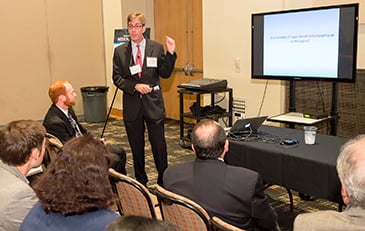
“All of a sudden, we’ve got some serious power to do some incredible analysis—to GPS our students and to GPS our programs,” said Anderson Spickard III, MD (pictured right), assistant dean of educational informatics and technology at Vanderbilt.
Dr. Spickard presented Vanderbilt’s new system at a special consortium meeting of 11 medical schools that received AMA grants as part of the AMA’s Accelerating Change in Medical Education initiative. The consortium schools met at Vanderbilt in September to discuss the progress they’re making in preparing tomorrow’s physicians for the rapid changes to come.
Each student is assigned a portfolio coach for the entirety of their education. Teachers who elect to become portfolio coaches each work with 10 students. Students meet with their coaches three times a year to review their educational data and determine what areas they need to work on.
Together, the learner and coach determine whether the student has developed the competencies necessary to move up to the next level of training. In this way, Vanderbilt is implementing competency-based education in its medical school. Promotion to the next phase isn’t based on grades but on individual students’ understanding and developing skill sets.
The system behind this intense tracking is called “VSTAR,” the school’s integrated learning platform. The software follows all the moving parts behind the medical school’s curriculum to provide broader snapshots of classes, groups and individual students over time.
Because the software is open-source, it’s ready for other medical schools to tweak and apply to their own settings. Vanderbilt is continuing to refine VSTAR and investigate ways students can take their data with them after they graduate and move on to their residency programs.
Vanderbilt and the other 10 medical schools participating in the AMA’s Accelerating Change in Medical Education initiative are working through new ways to train students. This consortium will identify best practices and rapidly disseminate them to other medical schools throughout the country.
This post is the first in a brief series on new medical education technology to be published at AMA Wire® over the coming weeks.