Baligh R. Yehia, MD, MPP, MSc, does not believe augmented intelligence (AI)—also called artificial intelligence— will replace all doctors. But Dr. Yehia, president of Jefferson Health, does think doctors who do not use AI should be open-minded.
That's why Jefferson Health is experimenting with an array of uses for AI while still focusing on the human element in health care.
Nearly two-thirds of physicians, 66%, surveyed by the AMA (PDF) in 2024 reported using health care AI—often called artificial intelligence. That rate marks a big jump from the 38% of physicians who said they used it in 2023.
“Health care for us is both high tech and high touch," said Dr. Yehia, an internist trained in infectious diseases. “There's a lot of things we do today with robots, but it's also high touch, which requires demonstrating empathy and caring, like touching someone's hand when they're sick or helping someone navigate social determinants of health issues. You can't just do that through a machine."

Jefferson Health is part of the AMA Health System Member Program, which provides enterprise solutions to equip leadership, physicians and care teams with resources to help drive the future of medicine.
To continue to advance AI at Jefferson Health, Dr. Yehia shared three focus areas for the health system and how they are using this technology.
Using AI to enhance patient care
AI is a core component relied on to enhance patient care at Jefferson Health. In fact, the AI experience begins before patients are even patients at all.
Jefferson Health uses AI for its symptom checker that interacts with users to direct them to the right type of medical attention. The checker has a text dialogue with users to understand their symptoms and provide next steps for care, such as recommending users call a doctor or visit an urgent care center.
The health system is also exploring how AI could be used as the basis for call center technology.
“How do you leverage AI to make calls more efficient and help route patients to the right places?" Dr. Yehia asked. "You've got to do that carefully. We've all been on phone calls where you just want to talk to a human.”
Find out how participants in the AMA Health System Member Program are using AI to make meaningful change. And learn more with the AMA about the emerging landscape of health care AI.
Using AI to ease physician workload
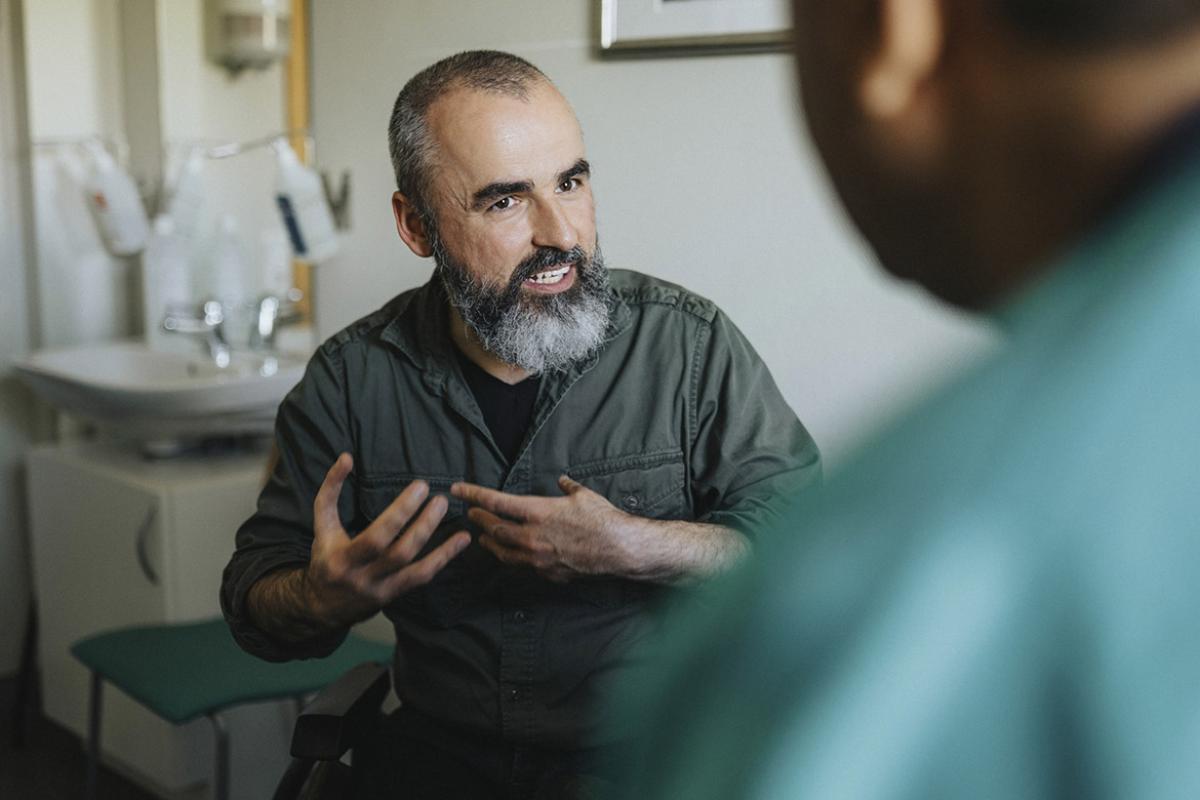
Perhaps the most significant way AI is currently being deployed at Jefferson Health is during patient visits. The health system conducted a pilot project that featured physicians using ambient scribe technology during medical visits. The software uses AI to listen to and summarize conversations between patients and physicians.
Using this technology means physicians no longer have to focus on the notes they're taking and instead can have more face-to-face time with patients.
The result has been overly positive, according to Dr. Yehia.
“We've seen love letters, frankly, coming from our doctors and advanced practice clinicians that say, 'Hey, I was able to get home on time, and I don't have to chart at home,’” he said, “or, ‘I was able to have more wholesome conversations with patients.’”
"That does allow for more interaction, literally being able to look face-to-face with a patient versus typing," Dr. Yehia said. "It's definitely saved a lot of time for our doctors. It has very high net promoter scores. People are very excited."
The standard of care in physician well-being recognition
Institutions in this article have been honored by the Joy in Medicine® Health System Recognition Program.
Jefferson Health also uses AI algorithms to assist with imaging, such as in radiology to better identify abnormalities. It's also being used with radiation oncology cancer treatment to more precisely target radiation beams to hit cancer cells and avoid normal cells. The result is improved operational efficiency and effectiveness.
"It's akin to spell check," Dr. Yehia said. "The film is read by a human, but then you can do a filter to make sure that you don't miss anything."
From AI implementation to EHR adoption and usability, the AMA is fighting to make technology work for physicians, ensuring that it is an asset to doctors—not a burden.
That includes the AMA STEPS Forward® “Governance for Augmented Intelligence” toolkit, which is a comprehensive eight-step guide for health care systems to establish a governance framework to implement, manage and scale AI solutions.
Teaching AI and its potential impact
Jefferson Health features more than 30 hospitals across Pennsylvania and New Jersey. It also is associated with Thomas Jefferson University and the Sidney Kimmel Medical College, which was founded in 1824.
The college offers a variety of educational opportunities to learn about AI and its impact on health care to better prepare future physicians to understand and work with the fast-evolving technology.
"Every AI tool we implement today could be out of date tomorrow because the field is progressing so quickly," Dr. Yehia said.
That is why it is important to offer courses and research related to AI. Jefferson Health also created an AI Center of Excellence to evaluate new products and their potential impact.
"You want to make sure that it's efficient, it's effective, it's safe and it's equitable," Dr. Yehia said. "We make sure that we do those analyses because you don't want it to create health disparities. You want it to make health care better."
The Center of Excellence serves as a hub and resource center for how to use AI and how it could help improve patient experience, ease physician workload, and ultimately make health care more efficient and effective.
"Tech is not a panacea for everything," Dr. Yehia said. "If you're able to hone in where it can help in specific areas, that's when you start to see a real impact."
Explore how to apply AI to transform health care with the “AMA ChangeMedEd® Artificial Intelligence in Health Care Series.”