Henry Ford Health’s adoption of RapidAI, a platform that dramatically speeds stroke diagnosis and treatment, has saved precious time for their physicians and improved treatment and outcomes for their patients.
RapidAI is an augmented intelligence (AI) tool that analyzes computed tomography (CT) scans for large vessel occlusion and instantly sends images and notifications to clinicians’ mobile devices. This enables immediate and fully informed decision-making that drives parallel workflow through every stage of response. Henry Ford Health’s embrace of RapidAI has reduced door-to-treatment time, facilitated collaboration across specialties, improved efficiencies around every aspect of stroke care, and delivered tangible and scalable results.
Nearly two-thirds of physicians, 66%, surveyed by the AMA (PDF) in 2024 reported using health care AI—often called artificial intelligence. That rate marks a big jump from the 38% of physicians who said they used it in 2023.
Nevertheless, many doctors still expressed that key needs must be met for them to build trust and advance their AI adoption. A feedback loop, data-privacy assurances, seamless workflow integration and adequate training and education are some of the essentials that physicians said they need to adopt AI. In its rollout of RapidAI, Henry Ford Health has taken steps to address these and other critical concerns.
Henry Ford Health is part of the AMA Health System Member Program, which provides enterprise solutions to equip leadership, physicians and care teams with resources to help drive the future of medicine.
Real-time alerts, real-time action
The traditional diagnostic path for suspected stroke was a series of steps. An emergency physician ordered a CT scan, which was then reviewed by a radiologist, then a neurologist, then a neurointerventionalist. This multistep process ate up time during a critical period.
RapidAI has reduced that process to minutes. The moment the scan is completed, the entire care team is notified, and coordination starts. Users can consult with others, highlighting specific areas of concern in the images and then collaborate on diagnosis and treatment.
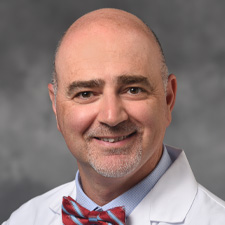
“We’ve decreased our median door-to-puncture time by about 20 minutes since 2021” — a reduction of approximately 40% since adopting the technology, said Alex Chebl, MD, interventional neurologist and director of the Henry Ford Stroke Center and the Division of Vascular Neurology at Henry Ford Health. “That’s a lot when we look at how many brain cells are at risk for every minute that stroke goes untreated.”
Megan Brady, MPH, MSW, is the stroke clinical program manager at Henry Ford Health, and during an interview with the AMA she recounted a case that had happened only days before. A patient in their 50s with severe stroke arrived at Henry Ford Wyandotte Hospital, about 15 miles away from Henry Ford Hospital in Detroit. Within minutes, RapidAI alerted the team, the on-call interventional radiology team was activated, and the patient was transferred.
“It was about 10 minutes from the first scan to the decision for a thrombectomy, and within 15 minutes of the decision, the patient was out the door on their way to the Comprehensive Stroke Center for the thrombectomy procedure,” Brady said. “The clot was retrieved in one pass, and the next morning their NIH Stroke Scale score went down from 23 to 3.”
Champion-driven physician confidence
To introduce RapidAI and secure buy-in, Dr. Chebl and Brady engaged “champions” among Henry Ford Health’s stroke neurologists. They tested the app, incorporated it into their workflows, helped troubleshoot, promoted the platform internally and provided feedback.
“Seeing how it works and getting a feel for it helped them say, ‘This is better, and I think we should expand this to our department and to our team,’” said Brady. The rollout then moved on to neurointerventionalists, interventional radiology technologists, nurses, emergency physicians and anesthesiologists.
“There’s always hesitation with something new,” Dr. Chebl noted. “But once team members saw how RapidAI gave them a heads-up about critical cases, even before they got a phone call, they saw the value.”
Brady and her team supported the transition further with in-person demos, drop-in sessions and video tutorials.

“That helped us expand adoption and build confidence across the board,” she said.
From AI implementation to EHR adoption and usability, the AMA is fighting to make technology work for physicians, ensuring that it is an asset to doctors—not a burden.
That includes the AMA STEPS Forward® “Governance for Augmented Intelligence” toolkit—developed in collaboration with Manatt Health—which is a comprehensive eight-step guide for health care systems to establish a governance framework to implement, manage and scale AI solutions.
Faster treatment that lowers costs
RapidAI requires upfront investment, but leaders at Henry Ford Health said the return on investment justifies it. Faster treatment means fewer days in the hospital.
“By moving patients through the system more quickly and achieving better outcomes, we reduce both direct and indirect costs,” said Dr. Chebl.
The platform is also helping Henry Ford Health grow its stroke program by identifying more treatable patients sooner. They are performing more thrombectomies while decreasing the length of stay for those patients by about 1.5 days, despite the rising number and complexity of cases they are treating now.
Henry Ford Health has seen other improvements in outcomes since adopting RapidAI.
“More stroke patients are going home rather than to rehab or long-term care,” said Dr. Chebl, with 57.4% of those patients discharged to home in 2024, compared with 48.8% at peer comprehensive stroke centers.
Better tools, better care, better days
There are other, everyday quality-of-life benefits for patients.
“People don’t want to be transferred 30 minutes away just to find out they’re not eligible for a procedure,” said Brady. “RapidAI lets us keep more patients in their community hospitals when appropriate.”
Satisfaction among Henry Ford Health’s care teams has improved too.
“Emergency department nurses, physicians and other personnel wouldn’t always get consistent feedback about a patient after they left their care,” said Brady. “Now they get updated immediately after the procedure, which helps reinforce the importance of their role in patient care.”
The team at Henry Ford Health views RapidAI as a critical assist that enhances care delivery.
“It’s just a tool,” said Dr. Chebl, “but it makes our job of making patients better, better.”
Find out how participants in the AMA Health System Member Program are using AI to make meaningful change. And learn more with the AMA about the emerging landscape of health care AI.
Also, explore how to apply AI to transform health care with the “AMA ChangeMedEd® Artificial Intelligence in Health Care Series.”
Subscribe to learn how innovative health systems reduce physician burnout.