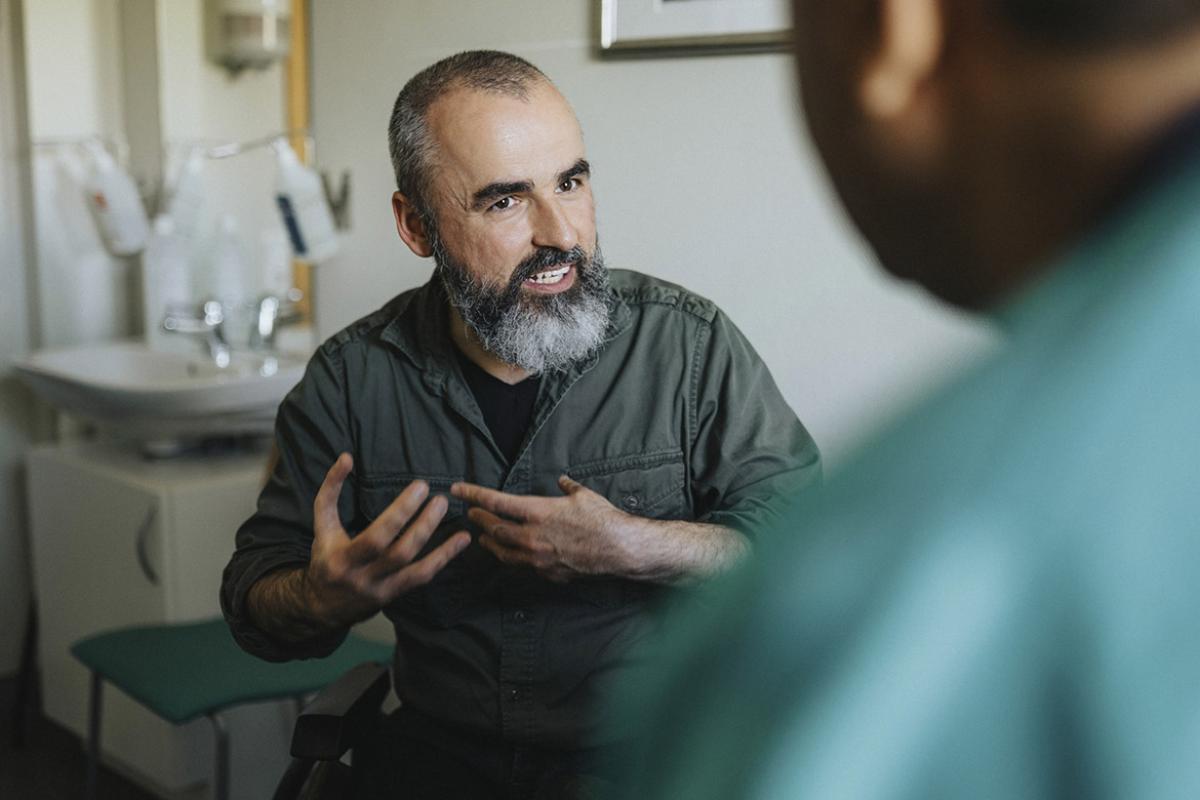
Featured topic and speakers
Physicians, residents, and medical students should be able to seek and receive care for mental health or substance use without fear of stigma and with full confidentiality protections. Requiring disclosure of medical diagnosis or treatment when there is no current impairment, however, causes physicians and other clinicians to not seek care out of fear of losing their job, license or judgment from their peers.
Rather than continue that cycle of stigma, the AMA, Dr. Lorna Breen Heroes’ Foundation and a growing coalition of medical partners have undertaken a national campaign to support physicians’ health and update all applications to remove inappropriate, stigmatizing questions about mental health and substance use.
What started out as a change made by a handful of states, health systems and hospitals has become a nationwide movement in just a few short years—more than 40 medical boards and 2,000 hospitals, health systems and other care facilities have adopted recommendations from the AMA and Breen Foundation to support clinicians’ health and well-being. Nearly 200 health systems have taken their commitment to physician well-being even further and earned recognition in the AMA Joy in Medicine® Health System Recognition Program. Are your state and hospital among them?
Learn more about these successes, how changes are being implemented by leading health systems, and what you can do to bring about change in your own state, hospitals and health systems.
Host
- Daniel Blaney-Koen, JD, senior attorney, AMA Advocacy
Speakers
- Bobby Mukkamala, MD, president, AMA
- Stefanie Simmons, MD, chief medical officer, Dr. Lorna Breen Heroes’ Foundation
- Mila Felder, MD, vice president for well-being, Advocate Health
Transcript
Blaney-Koen: Good afternoon, everybody. My name is Daniel Blaney-Koen. I am a senior attorney at the American Medical Association. And it is my pleasure to introduce you and welcome you to the AMA Advocacy Insights webinar, "How does licensing and credentialing application reform improve physician health and well-being?"
As many of you are aware, physicians, residents and medical students should be able to seek and receive care for mental health or substance use without fear or stigma and with full confidentiality protections. The AMA believes that requiring disclosure of medical diagnosis or treatment when there is no current impairment leads to medical students, residents and practicing physicians and other clinicians to not seek care out of fear of losing their job, their license or judgment from their peers.
Rather than continue that cycle of stigma, the AMA, Dr. Lorna Breen Heroes Foundation and a growing coalition of medical partners have undertaken a national campaign to support physicians' health and update all applications—medical licensing applications, credentialing applications, professional liability insurance applications, and any other application that you might be required to fill out—to remove inappropriate, stigmatizing language about mental health and substance use.
What started out as a change made by a handful of states, health systems and hospitals has become a nationwide movement in just a few short years. Three years ago, we had verified about 19 medical boards and fewer than 100 hospitals, had made changes consistent with recommendations from the AMA and Breen foundation. And just last week or two weeks ago, the Dr. Lorna Breen Heroes Foundation released its regular report showing that 43 medical boards, more than 70 boards total, and 2,100 hospitals, health systems and other care facilities had adopted the recommendations from the AMA and the foundation to support clinicians' health and well-being.
So I want to take a minute, however, to note that this success is built on a foundation of recommendations from the Federation of State Medical Boards and that many of the leading organizations, ranging from the American Osteopathic Association, Federation of State Physician Health Programs, the National Association of Medical Staff Services, the American Dental Association, the American Hospital Association, and many other medical and leading health associations have supported these recommendations since then.
In addition, nearly 200 health systems have taken that commitment to physician well-being even further and earned recognition in the AMA's Joy in Medicine Health System Recognition Program. Today, I want to go into the details and not only provide some best practices, but explain how you can take action in your state and hospital to accomplish this.
Thankfully, we are joined by three esteemed speakers, Dr. Bobby Mukkamala, who is the AMA president and a practicing head and neck surgeon from Flint, Michigan. We are also joined by Dr. Stefanie Simmons, an emergency medicine physician and the chief medical officer of the Dr. Lorna Breen Heroes Foundation, and Dr. Mila Felder, also an emergency medicine physician and the vice president for well-being at Advocate Health.
So to start this stage, we wanted to start out a little differently than we normally start out with an Advocacy Insights webinar by going into, because this issue is so personal to physicians, we wanted each of the physicians to talk about why this work is personal to them. Dr. Mukkamala, let's start with you.
Dr. Mukkamala: Sure, thanks, Daniel. I appreciate the opportunity to be here with all you guys on an important issue like this. And so when you asked me about, a personal experience, something where I thought, you know what, we can do better. It started back in medical school. So I also, at the University of Michigan, like Stefanie here, and I just remember, there was a time between M2 and M3 year where one of our students, just all of a sudden, had a mental health crisis. And at the time, it was something that was just totally put under the rug, something that people thought it was gossip, but nothing significant to help this student.
And that was something that, it was all focused on academic achievement and getting from M1 year to M2 year and then to graduation, and then to residency and then PGY1, PGY2, and so on, and so on. And the natural issues that we all face even now, like the turbulence, the challenges, the personal or family factors that basically, will occasionally cause us to pause, were something that just met with a lot of—everything from, boy, that's weird, to criticism, but not help.
And I see that as something that continues, and I would love to think that here we are several decades later and it's better. And as you pointed out, we're making good steps in the right direction with that stigma, but it still exists. And just like with anything, when we pass laws that say we should do this, getting those laws to actually impact how people think is a whole other issue.
And so it's converting what some of these states have done, what we want all states to do and all institutions to do, to actually, how everybody thinks. And I think that's just something we shouldn't assume happens when the laws change.
And I think about the data that I've seen recently about pregnant mothers that suffered from postpartum depression. And some people feel better, and they don't report it. And other people feel like the question says, have you ever had it? Have you ever gone through?
And then they say something about it, but then there's this immense fear. Like, what's going to happen? Is somebody going to read that and then I lose my ability, I lose my privileges? It's something that's an asterisk on my licensure or something like that.
And then one last thing I'll add is, I kind of went through not exactly the same experience, that it wasn't a mental health experience, but I would call it brain health experience. And so some of the people on this call probably have heard that a little over a year ago, I went through my own issue with the diagnosis of a brain tumor.
And I have to say that there was stigma associated with that because I'm a surgeon. I went to the facility, one of the places where I operate, and I said, hey, guys, I just want you to know, I've got an 8 centimeter astrocytoma. There's no motor issues involved. It's just an expressive aphasia where sometimes the words don't come out right, but it doesn't affect my surgical skill at all.
Well, immediately, the stigma led to the support staff in the operating room to say, you know what, we don't want to scrub with that guy. He's got a brain tumor. Nothing about the science. Nothing about whether it actually has a consequence on anything I'm doing today. But all of a sudden, they refused to scrub in with me in the operating room.
And I can't see that as anything but stigma when people hear about a diagnosis and they're like, oh, we can't work with that person anymore, it's too dangerous, without any of the science, the science of my brain tumor and the science behind whether somebody still has any sort of mental health consequence of a struggle they're going through. And so, it's something that we definitely need to work on. I do think it's better than the 1990s, but we got a long way to go.
Blaney-Koen: Dr. Mukkamala, I had not heard that part of the story before. I'm very sorry that happened to you. And it's indicative of why we try to emphasize the science. Dr. Simmons, what is your 'why' for doing this work?
Dr. Simmons: It's really interesting, Dr. Mukkamala, that you brought up postpartum depression because that was actually my first experience with a mental health challenge, personally. My life through undergrad, medical school and the first part of residency, I would characterize as smooth sailing, certainly challenging, as I think all of us can attest to.
But I didn't really experience or understand mental health conditions until I experienced one personally, and that was after the birth of my second child at the end of emergency medicine residency. I knew that something was wrong after she was born, but I was unwilling to receive a diagnosis or treatment because I knew that I was at the end of my training and I would be applying for my first professional license, credentialing jobs. And I did not want anything on my record as a diagnosis or treatment.
And it was a rocky few first years of my career in a way that I am not sure it needed to be if I had felt empowered to seek care and knew that that would not be an impediment to my career. At the same time, I don't think anyone knew anything wrong was going on with me except for the people outside of work—my family, my children.
And so this was always in the back of my head as an issue that felt deeply wrong, because in my medical practice, I was telling patients every day to take care of themselves, to seek care. And yet, I didn't feel like that was something that was available to me.
Now, in my professional career, I became the medical director of patient and clinician experience just a few years after that and was helping my colleagues in their communication skills, their patient experience and in their personal professional well-being.
And I realized at that point that I was not alone in my career, far from it. There were many people who were struggling with similar situations, and that pervasive belief that it wasn't safe because of these questions was out there.
And so I was motivated throughout my work to think about ways to dismantle some of those institutional sources of stigma, as well as doing the internal work on my own belief system and then having conversations with my colleagues to normalize the fact that we are all, in fact, human beings.
Blaney-Koen: Thank you, Dr. Simmons. And we're going to get into more of that systems work that you have done since then. Dr. Felder, tell us how this has become so personal to you.
Dr. Felder: I think for all of us—and I loved Dr. Simmons' personal reflection—for all of us, there are stories that build up like pebbles to how we arrive, to who we are. I think in my career, there were physicians who walked in talking about self-harm, and I helped navigate them. There were people who, residents early on, talked about leaving medicine because they couldn't feel like a whole person. And that was really hard, and it felt like we should be able to do more.
But one particular conversation, I think really shaped my desire to do this. There was a physician early on in my leadership work, who walked into my office and closed the door, sat down and said, I need help, and I don't think I can get it here. Can you help me?
And we talked about him wanting to go outside the health system, outside our insurance because they were worried, and I'm trying to avoid pronouns to make sure we're protected in the best way possible, but that they are able to get the care without having medical record. They read those licensure credentials sentences, and they were worried about getting the two connected, the medical care and getting help.
They were doing the right thing, what we ask physicians to do, get help early so it doesn't impact patients. They were doing incredibly well. There was no clinical signs of problem. They were tremendously respected. In fact, this was one of my attendings when I was a resident. Now, I was a leader in the department.
And so as I navigated through that journey with him, as they navigated some really difficult personal challenges and got the help they needed. What I realized is that the choice that they were facing between getting the help or being open didn't have to be the choice, but at the point we were with the language of licensure in Illinois and the language of credentials at the level of the state and the hospital, that was a real fear.
And maybe nothing would happen. But just the question itself, the way it's asked, when it's asking about history of mental health problem, as opposed to do you have any active problems that would interfere with your care of the patient, limits one's ability to either be honest or get help. And so that was my start for looking at it in terms of how can we protect both patient safety on one hand and clinician's well-being because they are one and the same.
And so that's how my journey started in trying to address the two. I don't think any physician should be choosing between getting help and protecting their job, just like, Stef said, we don't ask our patients to do that. We shouldn't ask each other to do that.
And so I hope we could make that more into a policy across all states, not just the states friendly to the AMA collaborative.
Blaney-Koen: Thank you, Dr. Felder. And I think that's a great transition. And to be clear, the language that we're talking about, for those health professionals who are on the call and have filled out an application or for the policy people who want to support this work, we do not support language on applications that asks physicians or other health professionals to disclose whether they have a diagnosis or receive treatment for mental health or substance use when there is no current impairment.
Yes, current impairment should be disclosed, but if there is no current impairment, the required disclosure of mental health diagnosis or substance use-related diagnosis or treatment, the surveys that we have done and that others have done, such as the Physicians Foundation and Medscape, demonstrate clearly, those surveys, 40% to 50% of medical students, residents and physicians do not seek care because of fear of disclosure.
So the advocacy part, and Dr. Mukkamala, I want to come back to you. This is one of the AMA's organizational priorities. And you testified last year in support of a Michigan bill to require the states licensing boards to make changes to ensure it did not ask the questions that I just mentioned.
Why, from the perspective of the AMA president, why is the AMA having its top leaders advocate directly for medical students, residents and physicians' health and well-being?
Dr. Mukkamala: To me, sorry to bring the brain thing up again, it seems like a no brainer. I mean, that's why we should. But the details are why I think it's a no brainer.
As you mentioned, I live here in Michigan. Last year, I gave testimony back in April to the Michigan Legislative Committee on physician burnout. And the other speakers included Stefanie, actually, from the Lorna Breen Foundation and also, our state society president, Mark Komorowski.
And that hearing was actually very productive in that it has resulted in two legislative initiatives, both led by one of our state reps. One of them, HB-4277, it's called, was going to prohibit licensing questions related to mental health for licensure and registration, just like you described. And so that bill actually passed through the state house back in December of just this past year, and it's been sent to the Senate Health Policy Committee.
And then there was another bill that's also worth noting. And this had to do with Michigan currently having the highest CME requirements, not directly related to this, but something that leads to a burden on physicians that affects us, not just time wise, but also, mentally. And this the CME was 150 hours over the course of three years, the highest in the country.
And this is also going to contribute, the administrative hassle that then leads to burnout, which is something that the AMA is big time in support of solving that problem. And so we were working on that, and the MSMS testified just a couple of weeks ago, actually, and it's going to be voted out of committee. But to your question, why is the AMA doing it.
And you can look at it, I think, from just in numbers, so just the calculation of it and how many physicians are planning on retiring early, the workforce shortage that we're going to have, north of 80 some thousand physicians short, soon to be 100,000, just a little over a decade from now. So just from the practical aspect of how are we going to take care of our country's health.
And then there's the moral aspect of taking care of physicians to be able to do what they love doing. And these are all things, whether you're looking at it from a purely numbers perspective or a moral perspective about the right thing to do, both of those lines of thought should lead to preserving the health of our physician workforce and the mental health of our physician workforce.
And so, I would say that we need to protect ourselves in order to keep our country healthier and continue to meet the health care needs of our country. And when I say that, even in those very administrative numbers focused, all of a sudden, you can see their head go, hm, I guess that makes sense.
Because again, from a numbers perspective, when physicians suffer in this way and they say, you know what, I can't do this anymore and they burn out, from a purely financial perspective, for an institution to replace them is a half a million dollar investment.
And it's not that their life doesn't matter. I mean, we see it as absolutely every life matters, and we need to help all these people. But if you're just an AI calculator-based mindset and you say, if we don't help this person, it's going to cost us half a million dollars, you're still going to come to the same conclusion, let's help this person.
And so this is the kind of thing that the AMA has data to say why it should be done from a numbers perspective. And then also, the moral part of these people, we work hard to improve the health care of our country, and therefore, our own health should also be prioritized, as opposed to assuming that we'll just tough it out.
Blaney-Koen: Thank you, Dr. Mukkamala, and extra props to you for the bill numbers. There's nothing like there's nothing that brings joy to the heart of a health policy attorney when our president speaks specific bill number, so thank you.
Dr. Simmons, maybe you can go into a little bit more detail about advocacy. You've testified in a number of settings, have had dozens of meetings behind the scenes with groups and the AMA and the foundation and partnered for several years now on these changes that have literally helped several million health care workers. Tell us a little bit deeper about the organizational partnerships and why those have been so important to advocacy.
Dr. Simmons: Thank you for that question, Daniel. And the collaboration between stakeholders on this issue has really been what's driven this work forward and allowed for the relatively rapid adoption of these identified best practices over the past three years. So as you mentioned before, there was existing policy, both in white papers from the Federation of State Physician Health programs, the Federation of State Medical Boards, and the AMA, pre-existing prior to the foundation's founding.
And there had been significant change in the licensing applications, such that 19 medical licensing boards had adopted these best practices. The thing that was able to catapult the change and accelerate the pace of change was these organizations coming together, meeting on a regular cadence and strategically outreaching to additional medical boards.
So it's the collaboration between organizations that's been critical, but also, celebrating the success of medical boards and organizations who have been able to adopt these best practices by awarding them a badge from this coalition, the ALL IN: Wellbeing First for Healthcare coalition to recognize this work.
So there is the Wellbeing First Champions Challenge badge, which recognizes state medical boards, hospitals, health systems, freestanding clinics that have made this change and eliminated invasive and stigmatizing language from their licensing applications, their credentialing applications and their peer reference forms. And it's really celebrating success that has made visible where this work has happened and, frankly, engendered a bit of cooperation among organizations to adopt these best practices.
In addition to collaboration and celebrating success, we've been sharing stories of why this work is important to the health care workforce. We hear every day from health care workers around the country—physicians, nurses, dentists, pharmacists—about why this change is critical to them, why it's important to them, how it could be life saving to them. And so we do our best to elevate and share those stories.
That's why I was so thrilled to share the advocacy stage with Dr. Mukkamala at the Michigan state legislature. Although Michigan is one of only four states that has changed their licensing language for every licensing application—physicians, nurses, dentists, pharmacists—the passage of a bill that codifies that language into law adds an additional layer of security and really helps health care workers feel confident that they're able to receive care, and that those questions not only aren't going to be asked now, but won't be asked in the future.
If you went back in time, 10 years in your wayback machine and you asked 10 years to 2016, Dr. Simmons, if she thought she was going to be doing advocacy at the state and federal level, I would have looked at you like you just grew a second nose. Because that was not on my plan. And it turns out that when there's something you care enough about, you have to step into the arena and you have to advocate for change, because that's how change happens.
Blaney-Koen: Thank you. And change, I think, Dr. Felder, is a perfect example of being an advocate, no pun intended, being an advocate within Advocate Health, to make change happen. And Dr. Felder, as an organizational champion, take us through what was the first step that Advocate Health took to update its credentialing applications to remove the stigmatizing language about mental health and substance use. And tell us, also about we mentioned bringing people together, how you brought people together, who was brought together, maybe, and some of the hurdles that you had to overcome all in a couple of minutes so we can ask more questions.
Dr. Felder: Absolutely. As Stef was speaking, Dr. Simmons was speaking about the national change with AMA and Lorna Breen Foundation, that momentum that's being built, I was thinking of the impact of that momentum on us and thinking beyond just changing the language. Looking at more of what are the operational changes that need to happen for us as an organization in order for us to claim more than the checkbox change.
And so we started looking at it in a very small group. I pulled together the lead of the medical staff services, Jenny Mangan-Moore, who I hope is here because none of this could have been possible without her and Dr. Lineberry. And we looked at it in terms of, what does the language say about ability to get care? How might we optimize or maybe modernize that language to make sure we focus on the current impairment, avoiding limitations to people getting care just because of the history of problems. We very quickly realized this was not a medical staff services problem.
And so we started pulling in other people. And the more we started talking to our legal and risk managed care, we pulled in governmental affairs and communications, compliance. We started talking to CMOs. We understood that while the language itself can be changed more easily in some states, advocate practices in than others, the understanding of importance and value and normalization of mental health is uniformly needed across the organization.
And so we started working in both directions. We started bringing in all of those new partners—legal risk, managed care, the CMOs, compliance—all those people started working together and the governmental affairs have been tremendous, helping to address the changes to the actual language. While we also started talking to clinician leaders in the frontline and CMOs about how do we normalize it so that as the language is being changed and evolves, we come back to the frontline feeling comfortable that culture has also adopted that change so that CMOs feel more comfortable talking about their own personal struggles or maybe elevating those of others.
And as we did that, we realized that that army of people supporting this work was growing. There was tremendous work put in with support of Lorna Breen Foundation because we had to pull in over 100 applications from different medical staff forms and used local leaders like Dr. Andrea Fernandez at Wake, who was actually Lorna Breen's classmate, who was incredible in pushing this forward specifically to North Carolina, and Dr. Gary Little in the same state.
Those challenges were different from challenges we had in Wisconsin, where the licensure language needed to change. And so we partnered with other health care organizations. And that's also where, both Lorna Breen, Wisconsin Hospital Association and Association for a Healthier Wisconsin were tremendous.
Then we came to Illinois, realizing that here our challenge is that the language of credentials is the problem. Licensure has been updated, but credentials now are mandated by the state. So we pulled together leaders across the state and worked with Illinois Department of Public Health to nearly change that language. We are working on it, but coming pretty close.
I guess all that to say that we need to change the language, yes, but that needs to be a part of the culture change. That cannot happen without frontline clinicians feeling that it is OK, not just OK, but it is in their patient's best interest, that they are well and that they're not afraid of it. Because to Stef's point earlier, how can we be honest with them telling them that they need to go and get help if we are afraid to be transparent about it and getting it get ourselves.
So as policy change opens that door, we need to enable access and the culture work around it. And I have a question for Stef. As more and more of this policy work comes on, what do you see is the biggest hesitation as you work with different health systems and states—facing AMA, facing other partners. Is it regulatory? Is it licensure and state? Is it operational compatibility? Where do you think the biggest challenges are to making this change?
Dr. Simmons: I think the biggest challenge to making this change is actually bandwidth. It is incredibly complex to run a hospital, to run a med staff, to do the work of health care. And organizations don't always immediately see the critical importance of this work in removing a barrier to mental health care for health care workers.
So if you fall even one or two lines down on the 1,000 part to-do list of a health care leader, it can be difficult to get traction in this work. So I think that, honestly, has been the biggest barrier as opposed to any active resistance. To counter that, there really are strong narratives and strong evidence about the importance of these barriers to physicians and that really coming in right after schedule.
And I think we can all appreciate that the time in your day is the biggest barrier to doing anything outside of your work. That stigma in the form of institutional stigma is actually the leading reason why people don't get help when they know they should.
And as med staffs, as medical exec boards, if we don't take the steps to lead the way in reducing that institutional stigma to keep physicians and patients safe, then it makes the job of going to payors, going to malpractice insurers, and asking them to make the change even harder. So it's important to make the change, and it's also important to lead the way.
Blaney-Koen: Dr. Mukkamala, maybe you could also jump in here, because these changes and leading the way, this is a role that is tailored for medical society leadership. And you mentioned the Michigan State Medical Society, and we're grateful to partner with them. The AMA supports the legislation that you've mentioned. But what would you say to medical societies who aren't quite sure where to start?
And I should say, medical societies have been some of our greatest partners in this effort, and we couldn't get it done without medical societies. But what would you say to a physician who says, I don't know if my medical society is really supporting this?
Dr. Mukkamala: I think it's an important question because so many of these things are in our backyard. I mean, they're in our communities, in our states, and yes, there's a national perspective that guides all of it. But at the end of the day, it's a state-by-state sort of thing.
And so what I would say to the medical societies, I would give them multiple angles because even within the leadership of a medical society, there's going to be different perspectives. One of them will have to do with just the numbers, like I mentioned before, the physician shortage. And what I would tell that person is that, yes, we have a physician shortage. We have a high rate of physician burnout, more than twice the number of other white collar professions.
And the way to deal with those things is that there will be some short-term issues that, yes, you as a society can deal with. You're working on this legislation—HR dot, dot, dot. And that's going to potentially pass this year, and it's going to make a dramatic impact. Let's say that's prior authorization and the headache factor that that causes, that affects the mental health of the physicians in their society that are in their state. That's fine. Great. Keep working on that.
But what about those things that are going to be long-term issues? Those things that aren't going to get fixed in 2026? If we're lucky, maybe in your term as a leader within the state medical society, maybe it'll get done, maybe it won't. Maybe it'll be something that's going to be five years, a decade, perhaps. What do we do in that situation that's going to continue to give people confidence in our ability to fight these battles?
Because the consequence of that is going to be a mental health issue. It's going to be that physician burnout where, you know what, I just can't deal with that anymore. And what I really like hearing nowadays is, it's not my failure that's conveyed in the term burnout. This is what a lot of people now refer to as moral injury. And what is the consequence of moral injury? It's something that's going to affect my mental health.
And so this is what I would tell a state society about why the work they do should be put in perspective so that the people that benefit—their membership, the physician community in their states—understands that value. And I think that when we start doing that, that means some people consider that strategy, that we will go from the point of treading water, basically, trying not to drown in this unnecessarily complicated health care system, to actually swimming in the right direction.
And I think that has a lot to do with physician leadership. And I think the other way to look at it is that in those states that take the initiative of doing this, that drink that Kool-Aid, and they're like, you know what, I understand. We're going to do that. All of a sudden, it becomes a state where the physicians themselves are experiencing the good consequences of that work, and they want to stay, as opposed to saying, you know what, this is just so hard to be here, I'm going to move.
And so they're likely to stay in those communities. And the other thing that I'm really proud of the AMA doing in this regard is, going into these states, going into health care institutions, hospital systems with our Joy in Medicine program. And that's something that, basically says, look, there are consequences to the current health care system. A lot of them happen in between your walls that are taking a toll on physicians' mental health. And that's why we have this Joy in Medicine evaluation that helps you, helps them to get to the point where they get a bronze, they get a silver, they get a gold evaluation result that basically says, yes, this is a place where physicians enjoy their practice of medicine.
And so this is something that I'm excited about and that when I heard Dr. Felder say about Advocate Health, this is, again, that intersection. So Betty Chu, I think, who's your chief medical officer over there is my classmate at University of Michigan and hanging out with Stefanie and I over there, but is also, on one of the councils of the American Medical Association.
So it just shows you how important it is to have that intersection between organized medicine and an institution just like Advocate, just like all of them, so that it's the left and right hands that have the same goal, which is preserving the mental health of a workforce that's critical for the health of our country.
So yes, I think organized medicine has a huge role to play in continuing us in the right direction for all sorts of reasons.
Dr. Simmons: I'd like to jump in.
Blaney-Koen: Go ahead, Dr. Simmons.
Dr. Simmons: I just wanted to emphasize too, the critical role that the Joy in Medicine program has played in driving organizations to the Wellbeing First Champions Challenge. So every year, we receive applications of organizations that have done the hard work of auditing, changing, and then having their applications verified as part of the Joy in Medicine program.
So it's been another example of the way that a national nonprofit, the AMA, and organizations are working together to wrap their arms around the physician workforce.
Blaney-Koen: Dr. Simmons, let me come right back to you real quick. Dr. Mukkamala mentioned physicians experiencing the good and in using this and this being used in recruiting and in other ways to show the benefits of being able to get care and being safe in a state or in a hospital or health system.
Take us through a little bit more about the importance of the state or the system actually communicating those results. And Dr. Felder, I'm going to ask, I'm going to ask you to comment right afterwards. Because I can recall there was a system that we worked with early on who made the changes. They were super excited. And then physicians from that system started calling us and saying, we thought you made the changes, and it turns out that the people in the C-suite, they were very excited, they did all the good work, but they forgot to tell the communications people to share the information with anybody.
Tell us more about this.
Dr. Simmons: Sure. So this is really a case of, if a tree falls in the woods and nobody is there to hear it, it doesn't make a sound. This is behavioral change at the root of it. We aren't trying to get forms to change. I could care less if a form changes. I want people to change their behaviors because they feel safer and they are safer.
So in order for people to know that they aren't going to be asked these questions, they have to know that the rules have changed because in the absence of information, people make a rational economic decision to believe the most conservative, little c conservative fact, that they should base their decisions on. And so it's critical for organizations and for states to communicate to the clinicians through the physicians in their state that these changes have been made.
That's one of the reasons we created the work, WellBeing First Champions Challenge badge is to serve as a visible symbol to organizations so they know that the change has been made. We also keep maps, both state maps of medical boards, and also, a map where you can interactively check which organizations have made the change in your state, so that you can confirm what the rules are, where you work.
That's really the tragedy of some of these stories we hear is, even in organizations where the change has been made, if it isn't communicated, people will assume it has not changed. So communicate, communicate, communicate. In fact, after the first year an organization or a state board gets the badge, in order to renew for a second year of the badge, they have to show us how they communicated the change in at least three different venues to their population.
So communicate, communicate, communicate, and make sure that as we move increasingly to online applications, applicants have the opportunity to see what's on the application before they get started.
Dr. Mukkamala: You're muted, Daniel.
Blaney-Koen: All right. No Girl Scout cookies for me tonight. Dr. Felder, tell us a little bit more how Advocate communicated the recognition, the fact that you had made these changes. But put it in the larger context that Dr. Simmons and Dr. Mukkamala are talking about, that this isn't just about changing the language on one question.
Dr. Felder: Absolutely. As I mentioned, we started parallel, working to change the language, but also, to normalize the language with our CMOs and medical staff leaders talking about what mental health challenges are in their personal life, how that may be impacting them and others and how to get the help, what resources are there available, putting things in the physician lounges in our communication platforms.
Recruiting all those operational leaders, we talked to about changing the language to also help socialize it. So taking in those governmental affairs and communications and risk and legal and all the people I mentioned earlier to help take it and make it their own language. And in fact, talking to our nursing colleagues and other professional colleagues and speaking about physicians being just the first engine for making the change and expanding beyond that, normalizing it for the entire health care team, talking to residents, et cetera.
So our platforms were not just the email, but this was the medical executive committee meetings and medical staff communications. We had our regional CMOs for the states, receive and put up the badge award. We also talked at so many levels with operational leaders, because I think a lot of times, there is a missing point where for clinicians, this impactful change is socialized. But operational leaders may not understand what that means and what dramatic difference it makes for their finances, for their bottom line and for just the number of ways that organization is perceived.
That's how we approached it. I think for us, it was more of a compilation of cultural. This is why we're doing it. Here's the result, the outcome, and here's how you may help us weigh in by sharing your story, by socializing what resources are available, by connecting back and being a spokesperson for it.
And that included our peer support system. That included a variety of different tools. So I suspect Advocate is not going to have any problem finding three ways that we communicated this badge, because we really have looked at it in terms of a team, a culture, and a language, not just any one of them.
Dr. Simmons: And Mila, you've got another way right now. You're doing it right now as you're speaking today. So you've got one box checked after this webinar.
Blaney-Koen: We had some questions that came in beforehand. So we want to make sure that we get to some of them. And this takes the discussion a little bit different, but as to why it's important to do this. Talk a little bit about—and Dr. Felder, let's start with you. If somebody doesn't feel safe in seeking care, what are the consequences, the health consequences, the patient safety consequences of not seeking care in a patient care setting?
Dr. Felder: So Bobby earlier talked a little bit about the finances, at least $500,000 per physician to replace the physicians at stake. The patient safety, physician who does not seek care, would show lower patient satisfaction results, higher risk of having bad outcomes and expected outcomes, just because of just like any other health issue, having untreated medical or mental health condition causes problems for performance, and patient safety is not a surprising negative outcome, potentially, with that.
When physicians trust institutions, and I always think of how Dr. Shanafelt at Stanford had all of us aspiring chief wellness officer, stepped into the CEO, CFO role and think through their lens of the risks. We talked about the financial risk and physician loss. We talked about reputational risk. And what does it mean for organizations if physicians are struggling and are unable to keep their jobs or leave at these tremendously high rates?
What is the risk to patient safety? We mentioned that. What is the retention cost in terms of morale for the team that remains behind? All of those costs are weighed in. And in the end, what is the human cost? What is the human cost to that group, that team that feels that they can't be honest with each other, they can feel safe?
And that psychological safety is increasingly the biggest factor in the conversations we're having with each other. And so I think as we look at this issue, if we want a stable workforce and strong culture and feeling safe in a very basic getting care, whether it is for cancer, tumor, heart attack, stroke, or mental health condition, allows our clinicians to feel like humans that they are.
And so maybe we could start in undergrad and medical school and residency to normalize those things. Because you know what, I don't remember that in my medical school when I gave birth, I was invited to take more than six weeks, to take a breath and reflect on how I feel about coming right back. We were superhuman. So as we transition back to human, I think our patients tend to stand to benefit, and our communities do too.
Blaney-Koen: I'm glad you mentioned medical students again. And Dr. Mukkamala, maybe you could talk a little bit more. What is the AMA—what advice can we give our medical students on how to be active in this area? And I'm sure you could draw on the recent student that we had at our State Advocacy Summit in California. Can medical students play a role here as advocates?
Dr. Mukkamala: Oh, absolutely, and they should. In fact, this is something that when I travel the country as president of the AMA, one of my favorite places to present are the medical students, the medical schools, for many reasons. I mean, not the least of which is that whatever it is that we can't fix in my lifetime, in this generation, they will inherit.
And so just preparing them to continue these efforts, because it's not going to be perfect when they start their practices and they start the practice of medicine. And so a lot of what I talk about with them is why they should continue to advocate to make sure that the health care system that they inherit and then work in is something that will keep them proud of their choices, happy with their choices, instead of entering their practice and being extremely frustrated. And so that's something that seems to resonate.
And the other aspect of it is that the American Medical Association, we have our effort that's called ChangeMedEd. So change medical education. So it applies to what we're dealing with today. When I was in medical school, it was M1, M2 year in the auditorium; M3, M4 year in the hospital; and off you go.
But now, the AMA is very focused on changing med ed to meet the challenges that we face today, everything from health system science. It's a book that we put out there. So you know before you graduate, what is prior authorization? How does that work? Why is that going to give me a headache? So that aspect of it, but also, exactly what we're talking about here today, to make sure that experience prepares them mentally to face these challenges, as opposed to questioning immediately, why the heck did I go into this profession.
And so I do think that's something that I'd like to share with medical students, to let them know that when they face that, when they graduate and they've got their cap and gown on and then off they go to their first job, and then they see this headwind that they're not the deer in headlights. They don't have to be because of organized medicine, because of the role that we played in bringing attention to this so that what they start their practice in is something that they're happy about as opposed to being surprised about. So yes, that's exactly what I talk to them about when I toured the medical schools in the country.
Blaney-Koen: Dr. Simmons, maybe you could follow that up. You've worked with some pretty outstanding medical student advocates. Tell us a little bit more about when you're talking to a medical student, how have some of the medical students that you've worked with been fantastic advocates?
Dr. Simmons: I think I mentioned that 10 years ago, Stefanie would never have considered advocacy, and that is certainly not true of the medical students that I'm talking to. They have a real understanding that without their voices, their world will not change.
And so they are lifting those voices. And for those who are engaged with advocacy, I've been so heartened by the deep understanding that they have of the issues. And if they didn't come in with that understanding, they're seeking out the information that they need to get it.
They are raising their voices. They're sharing their stories. Hopefully, they are not making the choices that some of us made 20, 30 years ago to not seek care. But they're feeling also empowered to take care of themselves and to reach out to their colleagues and check in as they go through the education system.
There have been real changes in the way that both medical colleges and residency programs support their learners, and I think we're seeing that in a reduction in stigma for some new physicians. And it's really interesting too, to Dr. Mukkamala's point, as I reflect on my own medical training, and University of Michigan should probably pay us some money, Bobby, for mentioning the school so often during this.
But I was an undergrad medical student and residency there, and I really felt as though the preparation that I received to not just be a physician scientist, but a leader made a tremendous difference in my ability to navigate these challenges in my early career. And so we are seeing medical students take up that mantle and tackle these challenges head on.
Blaney-Koen: Sometimes a physician is impaired or another health care professional in a system is impaired. What recommendations—and this is open for everybody. What would you say to a colleague who you think, you need help. You need to be evaluated. What would you say to that colleague?
Dr. Simmons: I think the hardest thing, when someone is in a point of crisis, is to make sure that they can see past the crisis that they're experiencing, that even if their career takes a pause while they recover from that crisis, that doesn't mean that their career or their life is over. And over a million patients lose their physician to suicide every year. And part of that, for physicians, is a real concern of loss of identity and career and collegiality and the isolation that goes with the concerns about what it will mean to be impaired.
So as we think about how to support our colleagues and how to move forward, sharing stories for those of us who have gone through a mental health condition, who have had impairment and gone through the process to the other side is critical to help engender that hope, and also, knowledge of the process through which you can return to a healthy practice in life.
Blaney-Koen: Dr. Felder.
Dr. Felder: Dr. Simmons, Stef, I love that you bring up that idea of taking a bigger shot, bigger look, broader look at the picture. And I think it's also important that as we look at the level of the hospital or the health system, we operationalize some of that so that it doesn't feel like I am the one off. I am failing, I am at fault.
What we did a few years ago, and Dr. Mystery at my hospital was tremendous supporter for that, is create a physician citizenship committee. This is where before there is any administrative issue, clinicians can come and speak to peers who are supportive, including a designated peer supporter in the room who's only there for that physician.
And sometimes get a reflection of what they might think versus what the perception might be. So it becomes a little bit bigger of a picture, a little bit more objective. And they get a chance to reflect on what help, if they want to, they may be able to receive without before any administrative consequences.
If we are able to build that in, so that we are not seen as being punitive the first time we reach out for that cup of coffee, I think what could go a long way to normalize all that we've been talking about in the last hour, where if I have a problem, I didn't fail. If I'm having postpartum depression or brain tumor or parent problem or whatever it is I'm dealing with, and I feel like it may be impacting me, but I'm so afraid others will know, I'm not afraid to ask what's available.
And I think that putting in structures in place is a tremendous way of accomplishing all of those goals, normalizing and promoting and retaining and creating safer organizations.
Dr. Mukkamala: Daniel, I guess I'm just thinking of your question in the context of today is Friday night. Well, soon it will be Friday night. And there'll be something social. And just like most of us, we'll have a lot of physician colleagues that we happen to be hanging out with. And in those conversations, if something like this came up and it was pretty clear that one of my colleagues, one of my friends, is having a mental health issue, that could have consequence.
It's wonderful that we have all these resources that we just talked about, but I don't think it's going to be good to jump from finding out and then saying you gotta go over here. You call this person, here's the number, and we'll help you get through it. In between is a lot of personal contact, the conversation that happens.
Just like with anything, if we had a patient that came in with an issue like this, we wouldn't say, you know what, here's a referral. It's a conversation that happens. And these are our colleagues. And so I think that just acknowledging, maybe even where there's similarity to something that I went through, something to leave that conversation not with, holy cow, I gotta call this number, and what's going to be the consequence of that and everyone is going to know.
It should start with, yes, I'm glad I'm not the only one. I enjoyed this conversation. Monday might be better. But if not, at least we know that this is something that, we, as colleagues, should help with, starting with just an acknowledgment, sharing our own context, and then maybe towards the end of that conversation, hey, by the way, you might remember I'm president of the AMA. Or I work with an organization like Stefanie does, that's all about this. Let me get you a website. And you plant those seeds so that they grow into roses and not weeds, I think is an important way to start that conversation.
Dr. Simmons: I absolutely agree, Dr. Mukkamala. And throughout my career leading this work for a large national medical group, responded to dozens of colleagues, if not hundreds, who were struggling with some aspect of potential impairment. And it requires leaders that are consistently connected with their teams, who then can go the next step further, whether it's a formal leadership, a friendship, a collegial relationship.
But it's not just handing a card and saying, call this number, it's a walking together towards help, whether that help is a conversation, whether that help is a therapeutic relationship, whether that help is formal hospitalization. And isolation is probably our biggest enemy here. And so as much as we can stay connected with people who are going through crisis, the better it will be for them and for all of us.
Blaney-Koen: Thank you, Dr. Simmons. Planting seeds. I want to come back to planting seeds. I would like each of you to plant a seed with our attendees for the next 30 to 60 seconds. Plant that last seed in them about whether their role is as a physician advocate, as a health system leader, or as a medical society, plant a seed with them about what they can do next, to be advocates to support physicians' health and well-being. Dr. Felder, let's start with you.
Dr. Felder: Absolutely. I think the best thing is to get familiar where you are in the state you practice. What is the current situation with licensure? What is the current situation with credentials? If this feels personal, then the easiest way to be impactful is to start speaking about it with your colleagues, with your medical staff leaders, and maybe at the state level.
Here, in the state of Illinois, I would love some help. And so reaching out to those partners or just parallel institutions and creating a coalition like we have with the help from Lorna Breen in a number of states to create the change, but also, to create the culture change. I think those are the easiest steps. Getting involved where you think it matters, where it feels personal, is the easiest way to get started.
Blaney-Koen: Dr. Simmons, 30 seconds to you.
Dr. Mukkamala: You're muted.
Dr. Simmons: No Girl Scout cookies for me either. This can feel a little overwhelming when you get started. And so the Lorna Breen Foundation, with the ALL IN Coalition and the AMA have developed a toolkit on how to help make these changes at your organization.
So I encourage you to go to our website, look up your state, look up your organization, and if you don't yet have the badge, visit the toolkit, advocate within your organization, make the change, and then spread the word.
Blaney-Koen: Dr. Mukkamala, last words.
Dr. Mukkamala: I guess, in that conversation, I would say that the theme that I talk about a lot is that we are a unified profession. The challenges we face, it's not unique. I don't want people to experience this and feel like they are three standard deviations above the mean as far as the distress they're feeling. We all go through that. These are the challenges that we all are aware of, and they're not alone in this.
And so the seed I would plant is, hey, this is not just you. We all have different extents of the same emotion. And therefore, we are creating a system. That's the role of organized medicine, to be able to help us to love our profession instead of being so challenged by our profession or the life around those professions.
And so, yes, that's the seed I would plant, is that you're not alone, and this is exactly why organized medicine exists and then help them navigate that system.
Blaney-Koen: Thank you, Dr. Mukkamala. Thank you, Dr. Simmons. Thank you, Dr. Felder, and thank you to everyone who attended today. I hope you'll take use of the resources and contact anybody that you've heard from today. We are here to help you. Have a good day, everybody.
Dr. Mukkamala: Thanks, everybody.
Disclaimer: The viewpoints expressed in this video are those of the participants and/or do not necessarily reflect the views and policies of the AMA.