As a medical student, do you ever wonder what it's like to specialize in pulmonary, critical care and sleep medicine? Meet AMA member Sreelatha Naik, MD, a specialist in pulmonary disease and critical care, as well as sleep medicine, and a featured doctor in the AMA's “Shadow Me” Specialty Series, which offers advice directly from doctors about life in their specialties. Check out her insights to help determine whether a career in pulmonary, critical care and sleep medicine might be a good fit for you.
The AMA's Specialty Guide simplifies medical students' specialty selection process by highlighting major specialties, detailing training information and providing access to related association information. It is produced by FREIDA™, the AMA Residency & Fellowship Database®.
Learn more with the AMA about the medical specialties of pulmonary disease and critical care medicine and sleep medicine.
“Shadowing” Dr. Sreelatha Naik
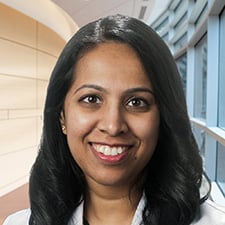
Specialty: Pulmonary disease and critical care; sleep medicine.
Practice setting: Health system.
Employment type: Employed by Geisinger Health, in Scranton and Wilkes-Barre, Pennsylvania. Geisinger Health is part of the AMA Health System Member Program, which provides enterprise solutions to equip leadership, physicians and care teams with resources to help drive the future of medicine.
Years in practice: Nine.
What the specialty of pulmonary, critical care and sleep medicine is: Pulmonary and critical care medicine and sleep medicine are two separate fellowship paths that many often pursue. All three of these specialties are evolving rapidly with novel therapies that allow us to enhance the life span and health span of our patients. While pulmonary medicine focuses on respiratory diseases, critical care medicine and sleep medicine have a broader, multi-system view of health. Because the field is so broad, after a training in pulmonary, critical care medicine and sleep medicine, some physicians choose specific niches within the field (such as pulmonary hypertension, advanced bronchoscopy, interstitial lung disease), others remain broad in their focus.
Over the years, however, my outpatient practice has become focused on patients with respiratory frailty and chronic respiratory failure who re on noninvasive or invasive home ventilation due to neuromuscular disease, very severe chronic obstructive pulmonary disease (COPD) or obesity hypoventilation syndrome. I also manage patients with tracheostomy who either are on long-term ventilation and remain on it or are working toward liberating from it for eventual decannulation.
A typical day and week in my practice: Given the variety of roles I have as a clinician, educator and leader, there really isn’t a single “typical” day for me. Clinically, my time may be spent in the intensive care unit (ICU), on the pulmonary consult service or in clinic.
A clinic day often starts with pre-charting before seeing 12–14 patients, many of whom are on long-term noninvasive or invasive ventilatory support, alongside sleep medicine fellows and sometimes internal medicine residents.
Outside of direct patient care, my days often include meetings related to quality improvement and project development. I also have administrative responsibilities in my roles as director of pulmonary and critical care and director of sleep medicine.
As an educator, serving as program director for the Sleep Medicine Fellowship and core faculty for the Internal Medicine Residency, I also spend time teaching, giving didactics, working on quality or research projects, and mentoring fellows, residents and junior faculty.
What I enjoy most is the opportunity to connect with patients, junior faculty and trainees. I’ve cared for some of my patients for most of the past nine and a half years, while others are new, but each encounter is an opportunity to understand what matters most to them, learn more from each of my patients and help improve their quality of life. Teaching fellows and residents, and learning from both them and our patients, is one of the most rewarding parts of my day.
Outside of work, life is just as full. As a mom of twins, my schedule often involves a fair amount of creative time management. I try to fit in a Peloton ride or a long walk with my dog when I can, and because mornings tend to be my most productive time, I often make dinner for my family before heading to work. I’m also pursuing an MBA, which means a few evenings each week are spent in class. Weekends are often dedicated to my kids’ activities: voice lessons in Carnatic music with my son and Bharatanatyam dance classes with my daughter, which I take alongside them. Between medicine, teaching, school, parenting and taking care of other family, my days can be busy, but they are also incredibly fulfilling.
The most challenging and rewarding aspects of pulmonary, critical care and sleep medicine: Many of my patients have severe respiratory disease and chronic ventilatory failure, so we often meet them at some of the most vulnerable stages of their illness. Over time, caring for patients with complex breathing needs means forming very close relationships with them and their families—sharing stories about family life, pets and vacations and telling inside jokes. One of the most challenging aspects of the work is saying goodbye when a patient eventually succumbs to their disease after years of shared care and trust.
The most rewarding part is helping patients live longer and better through home ventilation and other respiratory support strategies. These therapies can enable patients to remain at home, avoid invasive procedures—such as intubation or tracheostomy—if that is their wish, and continue experiencing important life moments with their families. At the same time, caring for these patients continually teaches us about complex respiratory physiology across different disease states and how that physiology interacts with ventilatory devices and their algorithms. I’m grateful for how much we learn alongside our patients.
As an example, I once cared for a patient with very advanced COPD who had been discharged from another hospital with a tracheostomy and an invasive ventilator after he could not be weaned. We met him for the first time in clinic after discharge from LTAC. Over several months, our team carefully managed both his severe lung disease and the anxiety that came with it, and we were ultimately able to remove the tracheostomy and transition him to noninvasive ventilation at home. Not only did he return to living with his family, he also regained his voice and was able to see his son get married. While he succumbed to his illness after two years, I am immensely grateful for being able to give him the time he needed with his family during a crucial time in his son’s life. Moments like that remind me why this work is so meaningful.
The impact burnout has on pulmonary, critical care and sleep medicine: Burnout is unfortunately prevalent among pulmonary and critical care physicians. A study published in JAMA in 2023 demonstrated that while burnout is high in both pulmonary and critical care, professional fulfillment is higher among physicians in critical care than those in pulmonary disease. Pulmonary disease was among the specialties with a relatively high proportion of survey respondents who met criteria for burnout and a relatively low proportion who met criteria for professional fulfillment. A separate study found female gender and work hours were associated with higher rates of burnout among pulmonary physicians.
How Geisinger Health is reducing physician burnout: Our health system has actively sought physician feedback to better understand what contributes to burnout and identify meaningful solutions. Changes have included adjusting clinic visit lengths to balance access with adequate time for care, restructuring bronchoscopy schedules into block time rather than very early daily procedures, and increasing protected non-patient contact time so more work can be completed during regular hours. We also try to keep meetings within the workday and promote career development by building clinical expertise and providing educational support for teaching, research and leadership development.
Because shift work is a major challenge in pulmonary and critical care, we’ve also emphasized circadian health. We’ve invited experts to speak at grand rounds on structuring shifts and transitioning between days and nights, and our sleep medicine faculty periodically join pulmonary and critical care medicine physician and nonphysician provider meetings to discuss fatigue mitigation and circadian strategies.
Our schedules are also designed to allow time for recovery and circadian adjustment after stretches of shift work. I’m grateful to work in a division that prioritizes physician well-being alongside patient care. There is, however, always a lot more work to be done to further mitigate burnout and focus on the growth and development of our team.
How my lifestyle matches, or differs from, what I had envisioned: I specifically recall interviewing for pulmonary and critical care fellowship in 2011—about 15 years ago—and one of the interviewers asked me where I saw myself in 10 years. I told her that I wanted to practice all of pulmonary, critical care and sleep medicine clinically, teach and also be the mom who bakes the best chocolate chip cookies. I remember the interviewer sarcastically saying to me, “Good luck with that!”
My life now is far more than what I imagined. In my professional life, while I get to teach at the bedside, I’m also able to participate in and lead curriculum development in residency and fellowship programs, structure and lead clinical programs, and ask my own research questions and mentor others, while also sitting on grant committees. I get to have an amazing clinical niche where I can serve patients with severe respiratory illness.
Outside of my job at Geisinger, I get to teach at multiple national and regional meetings each year, such as the CHEST and SLEEP conferences, and invited grand rounds at other centers. I also get to write textbook chapters, reviews and original research articles.
While my job and professional life is far more than I had imagined, I did not know how truly fulfilling it would be to be a mom to incredibly smart, compassionate and wonderful children and my dog. At times, I too am subject to burnout, but my children, husband, parents, siblings, friends and other members of my very large extended family have been a source of constant support.
I am fortunate to also to be able to attend my childrens’ school events, field trips and cultural/religious events, such as celebrations for Holi, Diwali and Ugadi. Sometimes, finding balance is very hard, and some things need to wait while others get prioritized—and that’s okay.
And yes, I do make really good, chocolate chip cookies.
Skills every physician in training should have for pulmonary, critical care and sleep medicine but won’t be tested for on the board exams: The abilities to connect with people and communicate are the biggest skillsets to have in pulmonary, critical care and sleep medicine. Even in pulmonary clinic or sleep clinic, we often have to share with patients things they don’t want to hear about a treatment plan or their symptoms, and having the skillset to be candid and firm and to balance compassion is incredibly important.
One question physicians in training should ask themselves before pursuing pulmonary, critical care and sleep medicine: I tell my residents and students that the only question they need to answer is whether this is a subject that interests them.
The best advice I received during medical school, from Dr. Ralph Oriscello, at Rutgers New Jersey Medical School, was to read the literature in the specialty and see if it actually maintains my interest. If what I was reading was not fun, it’s definitely not a field I should pursue.
Going to medical school and through residency and/or fellowship is really just the start of our training. After training, there are still so many avenues that physicians can pursue. Just choose a specialty that you want to read about, talk about and fall in love with.
Books, podcasts or other resources every medical student interested in pulmonary, critical care and sleep medicine should be reading or listening to: I learn more from reading articles than books, as articles are often more up to date. I set the search parameters for my weekly subscription on PubMed for topics related to home ventilation and chronic respiratory failure. I also follow folks on Tiktok, Instagram and Facebook, including CHEST and the Society of Critical Care Medicine.
Additional advice I would give students who are considering pulmonary, critical care and sleep medicine: Dive into what you love, but don’t put your life on a back burner. It’s important that we find professional fulfillment, but our professional lives are only a small part of a larger whole. We’re not doing our patients, our families or ourselves any justice by not taking care of the whole of our needs. This is true not only for physicians in my specialty, but also those in medicine in general.