As a medical student, do you ever wonder what it's like to specialize in hematology and medical oncology? Meet AMA member Amber Seba, MD, a specialist in hematology and medical oncology and a featured doctor in the AMA's “Shadow Me” Specialty Series, which offers advice directly from doctors about life in their specialties. Check out her insights to help determine whether a career in hematology and medical oncology might be a good fit for you.
The AMA's Specialty Guide simplifies medical students' specialty selection process by highlighting major specialties, detailing training information and providing access to related association information. It is produced by FREIDA™, the AMA Residency & Fellowship Database®.
Learn more with the AMA about the medical specialty of hematology and medical oncology.
“Shadowing” Dr. Amber Seba
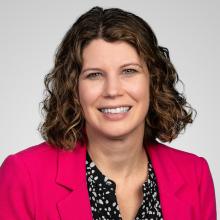
Specialty: Hematology and medical oncology.
Practice setting: Hospital.
Employment type: Employed by Advocate Health in Libertyville, Illinois. Advocate Health is part of the AMA Health System Member Program, which provides enterprise solutions to equip leadership, physicians and care teams with resources to help drive the future of medicine.
Years in practice: 13.
What the specialty of hematology and medical oncology is: I practice medical oncology and malignant and benign hematology. I work both outpatient and inpatient, and, in the outpatient setting I see breast cancer, gynecologic cancers and both benign and malignant hematologic disorders.
A typical day and week in my practice: I see patients in clinic 32 hours per week. A typical full day is 16–20 patients. I assist in making diagnoses, treatment planning for cancer patients, following up on treatment and managing side effects. I also provide some survivorship care for patients. For benign disorders, I help provide diagnosis and treatment recommendations.
I take calls on the inpatient service every six to seven weeks, when I see 10–20 patients per day. I also attend two to three hours of tumor boards per week and serve on a number of leadership and quality committees.
The most challenging and rewarding aspects of hematology and medical oncology: The most challenging aspect is losing patients who you know well. It’s hard to watch them go through pain, loss of function and other symptoms. Another challenging aspect is the time spent doing administrative tasks—the demands of patient portals can be particularly frustrating—and charting.
The most rewarding aspect is seeing patients do well, especially when it was not expected and they go on to have long, successful lives. Seeing patients cured or just living longer is the absolute best. Also, patients can be very gracious, and many want to bring gifts to thank you, which is so amazing to see.
The impact burnout has on hematology and medical oncology: Ultimately, burnout leads to loss of physicians in our field—be it to early retirement or non-clinical careers—resulting in longer wait times for patients and even more burnout. Even when physicians don’t leave, burnout leads to reduction in work hours, less empathy and less willingness to problem solve, which in turn causes worse outcomes and more safety events. We have a limited number of physicians training in oncology and more patients living longer and needing care, so the best thing we can do is help keep physicians working productively without burning out.
How Advocate Health is reducing physician burnout: Advocate is working on many fronts to head off burnout, including by:
- Creating teams to reduce administrative burdens.
- Using AI software for notetaking.
- Building smart sets to make ordering easier.
- Creating teams to handle tasks like forms completion and getting prescription assistance.
- Setting aside administrative time.
- Monitoring signal data on pajama time, such as work in the EHR.
- Boosting health counseling and employee assistance programs.
Many of these efforts are brought together in the Together as One program, which identifies adaptive coping strategies to improve resilience and reduce the negative impact of stress.
How my lifestyle matches, or differs from, what I had envisioned: Honestly, this is very difficult to say. I think I was a bit naïve when I went into medicine and was so focused on getting into residency that I didn’t really think about what would come after.
To maintain work-life balance, I attend as many of my kids' events as I can, and I try to exercise 150 minutes per week through cycling and strength training. I also try to get enough sleep—everything is worse when you are exhausted—and I take two or three vacations per year. Lastly, I keep in mind that a bad day is only temporary.
Skills every physician in training should have for hematology and medical oncology but won’t be tested for on the board exams: One is empathetic communication of unpleasant but critical information to help patients to make decisions.
Another is rapid evaluation of new clinical information that changes treatment paradigms and plans, as nothing stays the same.
It’s also important to know how to care for patients who don’t match the healthy patients in a clinical trial, since clinical trials don’t always represent real life.
In addition, you will need to know how to emotionally dissociate and still be an empathetic physician. After all, you can’t help patients if you are an emotional wreck. You must be able to put your emotions in check, but you can’t be cold and mean.
Question physicians in training should ask themselves before pursuing hematology and medical oncology: Can I emotionally dissociate? Also, am I OK giving up other opportunities for this one?
Books, podcasts or other resources every medical student interested in hematology and medical oncology should be reading or listening to:
- The Emperor of All Maladies: A Biography of Cancer, by Siddhartha Mukherjee, MD. This is a great history of cancer care, with insights into why we do what we do.
- The "A Slight Change of Plans" podcast. I love the stories of what people did when things didn’t work how they thought they would. I think cancer makes every patient change plans.
- The “HBR IdeaCast” podcast. I just love the insights. They always have timely guests and takes on current issues.
Additional advice I would give students who are considering hematology and medical oncology: You will not know everything going in. Don’t be afraid to take risks, make mistakes and change throughout your career. You will not be the same person in five years as you are now. Things change, so don’t be afraid to change with them.