As a resident physician, are you thinking about where you want to build your future in medicine? Meet AMA member Humberto Bailey, MD, a neurologist and a featured voice in the AMA’s “Finding My Place in Medicine” series.
In this series, physicians reflect on what influenced their decisions when choosing where to work—and what they wish they had known earlier. Explore his journey to help guide your own path toward a fulfilling medical career.
If you are looking for your first physician job after residency, get your cheat sheet now from the AMA. In addition, the AMA Transitioning to Practice series has guidance and resources on deciding where to practice, negotiating an employment contract, managing work-life balance, and other essential tips about starting in practice—including in private practice.
"Following” Dr. Humberto Bailey
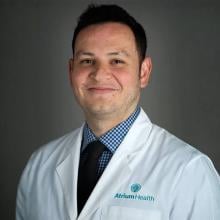
Specialty: Neurology, with a subspecialty in movement disorders.
Practice setting: Group.
Employment type: Employed by Atrium Health Neurology, which is within Advocate Health, in Gastonia, North Carolina. Advocate Health is part of the AMA Health System Member Program, which provides enterprise solutions to equip leadership, physicians and care teams with resources to help drive the future of medicine.
Years in practice: Five.
Key factors that led to me choosing to work at Advocate Health: I like the culture of the organization. It values patient satisfaction and good quality care. It also prioritizes education, such as through its partnership with Wake Forest University, grand rounds and specialty meetings.
Also, when I had my interview, I felt a lot of passion and energy from Advocate’s decision-makers to expand access to care, which is very important these days. So, I felt it was an organization where I could continue to grow and be supported.
I’m not part of a big team in my office, but we have a lot of neurology locations, and it feels like a cohesive team. I have opportunities to catch up with my colleagues in person—we have social events and other meetings where we get to see each other—and they’re always just a click away anyway.
What stood out to me during the interview and hiring process: The people were very welcoming and definitely showed their interest and their excitement to have me there.
I also felt that there was a need for my services. They didn’t just want another provider. They really had a vision about how they saw me as part of their organization and their process. They were very clear about their mission and their goals, which I liked.
They were very organized with the interview process. Everything was pretty much as seamless as it could be. I got to meet them in social settings, and I really enjoyed just getting to know them as people. They were also very transparent about what a typical day would be. I've been here almost two years, and I have to say that it has been what I envisioned.
They told me that it was really up to me how I wanted to have my practice. Some people only want to see X number of patients and then call it a day, but they said, “If you want to also take over more administrative roles, there's opportunity. If you want to do teaching or research, you can join the faculty at Wake Forest.” I thought it was very nice to have all of these tools and opportunities.
My core is seeing patients—that’s my No. 1—but since I've been here, I’ve taken on a couple of admin responsibilities and done a lot in education with physician assistants, nurse practitioners, medical students and residents. It's been really cool to be able to grow as a professional as well.
How feedback from peers and mentors influenced my evaluation process: Some advice was to see if I could imagine myself living there, because I would need to have work-life balance. Could I see myself in this new location? Is my family going to be happy? Would I be close to family or have easy access to them? It was important to think about that very human part and remember my personal goals and objectives.
I also had some people say that I should think about what I wanted to do besides patient care and ask if it was a place where I could grow professionally. You want to find a place where, if you feel you’re interested in taking a new role, they will give you the freedom or the tools to try things out.
Why I chose to work in this practice setting: Here, I found a good mix of the patient care focus you get in private practice, along with the teaching aspect of academic medicine through the partnership with Wake Forest. So, I still get to flex that muscle.
Some people like to be more solo and learn at their own pace, maybe through conferences. I like a combination. Sometimes there's a bit more motivation required in private practice than in academic medicine, where you might have a little bit less of a load because you have more administrative time. You have to take that into account.
Also, the salaries can be different between academic and private practice, although they vary a lot, of course. Some people say academic medicine has lower salaries than private practice does, but that’s not always the case. It really depends on the position, but those are things to consider.
The top three qualities for a great place to work for physicians: No. 1 is the culture of centering the priority of patient care—really being attuned to people's needs—whether that's getting patients into the clinic and seeing them on time and not having a lot of delays with referrals, or having an effective messaging system, or having a culture of patient safety.
No. 2 will be your support system. We have nurses who help us triage calls and answer clinical questions. We also have clinic supervisors who help us to make sure we have all the tools we need. And we have medical assistants who help us with administrative work.
No. 3 is that your employer cares about you as a person and helps you achieve work-life balance—that you have time for yourself or your family, that you don't feel that you're being just overloaded every day—because that will help you come to work more energized.
How my current practice supports physician well-being and work-life balance: For starters, they’re really good at keeping communication open between care teams and administrative leaders. This helps physicians build their ideal schedules. For some, that means a four-day work week—I do four and a half days per week—or seeing more of their subspecialties.
They also provide a lot of support in maintaining social connections. We have committees for quality and safety, but we also have committees for social events, and that’s very nice.
And then there’s the organization of our schedules. They try to avoid surprises. They set it up so that when you're done with your clinic activities, you’re not expected to work extra hours.
The workplace attributes that contribute most to my job satisfaction at Advocate Health: I feel like I have everything that I need for success here. For example, on the day I arrived, my office space was set up. Also, we have a wonderful EHR, Epic, and now we’re using more of its voice-to-text and AI capabilities. They're really up on new technological tools.
I also have great clinical leaders. Our clinic managers put in place everything I needed, including logistics and other resources. They were able to listen to what I needed and really helped me.
We have a lot of meetings with team leaders, so we can voice our concerns about things that are not working well or how things can be better. This is nice because, since we have many locations, we get to learn from what is working well in one place and then implement it. That constant feedback loop is really helpful.
The biggest challenges I faced when transitioning from residency to practice: One is not having your attending to go to for some of the challenging cases. I’m lucky that I have a team with a lot of subspecialists, but it felt a little challenging at the beginning. I was seeing patients and didn’t have colleagues right next to me all the time to discuss cases with or just confide in.
My advice to physicians transitioning to practice is to stay in touch with your fellow residents and fellows, because I'm sure everybody has similar challenges. You might feel a little lonely in the beginning, but as you build relationships with your patients and your care team, it gets better.

What I wish I had known about evaluating a job offer before choosing my first position: What’s the state of the support system? For example, as you start dealing with administrative things like appeal letters for insurance denials and disability inquiries. You’ll need this support so you're able to concentrate on your clinical work. It was a little bit more challenging in some other jobs when I didn’t have that. There was more of that administrative workload, and that can be difficult if you already have a busy clinic. I think it would be good to know: What do you have as part of your staffing or other processes to help?
What I would have done differently when choosing my first job after residency: I was living in a place that had a relatively high cost of living, and the salary was competitive nationally, but I think for the place where I was living, it was a bit of a challenge. Also, I ended up not seeing that as a place where I wanted to stay. So, it was kind of different from my life plans. It was still a great experience, and you learn from everything. I’d advise making sure you find a place where you feel you want to be, not only at the workplace but also geographically for the long term.
Why I changed practice settings midcareer: I was in a location that was a little farther from where I wanted to put down my roots. I was ready to be a bit closer to home.
I also wanted a job that I felt had more of an academic component. I was looking for a place that had a partnership with a university so I could grow into another role.
How I knew I was ready for a change: I'm still on a visa because I am an international medical graduate, and I worked three years in an underserved area, so I fulfilled that requirement. Also, more personally, I felt I had achieved my goals in that area. I had the experience of a first job, and I had really made a change in a place where I felt that I was able to make a change.
Also, they were starting to grow the practice, so I felt it would be OK to leave because somebody else was coming in. I didn't have to worry that the place was going to close because I wasn’t there. So, it just kind of felt like the right time to do it.
How my current role compares with what I imagined: I’m satisfied because, at the interview, they were very transparent. They gave me a clear picture of what they expected from me, what they would offer and what their culture was. I think it’s important for both parties to be very open and transparent, because if you don’t know what you're getting into, there can be problems down the road.
I found a place where I can grow. I have taken on some administrative and academic responsibilities, but I still get to see patients, which I love. I also get to do a little bit of my subspecialty, general movement, which I had wanted. Plus, I've been able to have flexibility with my schedule and get that work-life balance. So, it has worked out pretty well.