Two different approaches to evaluating and screening for impairment in senior physicians were discussed earlier this month during an education session at the 2014 AMA Annual Meeting.
The session was sponsored by the AMA Senior Physicians Section.
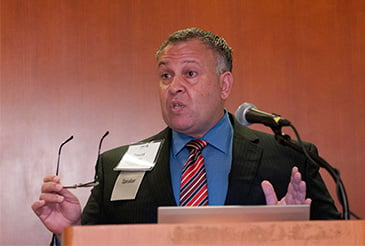
David E.J. Bazzo, MD, clinical professor in family medicine at University of California San Diego School of Medicine (pictured right), highlighted the paradox of aging: “Your physical health and some cognitive abilities decline with aging, while your own impression of how successfully you are aging, mental health and psychosocial functioning tend to improve.”
The percentage of physicians age 65 and older has grown from 9 percent in 1985 to 15 percent in 2011. But Dr. Bazzo stressed that “old does not necessarily mean incompetent.” Age may be a risk factor, but it’s not the only one, he added.
That’s where screening tools can be effective.
Dr. Bazzo noted that some hospitals begin screenings at age 70 and others at age 75. Frequency of assessment ranges from very year to every two years.
Areas of assessment include peer review of clinical performance, screenings for substance abuse and depression, cognitive screenings, and physical and mental examinations.
A second speaker explained how she uses the employee assistance program (EAP) model in helping to resolve personal behavioral problems that physicians might exhibit in the workplace.
Mary Yarbrough, MD, assistant professor in preventive medicine at Vanderbilt School of Medicine, noted the difficulty in treating physicians. “They are afraid to show weakness, delay seeking treatment and have a tendency for self-treatment,” said Dr. Yarbrough.
At Vanderbilt, Dr. Yarbrough uses the “Physician EAP” (employee assistance program) to:
- Assess behavioral problems
- Develop a plan of action
- Advise the physician’s supervisor
- Coordinate communications
- Monitor progress
- Maintain confidentiality
- Determine whether it is safe for the physician to practice
Dr. Yarbrough reviewed some Vanderbilt case studies in which recommendations included performance coaching, solution-focused counseling, and psychotherapy and/or medication.
Nancy H. Nielsen, MD, senior associate dean of health policy at the University of Buffalo School of Medicine, moderated the discussion for the approximately 150 physicians in attendance.