When Kyle Shelton, DO, started medical school in his early 30s, he brought with him over a decade of learned experience and professional exploration. That experience shaped his time as a medical student, then as a pediatrician with Texas Children's Pediatrics in Houston. His work there is no less grounded in his own origin story.
Texas Children's Pediatrics is part of the AMA Health System Member Program, which provides enterprise solutions to equip leadership, physicians and care teams with resources to help drive the future of medicine.
Born at just 25 weeks and weighing 1 pound, 12 ounces, Dr. Shelton was a fragile patient who, along with his family, was guided through the uncertainties of neonatal care by his pediatrician—and now colleague—James Allison, MD.
“Kyle Shelton’s story is truly miraculous,” said Dr. Allison. “In those early days of the neonatal intensive care unit, the outlook for extreme premature infants was not good, for either survival or quality of life if they did survive.”
While Dr. Allison was not in the neonatal intensive care unit (NICU) personally, the role he played as his pediatrician “was to explain, interpret and put into perspective for his parents the roller coaster ride of ups and downs for a premature baby in a NICU,” he explained. “I tried to be optimistic, but honest” throughout the whole journey.
“Kyle was clearly a fighter, and I urged his parents to believe in him,” Dr. Allison said, joking that he does “not recall, however, suggesting that he become a pediatrician.”
Dr. Shelton represents more than a remarkable clinical outcome. He is representative of the impact that physicians can have on patients and their families.
In an interview with the AMA, Dr. Shelton reflects on how his early start in life and relatively late start in medicine have shaped his career, strengthened his patient relationships, and demonstrated the value of perspective, resilience and mentorship in medicine.
AMA: What gave you the confidence to start studying medicine in your 30s?
Dr. Shelton: I got a degree in English, but I always knew that I wanted to be in a helping profession. I got a master’s in adolescent development and considered teaching for a while, getting a PhD and becoming a professor, and I also did research in psychology. Then I considered counseling and therapy.
But I was never really good at math and science, and I thought that to be a doctor, I had to be good at those things, so I thought that medicine wasn’t in the cards for me. I finished graduate school in my 30s, but I was drifting a bit, and after a year or so of working as an online counselor for college students, I really had a sit-down with myself about what I wanted my life to look like and what kind of career I wanted to have.
I had to go back to do prerequisites for two years at the University of Houston to prepare myself for medical school. While I did that, I worked as a technician at a psychiatric hospital as well as holding down a part-time job. I told myself, “I’m going to apply to medical school, and if I get in, then I’ll go.” And I got in!
AMA: You were born at 25 weeks at just 1 pound, 12 ounces. How has that shaped your approach to medicine, resilience and the role a physician can play in a family’s life?
Dr. Shelton: My parents and grandparents, my grandmother especially, would mention that to everybody all the time. She’d be in line at the bank and say, “Hey, this is my grandson. He’s a miracle,” which created something of a personal struggle. I sometimes felt that I needed to do something with my life and prove myself worthy of that gift. I wasn’t sure what that looked like for a long time, and when I got into medical school, I said to myself, “If this is going to be my path, then I’m going to take it and use it to the best of my ability.”
Medical school gave me an understanding of what families go through, especially during my residency in the NICU and longitudinal care clinic. They are dealing with very serious medical issues, some of which can be life-threatening or cause problems later.
That uncertainty and confusion were very hard for my parents when I was a baby. So, what I look at in terms of my own background is that I can’t pretend to know all of the answers about what’s going to happen in a patient’s life or diagnosis. There’s always the risk of something very bad, but in many cases, it doesn’t happen, so a reasonable amount of hope about a medical condition can be really helpful to parents.
I did a rotation with a neonatologist, and he would tell my story to many of the patients, and it made me a little uncomfortable, but he said, “I tell them because it gives them hope. It makes them feel like their kid can do OK too.” That made me realize that if I can use my background to help do that, then that’s what I have to do.

AMA: Dr. Allison cared for you as a baby and now you work together. What does that personal and professional connection mean to you?
Dr. Shelton: It means a lot. I saw Dr. Allison from the time I was born until I was probably 15. My mother always talked about what a great pediatrician he was because at the time there was so little information about how I would do, and many neonatologists had prepared her and my father for the worst. They didn’t want them to have false hope that I would be perfect.
From the way my mother tells it, Dr. Allison was so calm and reassuring. He never gave them an excessive amount of hope but enough to reassure them. He said to her, “I can tell by looking into Kyle’s eyes that he’s going to be all right, but we’re going to help him in any way that we can,” and to this day she says what a wonderful man he is and how much that reassurance meant to her.
That’s something that has always struck me, that he meant so much to my mother. And when I was in medical school, I always knew that I wanted to work with children and that I wanted to be a pediatrician.
I wasn’t sure what kind of pediatrician, though. I considered NICU for a while, but it wasn’t the right fit. However, I could do general pediatrics because that’s what Dr. Allison does, and I could have that same experience, guiding families through a path that might last 18 years and make a huge impact on their peace of mind.
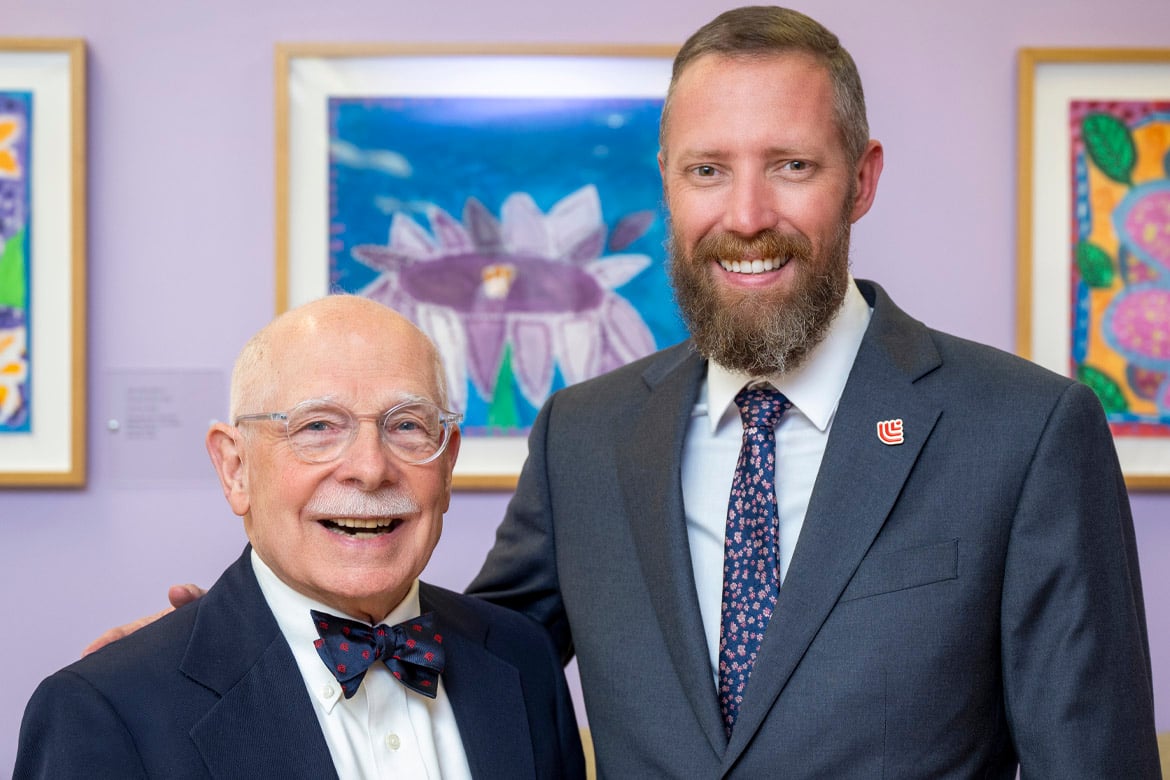
When I finished residency and moved back to Houston, my daughter was three-and-a-half years old and my son was one-and-a-half years old, and we were looking for a pediatrician. I checked to see if Dr. Allison was still practicing, and he was, so he started to take care of my children.
I don’t know if he remembered me at first, but I remembered him. He looked the same, just older. I hadn’t seen him in probably 30 years and I said, “Dr. Allison, you are a huge part of the reason that I do what I do.”
I’m still learning from him. My son had a medical condition, and we worried about some developmental concerns. Dr. Allison said the same thing to us as he said to my mother. He said, “Kyle, he’s going to be fine. I’m not worried about this, and it’s going to be okay,” and later an MRI showed that everything was normal.
When they posted a picture of me and Dr. Allison on the Texas Children’s website for National Doctors Day, two friends from high school commented, “Oh, Dr. Allison was my doctor. He’s the best!” The number of people, families and patients whose lives he has touched over a 40-some-year career is incredible.
AMA: Starting your medical career later in life, what challenges did you face and how did you navigate them?
Dr. Shelton: The biggest concern was that maybe it was too late and that I would fail. But I had a conversation with my dad, and he said, “Kyle, at some point you’re going to be 40 years old. Would you like to be a 40-year-old doctor, or 40 years old and doing something else?”
I did struggle my first two years of medical school because I didn’t have the background in science, but on the flipside, being an older student meant that I had more experience interacting with people.
Having 10 years on most of my classmates made a big difference in my ability to interact with other people and meet them where they were. At the same time, it was a struggle, because residency is a young person’s game. It’s 80 hours a week, every week, for three years.
The preclinical years were difficult, but if I was born at 25 weeks and overcame that, then I could overcome other things too.
AMA: Are there moments with patients or families when your own story is relevant?
Dr. Shelton: Yes, mostly with former preemies, but I don’t generally share it with most families because I don’t want to make the visit about me. It is not pertinent. But if I see children who are preemies, or ex-preemies, I mention that I was one too, especially if they are doing well, or let them know they can ask me questions about what might happen after their child is discharged.
Helping families understand that there could be issues in the future and that there are things we can do to help them navigate that is a passion of mine. So, I will share it with families if it’s appropriate, but it is not about my story. It’s about them and their children. When I do, I get positive feedback because they think that because I’m doing well, their kids will do well too, and that makes them feel better.
AMA: What do you hope your story imparts to patients, families and fellow physicians about survival, purpose and how a medical journey can come full circle?
Dr. Shelton: That it’s never too late. Thinking that you’re too old is never a reason to not do something, whether it’s medicine or any other career. If there’s something you want to do, don’t let the fact that you’re older hold you back.
If a child is born prematurely, we have to be honest and open and forthright about potential concerns and problems the child may have later in life. Simply because most children have a certain outcome doesn’t mean that all children will have that same outcome.
But a reasonable amount of hope is a good thing and I’m living proof. There are other children who were born when I was and had all the medical problems that were anticipated, so I’m not saying that I’m better than them, but just that every child is different. We have to expect the unexpected in medicine, and I think my story proves that.
I also want to emphasize the importance of mentorship, especially in pediatrics. One of the most beneficial things a family can have is a rapport and a longitudinal environment where they can see the same doctor in the same place and get ongoing support.