Health spending in the U.S. increased by 7.2% in 2024 to $5.3 trillion or $15,474 per capita. This growth rate closely matched the 7.4% rise in 2023, and apart from the 10.5% surge in 2020 due to the COVID-19 pandemic, the 2023 and 2024 growth rates are the highest recorded since 2003 (8.6%). Similar to 2023, the acceleration in 2024 was driven by higher demand for healthcare goods and services. For the second year in a row, the growth in healthcare spending (7.2%) outpaced GDP growth (5.3%). Overall, healthcare spending accounted for 18.0% of GDP in 2024, similar to pre-pandemic shares (17.7% in 2019).
Policy research perspective
A new AMA Policy Research Perspective provides an in-depth look at U.S. health spending in 2024.
Health care spending explained
The United States spent $5,278.6 billion on healthcare in 2024.
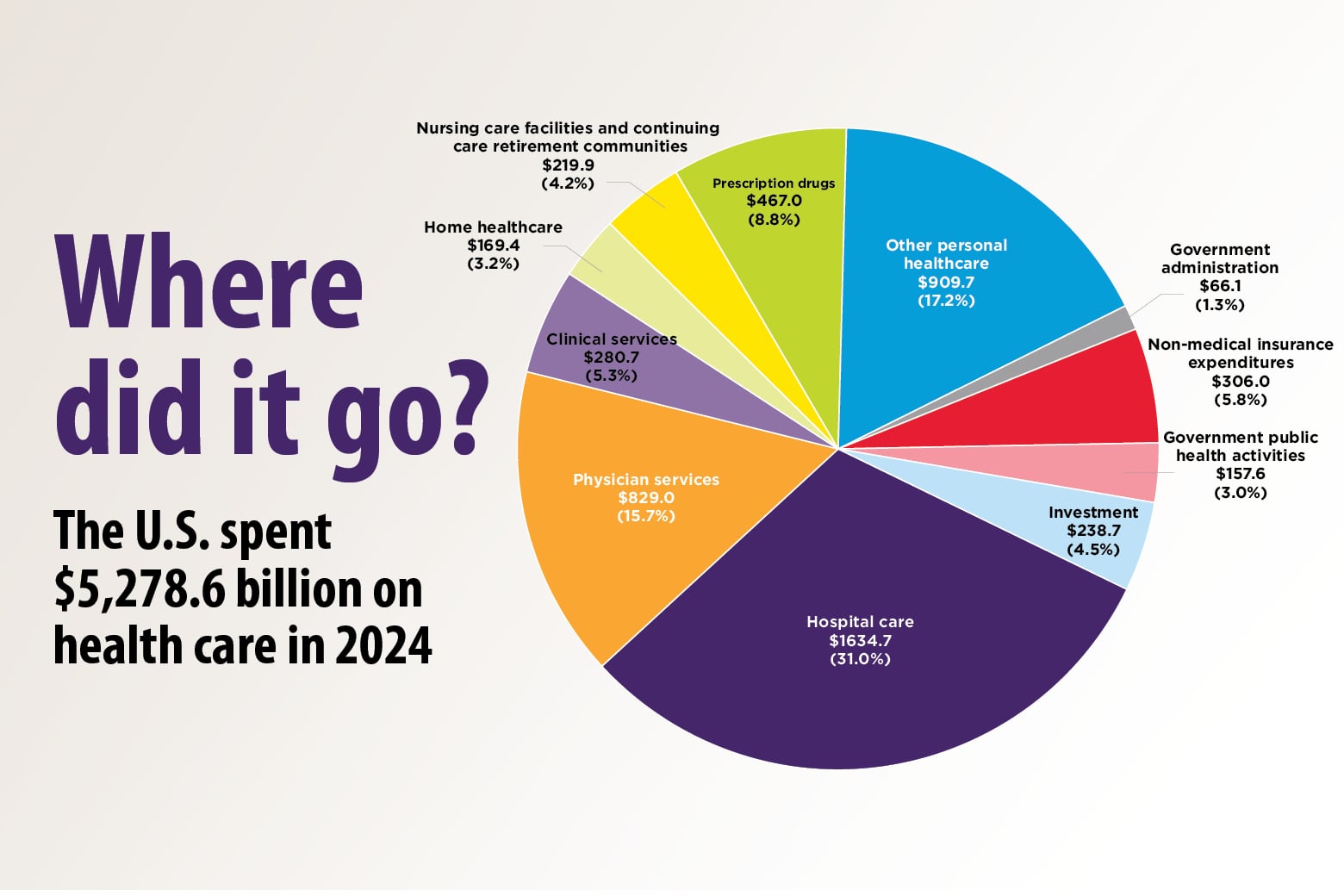
This spending can be broken down into the following categories:
- Hospital care
- Physician services
- Clinical services
- Prescription drugs
- Nursing care facilities
- Home healthcare
- Other personal healthcare costs
- Government administration: includes all administrative costs associated with insuring individuals in government health insurance programs
- Non-medical insurance expenditures: The difference between what insurers incur in premiums and the amount paid in benefits. This includes administrative costs, additions to reserves, rate credits and dividends, premium taxes and fees, and net underwriting gains or losses
- Government public health activities
- Investment spending
Hospital services and physician services are two of the largest categories of personal healthcare spending, followed by prescription drugs and clinical services. From 2015 to 2024, clinical services had the largest average annual growth rate (6.8%), followed by physician services (6.3%), hospital care (5.7%), and prescription drugs (4.9%).
Due to increased utilization, personal healthcare spending grew by 8.3% in 2024, following a 9.4% rise in 2023, the fastest growth rate since 1990. In 2024, spending on hospital care and prescription drugs rose by 8.9% and 7.9%, respectively. Spending on physician services and clinical services increased by 8.1% and 7.9%.
The report discusses this breakdown in further detail and also assesses spending by source of funds (i.e., private health insurance, Medicare, Medicaid, etc.) and sponsors (i.e., federal government, households, private businesses, etc.).
*Hartman M, Martin AB, Lassman D, Catlin A, National Health Expenditure Accounts Team. National health care spending increased 7.2 percent in 2024 as utilization remained elevated. Health Affairs. 2026;45(2),110-120. Accessed May 11, 2026.
Previous policy research perspectives
- Policy Research Perspectives: National Health Expenditures, 2023: Health Care Spending Growth Outpaced GDP for the First Time Since the Pandemic as Utilization Rose (PDF)
- Policy Research Perspectives: National Health Expenditures, 2022: A Return to Pre-Pandemic Growth Rates As Spending on Physician Services Decelerates (PDF)
- Policy Research Perspectives: National Health Expenditures, 2021: Decline in pandemic-related government spending results in 8-percentage point decrease in total spending growth (PDF)
- Policy Research Perspectives: National Health Expenditures, 2020: Spending accelerates due to spike in federal government expenditures related to the COVID-19 pandemic (PDF)
- Policy Research Perspectives: National Health Expenditures, 2019: Steady spending growth despite increases in personal health care expenditures in advance of the pandemic (PDF)
- Policy research perspectives: National Health Expenditures, 2018: Spending growth remains steady even with increases in private health insurance and Medicare spending (PDF)
- Policy research perspectives: National health expenditures, 2017: The slowdown in spending growth continues (PDF)
- Policy research perspectives: National health expenditures, 2016: Annual spending growth on the downswing (PDF)
- Policy research perspectives: National health expenditures, 2015: Annual spending growth at its highest rate since 2007 (PDF)
- Policy research perspectives: National health expenditures, 2014: Spending grows by more than 5% for first time since 2007 (PDF)
- Policy research perspectives: National health expenditures, 2013: Another year, another record low for growth (PDF)
- Policy research perspectives: What's behind the recent spending slowdown? An overview of literature that tries to explain it (PDF)
- Policy research perspectives: Perspectives on the recent slowdown In health spending growth (PDF)
- Policy research perspectives: National health expenditures, 2010: slow growth continues (PDF)
- Policy research perspectives: National health expenditures: What do they measure? What’s new about them? What are the trends? (PDF)