When Sunita Koshy-Nesbitt, MD, says career paths are not linear, she's not just repeating some old adage. She's speaking from experience.
Before deciding to go to medical school, Dr. Koshy-Nesbitt was an undergraduate music major and a concert-level violinist. Classically trained, she benefited from a broad musical education and traveled the world performing from an early age. Today she is a cardiac electrophysiologist and chief medical and quality officer for Texas Health Physicians Group (THPG).
"It will take so many turns, valleys and peaks to get to where you want to be. Just because your journey is not identical to someone else's does not mean it is the wrong one," Dr. Koshy-Nesbitt said. "I went back and forth about pursuing a career in healthcare administration, and in those moments, there was considerable doubt. I often asked myself, 'Am I really going in the right direction?' I have always believed the answer is 'Yes,' even when you cannot yet see the full journey or its outcome."
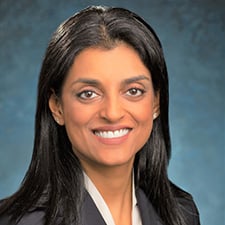
Dr. Koshy-Nesbitt spoke with members of the North Texas Chapter of the American College of Healthcare Executives (ACHE) as part of its Breakfast with the CMO series. She reflected on the lessons she shared at that event and the advice she gives to women in medicine.
Texas Health Physicians Group is part of the AMA Health System Member Program, which provides enterprise solutions to equip leadership, physicians and care teams with resources to help drive the future of medicine.
Leading with impact
When Dr. Koshy-Nesbitt pivoted to medicine, she did not envision becoming a leader in the field. Her goal was simple: to become the best physician she could be. Over time, however, she realized she wanted her impact to extend beyond what she could achieve in an individual clinical role.
"As a physician, I saw recurring quality and safety issues affecting entire populations, and I wanted to help solve them," Dr. Koshy-Nesbitt said. "I came to understand that leadership could multiply the impact I might have on patients and communities."
She sees that broader impact in her leadership role today.
As chief medical and quality officer for Texas Health Physicians Group, she focuses on clinical performance, patient safety, professionalism, quality outcomes, risk management and well-being. Her work supports more than 1,500 clinicians with Texas Health Physicians Group who collaborate across North Texas and the Texas Health system’s 29 hospitals.
Refusing to compromise
With such broad responsibilities, it would be easy for work to occupy every waking minute. When her children were young, however, Dr. Koshy-Nesbitt intentionally structured her schedule so she could take them to school each day. She has maintained that commitment as her children have grown into high school students.
“Being a mother and a working professional is a constant struggle,” Dr. Koshy-Nesbitt said. “Many mothers want to be the perfect parent and excel in their careers. The moment one of those areas falters, it can feel as though you have failed. But perfection is not the goal."
One trait that has been critical to Dr. Koshy-Nesbitt's continued success is her willingness, and desire, to ask for help. She said many people, particularly women, hesitate to do so, even though asking for help is vital in healthcare.
"Asking for help is a strength, not a weakness," she said. “The bravest people are those who ask for help."

Leading from experience
That belief in seeking support is one reason Dr. Koshy-Nesbitt strongly advocates for mentorship. She knows she would not be in her current role without the time, support, dedication and guidance of leaders throughout her career.
Her own experience fuels her commitment to mentoring aspiring healthcare leaders, particularly women. It was also one reason she was excited to participate in the ACHE of North Texas Breakfast with a CMO event.
Dr. Koshy-Nesbitt also wanted to serve as a model for other women in healthcare, not as someone to imitate, but as an example of what is possible.
"Diversity and the representation of all perspectives matters," she said. "We are still on a journey toward a future in which women can see other women who have successful navigated both clinical practice and executive leadership. The more people see that path modeled by someone else, the more they can be inspired to pursue it if they choose.”
She also emphasized the importance of organizations creating programs and opportunities that help aspiring leaders grow. For those programs to succeed, executive leaders must not only identify emerging talent, but they also need to develop people through meaningful experiences so they can learn what leadership requires, rather than simply being told what to do.
"Leadership is developed through experience, not simply by instructing someone to 'Go do this,'" Dr. Koshy-Nesbitt said. "If we want more competent leaders, we must create opportunities for them to see the impact of meaningful work.”
Although organizations are responsible for identifying and developing emerging leaders, she also said aspiring leaders must also step forward rather than wait for someone else to give them permission.
“If you are interested in leadership and are ambitious, just start. You don't need to wait for anyone or ask for permission," Dr. Koshy-Nesbitt said. "Regardless of where you are in life, opportunities remain if you are willing to pursue them.”
Learn more about the AMA Women Physicians Section, which seeks to influence and contribute to AMA policy and program development on issues of importance to women physicians, and to increase the number and influence of women physicians in leadership roles.