- Importance of impairment rating reports
- The importance of current high quality medical guidance
- Commitment to transparency
- Maintaining healthy boundaries: Medicine and law
- Modernizing the AMA Guides
- Collaborating with other stakeholders
- Changes to the AMA Guides® Editorial Panel work
- Download & share AMA Guides information
- Contact us
For over 50 years, the AMA Guides to the Evaluation of Permanent Impairment have been the trusted source that physicians, patients, insurers and regulators rely on for fair, equitable and consistent impairment rating guidance. More than 40 states and several countries rely on the AMA Guides® as the accepted authority to assess and rate permanent loss of function.
Importance of impairment rating reports
The AMA Guides provide a reliable, repeatable measurement framework for permanent impairment in patients who have suffered an injury or illness resulting in long-term loss of a body part or reduction of body function. Once a patient has reached Maximum Medical Improvement, physicians use the AMA Guides to assess a patient’s impairment and document findings. A properly completed impairment rating report produced using the appropriate AMA Guides content is the gold standard for documenting permanent impairment to support insurance and legal proceedings.
The importance of current high quality medical guidance
- Current evidence-and consensus-based science is critical to providing fair and consistent impairment evaluations. The various editions of the AMA Guides, published as hardcover reference books, were snaps in time. Yet over time, and with medical advances, patient outcomes should improve and impairment should be reduced for some types of injuries or illnesses.
- These medical advances move at different paces across diagnoses, with the result that some injuries can experience significant improvements in long-term outcomes, while others do not.
- As a result, use of outdated AMA Guides can result in inequitable ratings.
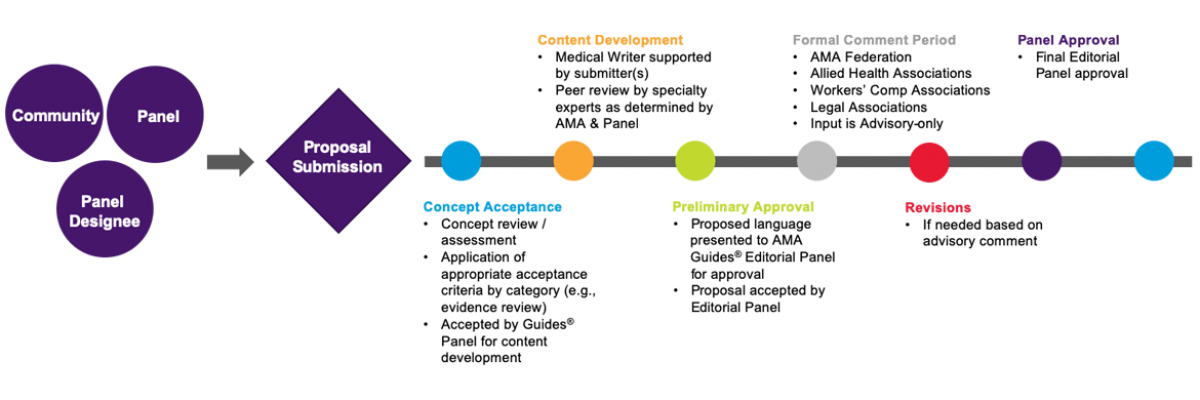
AMA has created the AMA Guides Editorial Panel as a transparent process in which a broad spectrum of relevant professionals can consider, vet and determine whether, when and how the AMA Guides should be improved, enhanced or revised. The AMA Guides Editorial Panel will periodically publish a set of editorial priorities to inform the broader stakeholder community of the Panel’s primary focus. The priorities identify areas where additional guidance is most needed. Relevant stakeholders are invited to develop proposals for enhancements to the AMA Guides based on advances in medical science in their particular areas of focus.
Commitment to transparency
Stakeholder groups will have the opportunity to provide advisory commentary via a public comment period on all proposed changes to the AMA Guides. After final panel approval, written content will be incorporated into the AMA Guides as approved on the release cadence defined by the AMA. This release cadence will contemplate the importance of implementation considerations in delivering equitable rating programs.
Maintaining healthy boundaries: Medicine and law
Impairment ratings and impairment rating reports produced using the AMA Guides are used extensively in the United States and abroad as a critical input to determining fair compensation for individuals with work related injuries. Importantly, determination of appropriate compensation is the realm of state governments, not physicians. As such, the impairment rating provided by a physician is often only one input into a complex disability and compensation calculation.
With the goal of reducing physician burden, advancing the science of impairment rating, and delivering the most equitable ratings for patients, the AMA recommends that jurisdiction-specific adjustments ("non-medical adjustments" or "legal adjustments" required by a regulatory body) be applied only after a standard AMA Guides impairment rating has been completed by a physician.
Modernizing the AMA Guides
AMA Guides digital subscription
"All Access Bundle" includes all editions of AMA Guides and access to the complete newsletter article archive dating back to the inaugural September/October 1996 issue.

As a leader in advancing the future of digital medicine, the AMA is committed to utilizing technology to advance fair and equitable impairment ratings and to reduce physician burden.
- The AMA Guides are now available on AMA Guides Digital, a digital platform that leverages advances in technology
- Online publishing enables timely content updates that reflect the most current panel decisions
- The digital platform reduces physician burden by allowing easy and secure access to materials
- Ease of access and continual updates improve the quality and consistency of evaluations
- The digital solution supports a reasonable transition for stakeholders to the most current medicine
Collaborating with other stakeholders
The AMA is committed to serving patients and physicians with the most current medicine. In order to achieve these objectives, the AMA recognizes that jurisdictions must adopt this medicine. However, historically adoption has faced a number of obstacles, often varying region to region. Through extensive research, the AMA has found that these obstacles rarely relate to the medicine, and more frequently relate to non-medical implementation challenges.
To further our understanding of these challenges, with the goal of overcoming them, the AMA has invited a broad array of stakeholders to the conversation, including the regulatory and legal communities, as well as international stakeholders.
Changes to the AMA Guides® Editorial Panel work
The AMA will soon transition from active content development to a model focused on sustained support and accessibility of the existing AMA Guides content. After the release of the AMA Guides Sixth 2025, the active AMA Guides Editorial Panel work will conclude with updates which include:
AMA Guides Sixth 2025
- Chapter 5: The Pulmonary System
- Chapter 11: Ear, Nose, Throat and Related Structures
AMA Guides Sixth 2024
- Chapter 15: Upper Limb
- Chapter 16: Lower Limb
- Chapter 17: Spine and Pelvis
AMA Guides Sixth 2023
- Chapter 13: The Nervous System
- Chapter 11: Ear, Nose, Throat, and Related Structures
AMA Guides Sixth 2022
- Chapter 2: Practical Application of the AMA Guides
AMA Guides Sixth 2021
- Chapter 14: Mental and Behavioral Disorders
AMA Guides will prioritize long-term initiatives such as:
- Enhancing support resources, including addition of descriptive clinical vignettes
- Clearly noting chapter update timelines for transparency
- Streamlining access to ensure continued relevance and usability
This strategic pivot is designed to protect and strengthen the value of the AMA Guides for all stakeholders and maintain their position as the trusted resource for impairment evaluation. The AMA expresses its gratitude to our AMA Guides Editorial Panel members for their expertise and dedication in shaping the AMA Guides content for the benefit of the entire field.
Download & share AMA Guides information
Download these AMA Guides handouts to share with constituents:
- Medicine key to accurate permanent impairment ratings (PDF)
- What to expect from AMA Guides updates (PDF)
- Why AMA Guides is moving to digital: FAQs for distributors & customers (PDF).
Contact us
If your organization would like to engage in a discussion with the AMA, please contact us.